
In the world of cinematography, there exists an almost religious aesthetic worship—Anamorphic Lenses。
From Blade Runner 2049 to Dune, those captivating, stretched widescreen frames, the unique out-of-focusOval Bokeh, theBlue Streak Flaressweeping horizontally across the screen,and the slightly warpedBarrel Distortion
at the edges of the frame, together constitute the ultimate visual physiological instinct of audiences worldwide for the “Cinematic Look.”However, these features, revered by filmmakers as the “optical soul,” are, in physics and optics, essentially”。
lens “imperfections.” the daily reality ofWhen these century-old lenses, full of "physical imperfections," encounter the absolute, precise, and rigid Euclidean geometry algorithms of
XR virtual production, a fierce battle between art and mathematics erupts on set.
If the lens's “optical imperfections” cannot be encoded in real-time into Unreal Engine's calculations, the digital background and physical foreground will fall apart in the lens.To save the "optical soul" of cinema, the film technology industry had to invent a brand-new cross-disciplinary craft:。
High-Precision Lens Calibration and Optical Reconstruction
I. The Geometric Conflict: Absolute Precision Algorithms vs. Willfully Distorting Glass
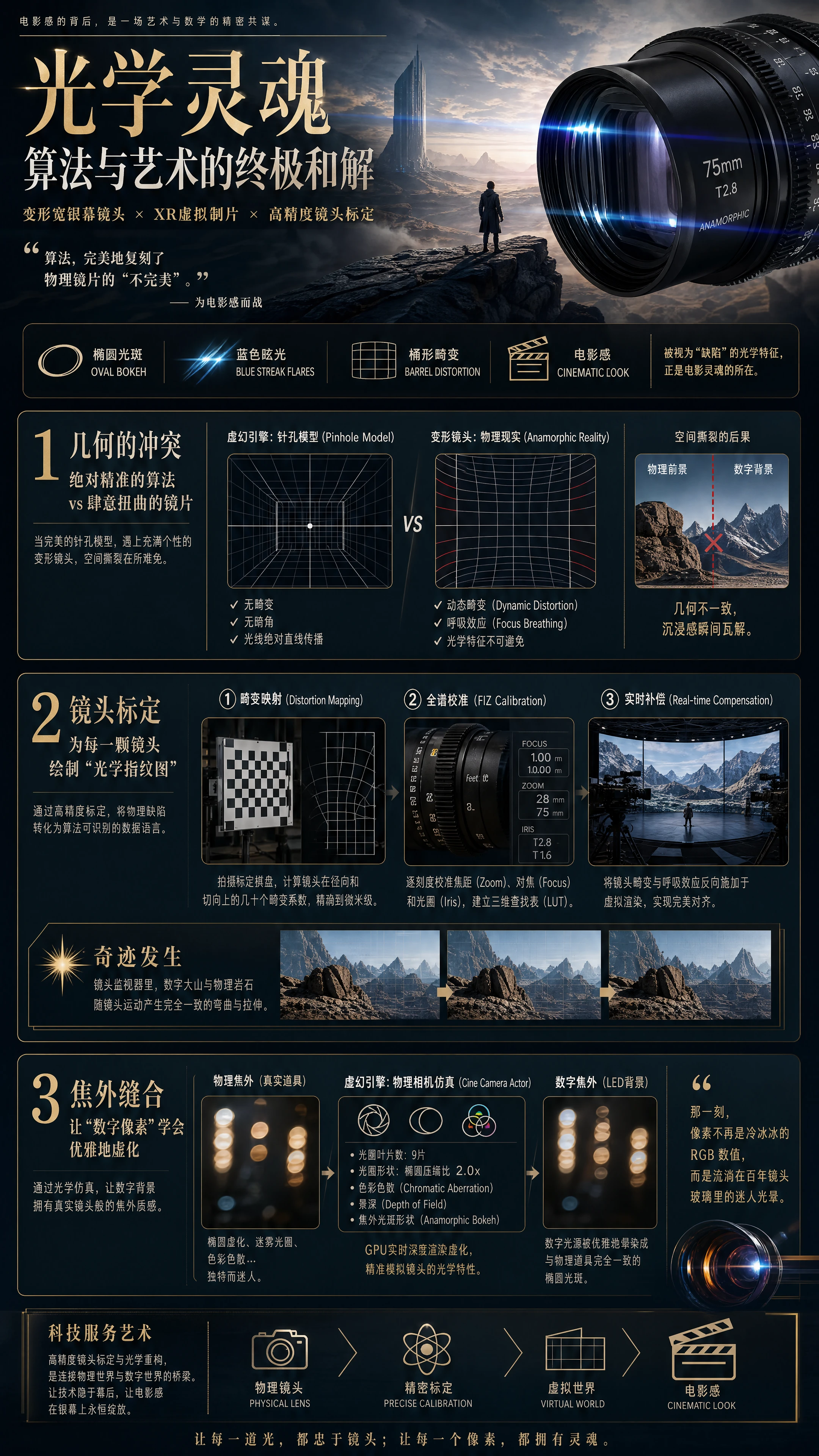
To understand this conflict, we need to deconstruct the spatial alignment logic in XR virtual production.In Unreal Engine, the system's default virtual camera is aperfect "Pinhole Model."
In the algorithmic world, there is no distortion, no vignetting caused by lens refraction; light always travels in an absolute straight line.
- But when a physical camera is fitted with a classic anamorphic lens: Dynamic Distortion:
- Anamorphic lenses compress the horizontal field of view to achieve a widescreen frame. This results in highly uneven stretching between the center and edges of the image. When the camera pans, the edges of the frame physically distort like ripples in water. Focus Breathing:
When the focus puller rotates the follow-focus ring, shifting focus from an actor in the foreground to a distant vista, the lens's actual focal length undergoes a slight physical change, causing a subtle “zoom in or out” of the image.
If, at this moment, the backend computer still renders the background on the LED wall according to the perfect "pinhole model," a mismatch becomes inevitable.“The audience will see the physical rock behind the foreground actor bend due to the lens distortion, while the digital mountain on the LED wall remains perfectly straight. This”"tearing of spatial geometry"
instantly destroys all immersion.“
II. Lens Calibration: Drawing an "Optical Fingerprint Map" for Every LensTo eliminate this tearing, an extremely tedious yet crucial ritual must be performed before an XR studio starts shooting:。
Lens CalibrationTechnicians place a special calibration board printed with precise geometric patterns in front of the physical camera:。
- Calibration Grid Distortion Mapping:
- The camera captures the calibration grid. Calibration software (such as EZtrack or Live-Link) compares the “distorted grid captured by the physical camera” with the "absolute straight lines in the computer" in real-time. Using complex mathematical models (like the Brown-Conrady distortion model), the algorithm calculates dozens of distortion coefficients for the lens in both radial and tangential directions, accurate to the micron level. Full-Spectrum FIZ Calibration:The calibration team rotates the lens's zoom ring, focus ring, and iris ring increment by increment. The system builds a massive3D Look-Up Table (LUT)for this lens. When you pull focus from 1 meter to 10 meters on set, the encoder transmits this physical displacement to Unreal Engine at millisecond speed. The engine responds by
[The Miracle Happens]: applying the physical lens's "distortion" and "focus breathing" in reverse to the virtual rendered image on the large screen in real-time.
On the camera monitor, the virtual mountain on the LED wall bends and stretches in perfect sync with the foreground rock as the physical lens moves.
The algorithm perfectly replicates the “imperfection” of the physical glass.
III. Bokeh Stitching: Teaching "Digital Pixels" to Blur ElegantlyHaving solved the geometric alignment, the Director of Photography (DP) must now confront the final and most challenging artistic fortress—。
Bokeh Consistency
- When an actor stands in front of a green screen, the post-production blur is software-simulated, often appearing flat and artificial. But in an XR studio, physical bokeh and digital bokeh meet within the same lens: Physical Bokeh:
- Real props in front of the lens, refracted by the anamorphic lens, exhibit captivating oval-shaped blur and misty halos. Digital Bokeh:
The pixels on the LED wall are themselves in the out-of-focus area of the camera.To seamlessly stitch these two together, Unreal Engine introduces the。
Cine Camera Actor
Technicians digitize all parameters of the anamorphic lens: the number of aperture blades (e.g., 9 blades), the aperture shape (elliptical compression ratio 2.0x), and even the chromatic aberration at the lens edges.
As the actor moves and focus changes, Unreal Engine uses the GPU to render a depth-based blur for the background in real-time.
The digital light sources on the large screen are gracefully diffused within the camera's lens into stretched oval bokeh identical to that of the physical props.At that moment,。
Conclusion
pixels are no longer cold RGB values, but the enchanting halos flowing through the glass of a century-old lens.
This is one of the most interesting paradoxes in the history of modern film technology:
We have expended humanity's finest silicon, vastest computing power, and most complex algorithms, all with the goal of 100% faithfully reproducing, in the digital world, the "beautiful imperfections" of a hundred-year-old piece of physical glass, born from the limitations of craftsmanship.
But this is precisely technology's most profound tribute to art.
Technology did not eliminate art's individuality, nor did it unify the world with "absolute perfection." Instead, it used digital flexibility to embrace and inherit the romance of the film era.

 简体中文
简体中文  English