
In virtual production and advanced mixed reality (MR) production, there is a common ailment known as “visual gravity deficiency.”
When viewers watch a host physically standing on a green screen stage, set against a cyberpunk street rendered in Unreal Engine 5 (UE5), no matter how detailed the background polygons or how realistic the ray-traced reflections, the image always subtly exudes an incongruous sense of a “sticker effect” or “floating sensation.”
As a Compositing Supervisor and a physicist of light and shadow, you deeply understand the physical essence of this dissonance:the lack of authentic bidirectional light-shadow interactionThis manifests specifically in:
- Volumetric Occlusion Failure: When a strong virtual backlight (such as a searchlight or sunlight streaming through a window) shines toward the camera, the real actor should physically block this light, casting a sacred volumetric shadow (i.e., God rays/light shaft occlusion) in the virtual air. However, in traditional compositing, the virtual volumetric light passes unhindered through the “ghostly body” of the live-action figure.
- Contact Shadow Absence: When a real person stands on the ground, the seam between the shoe sole and the floor produces extremely fine, nearly black contact shadows due to Ambient Occlusion (AO). The shadow edges exhibit nonlinear penumbra attenuation as the distance from the foot increases. Traditional keying simply layers the person over the 3D background, making the figure appear to “float” above the virtual floor.
To solve these physical-optical problems, the system cannot merely perform simple 2D layer overlays; it must executephysical-level reconstruction within the real-time rendered Z-Depth and 3D light field space.。
Aximmetry Leveraging its unique “Z-Buffer Injection” and “Real-Time Shadow Projection Matrix Algorithm,” it forcibly establishes a gravitational pull of light and shadow that conforms to the laws of physics at the intersection of the virtual and the real.
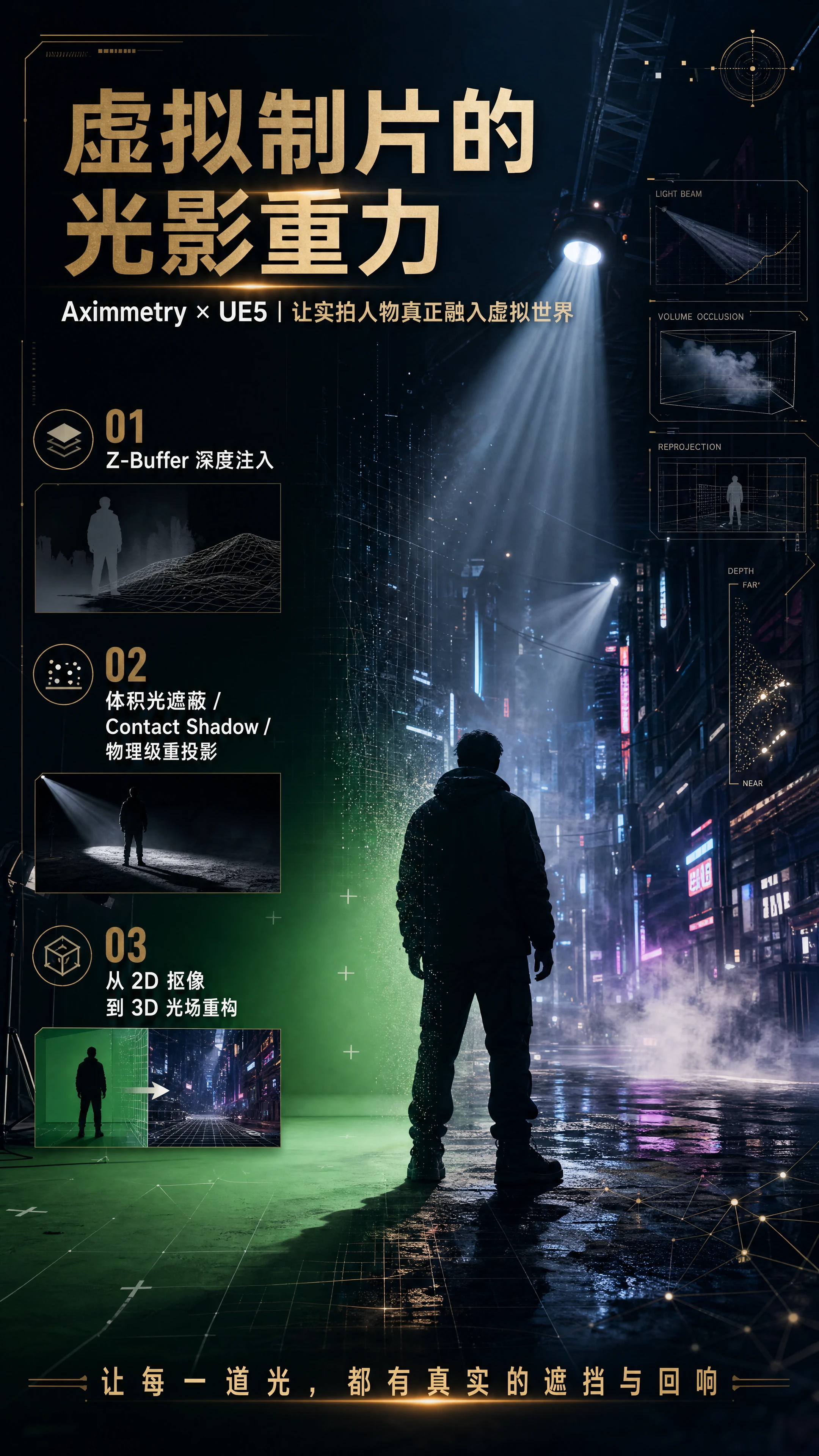
I. Depth Elevation: From 2D Keying to Dynamic Reconstruction of Real-Time Virtual Z-Buffer
To achieve physical-level overlap of light and shadow between the live-action figure and the virtual world (e.g., being occluded by or occluding a virtual streetlight), the first step is to let the rendering engine know the “thickness” and “depth” of the live-action figure in 3D space.
In traditional compositing pipelines, live-action video is merely a flat 2D “sticker” without depth information.
Aximmetry employs“Dynamic Depth Billboard” and “Edge Distance Fields”technology to complete the elevation from 2D pixels to 3D depth space.
Dynamic Position Tracking and Billboard Positioning
Aximmetry captures the 6DOF data from the camera tracking system in real time, calculating the absolute physical distance between the physical camera and the live actor. It then dynamically generates a virtual “Billboard” carrying the live-action green screen keyed image, closely adhering to the actor's actual standing position within Unreal Engine's 3D space.
Pixel-Level Depth Map (Z-Depth) Reconstruction
If it were merely a flat billboard, when the actor extends an arm, the arm and body would be considered on the same depth plane in 3D space, causing severe clipping and distortion in virtual lighting calculations.
Aximmetry's compositing engine, at the underlying level, utilizes the Alpha Gradients and high-frequency brightness details obtained from keying. Through differential estimation algorithms, it generates aPseudo-3D Depth Mapfor the 2D actor in real time within GPU memory. It dynamically injects this depth map into Unreal Engine's Z-Buffer.
At this point, within the engine's computational world, the actor is no longer a thin sheet of paper but a 3D “physical entity” with undulating contours and adaptive thickness. Whether virtual smoke flows around the actor or a virtual point light moves beside them, absolutely correct spatial occlusion feedback is achieved.
II. Photon Occlusion: Pixel Reverse Projection Algorithm for Real-Time Volumetric Light Shafts (God Rays)
In Unreal Engine 5, the calculation of Volumetric Fog and Light Shafts is extremely GPU-intensive. It is rendered by sampling 3D volume pixels (Voxels) within the camera's view frustum using raymarching. To have the live-action actor physically block virtual light and cast volumetric shadows, the actor must participate in UE5's physical raymarching calculations.
Aximmetry's solution is a paradigm shift in optical compositing, employing“Light-Space Reverse Occlusion Projection”technology:
Light Source View Matrix Transformation
When a strong light source in the virtual scene (e.g., a virtual spotlight behind the actor) is activated, Aximmetry does not attempt to construct a complex 3D model of the actor in 3D space to block the light. Instead, it transforms the current camera's live-action Alpha matte into theLight Clip Spaceof that virtual light source through one-dimensional matrix operations.
Dynamic Black-and-White Matte Injection
From the light source's perspective, the live-action actor's Alpha channel becomes a black-and-white occlusion map. Aximmetry writes this dynamic map in real time into the virtual light source's“Light Function Texture Slot”or as a Dynamic Shadow Mask. When UE5 renders volumetric fog and accumulates raymarching steps, any photons within the black areas of this occlusion map have their energy forcibly attenuated to zero at the emission source.
This clever algorithm directly allows the virtual light to “perceive” the presence of the real actor at the physical source. Viewers will witness a stunning scene in the final image: as the live actor waves their arm in front of the green screen, several large, shifting beam shadows are projected in real time and synchronously within the virtual scene's dense fog. This physical fusion of light and shadow instantly imbues the scene with an incredibly realistic sense of atmosphere and spatial tension.
III. Eliminating “Floating”: Reprojection of Contact Shadows and Nonlinear Penumbra Matching
The ultimate weapon for “welding” the live-action figure onto the virtual ground is thereal-time rendering of physical-level Contact ShadowsTraditional compositing software merely places a blurred black circle under the actor's feet. This might barely suffice for static camera shots, but during camera pan/tilt and dolly movements, the black circle will noticeably slide and misalign with the actor's feet.
"Absolute Radiance Converter"“Projective Shadow Receiver Pipeline Based on Geometric Projection”:
Virtual Shadow Receiver
In Aximmetry's flow graph topology, the system automatically places an invisible virtual plane specifically designed to capture shadows at the physical floor location where the actor stands in Unreal Engine. This plane only receives shadows and does not render its own material (Shadow-catcher Pass).
Optical Reprojection
Aximmetry reprojects the real-time keyed actor silhouette onto this virtual shadow receiver plane with pixel-level precision, based on the 3D coordinates and direction of the virtual light source (e.g., an overhead chandelier). Because this projection calculation is linked in real time to the physical camera tracking and virtual light source position, the projected shadow remains physically bonded to the shoe soles regardless of camera movement or actor walking, completely eliminating “spatial sliding.”
Nonlinear Penumbra Attenuation Matching
Real shadows are never uniformly black. The shadow near the feet (Umbra) is extremely dark with sharp edges, while the shadow farther from the feet (Penumbra) rapidly becomes lighter and blurrier due to ambient light diffusion.
Aximmetry uses a custom GPU Shader to apply aDistance-Based Multi-Tap Gaussian Blurto the reprojected shadow layer. It calculates the physical distance between the shadow pixel and the foot contact point. The farther the distance, the exponentially larger the Blur Kernel radius and the more nonlinear the Opacity attenuation.
This results in shadows on the virtual floor exhibiting an almost artistic physical quality: a razor-sharp black line at the edge of the shoe sole, which then dissolves into a gentle, faint gray that fades into the air.
IV. Physical Closure: Anti-Double Shadowing and Ambient Light Absorption Matching
After solving the “presence or absence” of shadows, senior technical directors often face deeper optical conflicts:Double Shadowing and Ambient Light Distortion。
On a green screen stage, to achieve a clean key, lighting technicians typically use high-intensity green screen backlighting and fill lights. These real-world lights have already “frozen” certain creases and shadows onto the actor's video footage. If Aximmetry, when compositing the virtual background, indiscriminately overlays the virtual world's ambient light onto the actor, it will result in contradictory double shadows with opposing directions on the actor, creating a highly dissonant visual effect.
Aximmetry'sColor & Intensity Balancercompletes the final physical closure here:
Diffuse Irradiance Matching
It reads the ambient diffuse color and light intensity calculated by Unreal Engine in the actor's standing area (real-time light field data from Lumen) in real time. It then uses this data as a color cast reference to dynamically adjust the overall Black Level and shadow saturation of the live-action actor footage. If the virtual scene is a blue glacier, the dark shadows on the actor will be automatically tinted with a natural icy blue, eliminating the color temperature disconnect between the live figure and the virtual environment.
Intelligent Shadow Removal and Anti-Double-Shadowing
Aximmetry can identify existing hard shadow areas within the actor's video. When virtual shadows are overlaid, it uses a Multiply blending algorithm with threshold limits to ensure virtual shadows only take effect in areas without strong real-world lighting, preventing unnaturally “dead black” patches where shadows from both worlds overlap.
Conclusion: Unshakeable Physical Aesthetics
In today's rapidly evolving digital visual technology, high-precision polygons and exquisite material textures are readily available. However, what truly distinguishes “crude green screen compositing” from “stunning cinematic live-action integration” is precisely the rigorous reverence for physical laws such as photon flow, spatial depth, and shadow attenuation.
Unreal Engine 5 outlines a magnificent virtual world, but it cannot by default perceive the physical properties of the real human in front of the lens. In this gap where light and shadow intersect,Aximmetry Aximmetry acts as a cold and precise physics judge.
It rejects superficial planar overlays, choosing to meticulously dissect layers within the underlying Z-Depth, raymarching channels, and GPU pixel shaders. By reconstructing dynamic depth maps, firmly controlling volumetric light occlusion, and sculpting contact shadows that conform to nonlinear physical attenuation, Aximmetry forcibly pulls the live-action figure, wandering on the edge of the virtual world, back onto the solid ground with the gravity of light and shadow.
This steadfast adherence to and reconstruction of physical aesthetics at the pixel level is the invisible trump card that allows Aximmetry to continuously dominate the top-tier virtual production industry.

 简体中文
简体中文  English
  한국어
한국어  日本語
日本語