
In metaverse interactions, large-scale esports events, and future cultural tourism projects,“AI-Driven Virtual Presenter”is rapidly moving from proof of concept (PoC) to commercial live streaming.
In such scenarios, the audience or on-site guests engage in impromptu, two-way voice conversations with virtual characters on the big screen. The system must complete the following chain in milliseconds in the background: Microphone pickup -> STT (Speech-to-Text) -> LLM (Large Language Model inference for response generation) -> TTS (Text-to-Speech synthesis) -> Audio-to-Face (real-time facial expression and lip-sync Blendshapes generation based on audio stream) -> Drive UE5 for skeletal and material rendering.
However, when a Technical Director (TD) attempts tonative Unreal Engine 5 (UE5)establish this “digital reflex arc” internally, they immediately hit an insurmountable“Wall of Compute Power and Thread Deadlock”:
- “Asymmetric Throughput” of the Main Thread: UE5's rendering engine is highly synchronous, dominated by single-threaded tick polling. In contrast, AI interfaces (such as OpenAI API, local ONNX inference, TTS streaming) are typicalasynchronous, non-deterministic, high-latency (Jittery)data sources. Frequently parsing large JSON payloads and handling network socket handshakes in Blueprints or C++ can easily trigger microsecond-levelThread Stallsand Garbage Collection (GC), directly causing the rendering frame rate to plummet from 60fps to single digits, freezing the screen instantly.
- “The Uncanny Valley of ”Audio-Visual Separation": The audio stream from TTS is output through the sound card, while the generated 52 ARKit facial expression coefficients (Blendshapes) drive UE5 rendering. Due to Network Jitter, if the arrival time difference between audio packets and expression packets exceeds 40 milliseconds (one and a half frames), the virtual character's lip movements will eerily desynchronize from the voice, creating a highly uncomfortable “digital puppet” effect.
Facing this hard collision between non-linear data and linear rendering,Aximmetry With its unique“Sandboxed Gateway” and “Timing Phase-Locked Bus”to build a high-throughput, frame-accurate AI interaction gateway outside the engine.
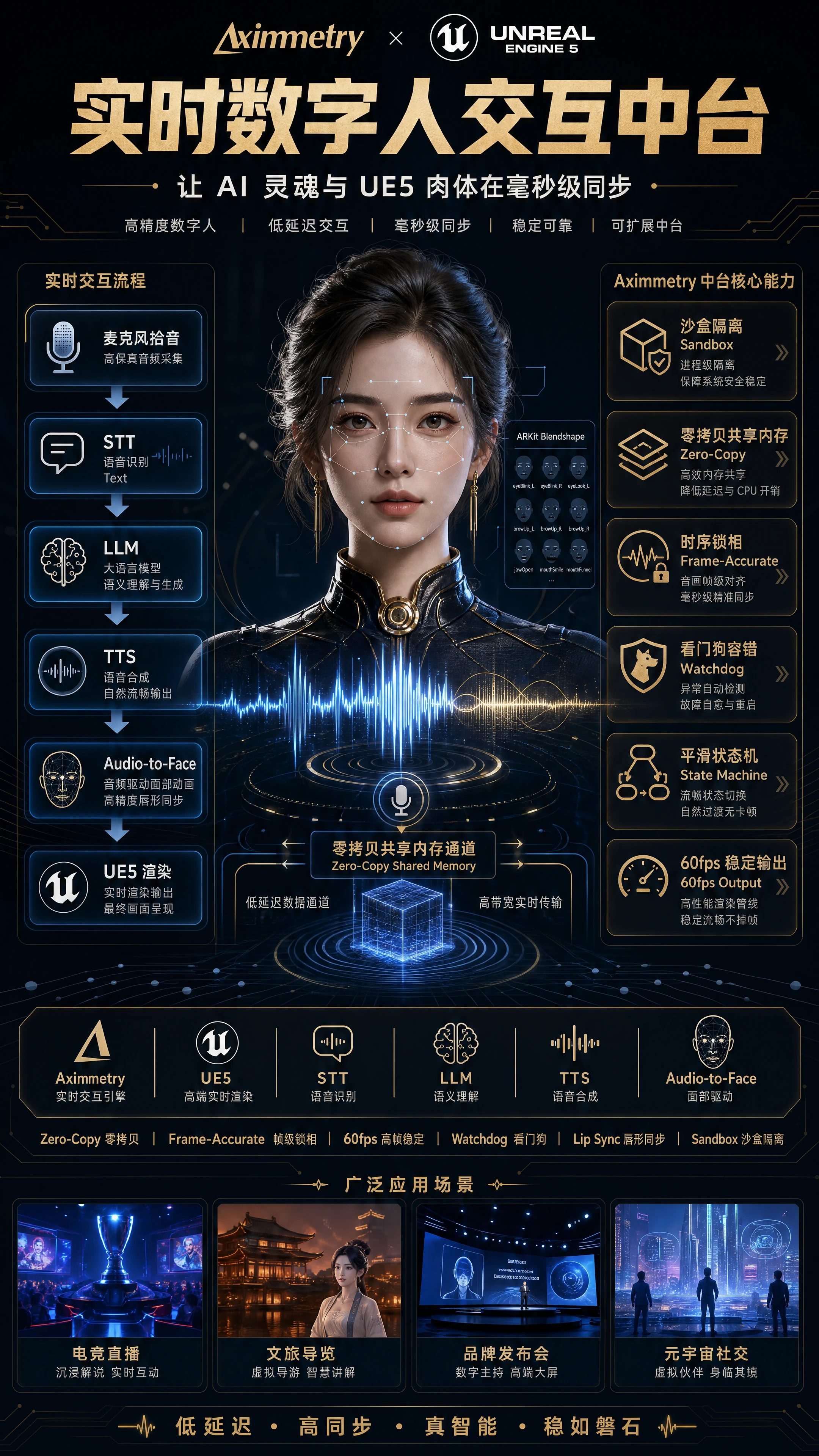
I. Compute Decoupling: Aximmetry's “Heterogeneous C++ Sandbox” and Zero-Copy Data Channel
To protect the fragile UE5 rendering pipeline, Aximmetry establishes an iron rule:All computations not related to 3D rendering are completely “physically isolated” within Aximmetry's independent sandbox space.
[External AI Ecosystem (LLM / TTS / STT)]
│ (High-concurrency, variable-latency JSON / TCP data)
▼
[Aximmetry Independent C++ Runtime Sandbox (Multi-threaded Asynchronous Parsing)]
│
├─► [Audio De-streaming and FFT Transform] ──► [Physical Sound Card Output (Low-latency ASIO)]
│
└─► [Extract 52 ARKit Blendshape Coefficients]
│
▼ (Shared Memory Zero-Copy Channel)
[Aximmetry GPU Memory Variable Injection Area]
│
▼ (No deserialization overhead, directly overwrite GPU vertex offset addresses)
[UE5 Render Instance (Consistently maintains stable 60fps)]
1. Heterogeneous Thread Decoupling
Aximmetry establishes a high-concurrency asynchronous I/O thread pool at the system level. When high-frequency network API responses, TCP voice packets, or local ONNX runtime inference results flood in, Aximmetry performs high-speeddeserialization, character cleaning, and numerical mapping on physical CPU cores completely independent of the UE5 rendering main thread.2. Zero-Copy Shared Memory Communication
Data filtered and formatted by Aximmetry (e.g., a Float array of 52 facial muscle movement coefficients) is never transmitted through traditional network protocols (like Socket) or UE's standard parameter channels.
Aximmetry uses underlying
Shared Memory and GPU register mapping technology.It creates a fixed-address physical buffer in GPU memory, directly writing the parsed expression coefficients to that address.For UE5, during each frame's rendering cycle, it only needs to read this GPU memory address at microsecond speed via the Aximmetry DE plugin to update the Skeletal Mesh's Morph Targets. By eliminating memory copy and CPU-to-GPU data transfer latency, UE5 is completely freed from external AI data interference, maintaining rock-solid 60fps cinematic rendering even in full ray-traced scenes.
II. Timing Alignment: Lip-Sync Engine Based on "Audio-Visual Physical Phase Locking"
After solving the stuttering issue, the second challenge is
"Absolute Audio-Visual Synchronization."“Real-time TTS voice synthesis is typically streamed in”small audio chunks (e.g., 20ms PCM packets).The corresponding expression data also arrives at highly irregular frequencies.Aximmetry introduces a time-tested technology from the broadcast television field:
"Clock Phase Alignment."“It establishes a rigorous ”reflex arc synchronizer" for virtual digital humans.”[ 120ms Elastic Delay Line ]

 简体中文
简体中文  English