
In the industrial-grade field of Extended Reality (XR) and LED Virtual Production (ICVFX),“Multi-Camera Shooting”is an absolute necessity for improving production efficiency and capturing multi-angle action.
However, inside an LED Volume, when the director presses the camera switch button (Camera A $\rightarrow$ Camera B) on the switcher, a physical storm of space-time reorganization is triggered at the system level.
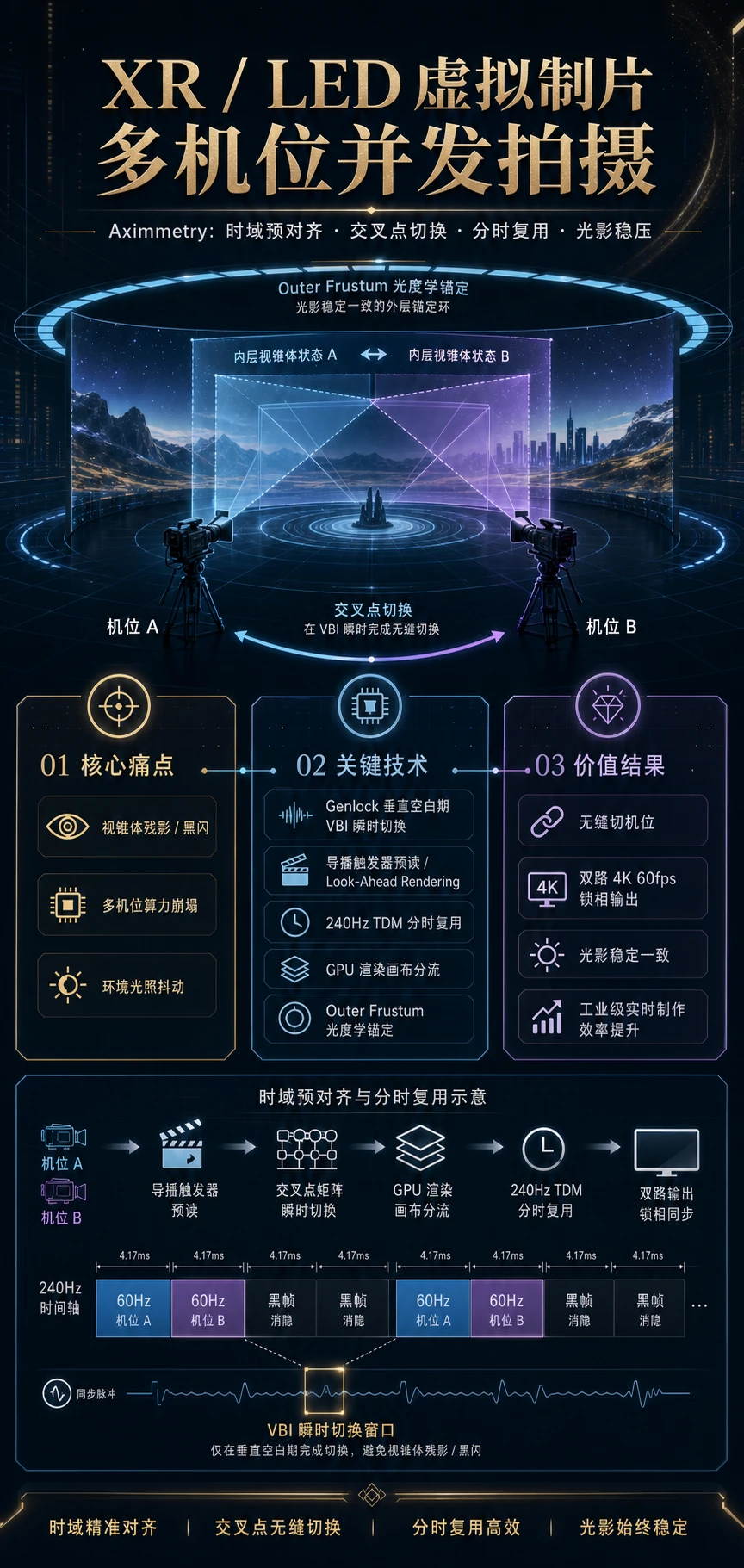
At this moment, the "Inner Frustum (high-resolution rendering area)"“on the LED wall corresponding to the camera's frame”must instantly transition from the perspective of Camera A to that of Camera B. During this brief single-frame switch interval, any system misstep can lead to fatal visual artifacts:
- Frustum Residuals and Black Flash (Frustum Flash): If the rendering engine experiences a 1-frame unpacking delay after receiving the switch command, the shutter of physical Camera B will capture the LED image still in Camera A's perspective the moment it opens. This results in extremely jarring “perspective distortion tearing” or full-screen “Black Flash” in the final image.
- Multi-Camera Compute Collapse (Render Overload): The simplest brute-force method to avoid switch latency is to have the GPU render the Inner Frustums of both Camera A and Camera B simultaneously (dual-frame concurrency). However, under the extreme load of 4K 60fps, this forces Unreal Engine 5 (UE5) to perform double the Lumen and geometry rendering, instantly consuming the GPU's VRAM and causing severe frame drops or crashes.
- Environmental Lighting Instantaneous Flicker (Lighting Flutter): The Outer Frustum provides physical environmental lighting for the on-set talent. When the Inner Frustum jumps, if the peripheral low-resolution background also shudders, the physical highlights and shadows on the talent will “flicker” at the moment of the camera switch, exposing the illusion.
Aximmetry Leveraging its "Temporal Pre-Alignment and Hardware-Level Crosspoint Routing Matrix,"“specifically reconstructed for multi-camera topology,”it establishes a seamless “space-time portal” between multiple high-bandwidth signals and the 3D rendering space.
I. Temporal Mutation Suppression: Instantaneous Routing Switch Based on Genlock Vertical Blanking Interval (VBI)
To completely eliminate “Frustum Residuals” and “Black Flash” during camera switching, Aximmetry strictly confines the switching action within the extremely briefVertical Blanking Interval (VBI).Inside.
1. Trigger Pre-reading by the Director
When the director presses the switch button on a physical switcher (e.g., ATEM or Kahuna), Aximmetry's GPI/O interface or IP protocol stack (Ember+/TSL 5.0) intercepts and pre-reads this switching signal within microseconds.
2. Look-Ahead Rendering
Upon receiving the pre-switch signal, Aximmetry immediately instructs Unreal Engine 5 to pre-render the first frame of the Inner Frustum for the “incoming” Camera B in a background thread (Warm-up Frame). This frame is held in a pending state and does not occupy current display bandwidth.
3. Hardware-Level Crosspoint Switch during VBI
Within the Vertical Blanking Interval (a 2-millisecond physical gap),which occurs when the external Genlock sync signal reaches the falling edge of the next V-Sync pulse and the camera sensor stops exposing,Aximmetry forcibly executes the signal crosspoint switch through direct control of its hardware capture card and GPU. The previous frame outputs Camera A's Inner Frustum, and in the microsecond before the next frame's shutter opens, the LED screen already perfectly displays the precise 3D image corresponding to Camera B.
The spatial transition of the Frustum is completed silently within the camera's “blind spot.”
II. Spatial Dimension Decoupling: Breaking Compute Boundaries with Ultra-High Refresh TDM (Time-Division Multiplexing)
If the director requires multiple cameras forconcurrent monitoring and switching (simultaneously recording two camera feeds),the “instant switch mechanism” described above is no longer applicable. This is because the Inner Frustums of both cameras must coexist on the LED wall simultaneously.
Aximmetry introduces cinematic “Time-Division Multiplexing (TDM)” 与 “Multi-Frustum Merged Rendering” "Audio Bypass"
1. 240Hz Ultra-High Refresh Time-Division Projection
When paired with a high-refresh-rate LED controller (e.g., Brompton Tessera SX40) and cinema cameras equipped with Global Shutters, Aximmetry boosts the physical refresh rate of the LED to 240Hz(i.e., 240 frames per second). Aximmetry divides these 240Hz into 4 independent Time Slots:
- Time Slot 1 (60Hz): Projects Camera A's Inner Frustum (Rendering Angle A);
- Time Slot 2 (60Hz): Projects Camera B's Inner Frustum (Rendering Angle B);
- Time Slots 3 & 4: Project a common green background (for real-time keying assistance) or black frames.
2. Phase-Locked Shutter
Aximmetry uses Genlock to precisely control the physical shutter open/close phases of Camera A and Camera B:
- Camera A's shutter opens only during Time Slot 1, thus it captures only Camera A's 3D virtual background;
- Camera B's shutter opens only during Time Slot 2, thus it captures only Camera B's 3D virtual background.
3. GPU Render Target Packing
On the GPU side, Aximmetry avoids running two completely independent rendering pipelines in UE5. It packs the rendering tasks for Camera A and Camera B into a single, wide-screen ultra-high-definition GPU Render Target, computing them together under a unified Occlusion Culling algorithm. This reduces the GPU overhead for dual-camera concurrent rendering by over 40%,easily squeezing out the ultimate output of dual 4K 60fps phase-locked frames from a single workstation.
III. Lighting Stabilization Mechanism: Global Photometric Anchoring of the Outer Frustum
During frequent multi-camera switching, how can the lighting (Environmental Lighting) cast on the on-set talent by the LED wall be prevented from any jumping?
Aximmetry introduces“Photometric Anchoring and Outer Frustum Independent Routing”technology:
1. Outer Frustum Rendering Separation
Aximmetry splits the LED wall into two rendering layers:
- The dynamically updatedInner Frustum Layer:Moves and switches rapidly with camera tracking data;
- The relatively staticOuter Frustum Layer:Used solely to provide environmental lighting.
2. 3D Lighting Information Locking
Regardless of how the active camera switches between Camera A and Camera B, Aximmetry firmly anchors the rendering data of the Outer Frustum (i.e., the large LED area outside the talent's line of sight) to the main scene's global illumination model. When the Inner Frustum switches, the brightness, color temperature, and environment map projection angle of the Outer Frustum's image remain absolutely constant in the GPU memory.
This ensures that no matter how frantically the director switches cameras on the switcher, the physical environmental light falling on the talent's face remains seamlessly integrated and undisturbed, completely solving the industrial-grade problem of facial flicker during multi-camera switching.
Conclusion: The Symphony Conductor of Multi-Dimensional Space-Time
In the battles of large-scale live event broadcasts, international remote collaborations, or cinematic multi-camera shoots, the smoothness of image switching and the stability of lighting directly determine the success or failure of this real-time audiovisual art. Any minor clock desynchronization or any drastic fluctuation in computing power can instantly turn a virtual illusion worth tens of millions into nothing during a live broadcast.
Unreal Engine 5 outlines a brilliant 3D world, but its underlying game logic cannot independently handle the hardware-level crosspoint control of multiple SDI/IP broadcast signals, nor can it self-schedule the phase resonance of multiple camera shutters.
Aximmetry The technical value of Aximmetry lies precisely in its role as the“Symphony Conductor”。
in this multi-dimensional space-time resonance. At the bottom layer, it uses the Genlock Vertical Blanking Interval to lock the Frustum switch, uses TDM to break through GPU compute boundaries, and uses Photometric Anchoring to guard the constancy of environmental lighting. It is precisely because of this absolutely rigid, ultra-fast multi-camera hard sync and routing pipeline built by Aximmetry that the world's top virtual studios can unleash the fullest and most coherent visual tension during high-frequency camera switching, perfectly folding multi-dimensional space-time into the photon epoch of every shutter opening and closing.

 简体中文
简体中文  English