
In Hollywood and the global film industry, there is one classic scene universally acknowledged as the most torturous for directors and VFX supervisors—Car Scenes。
Whether it's superheroes racing through neon-lit streets or a heartfelt dialogue between protagonists in a rain-soaked car in an art film, perfectly replicating the visual texture of “a moving vehicle” inside a studio is almost a task that defies the laws of physics.
In the past, production crews had two compromised options:
- Process Trailer (Real-World Shooting): A massive flatbed truck mounts the film camera and lights, towing the hero car along real public roads. This method is not onlyextremely dangerous, weather-dependent, and difficult to reshoot repeatedly, but the high cost of road closures often makes producers wince.
- Traditional Green Screen: The car is parked in front of a green screen inside the studio, the crew shakes the vehicle vigorously, and VFX assistants manually wave flashlights on poles outside the windows to simulate passing streetlights. During post-production compositing, compositors struggle with highly reflective paint, large windshields, and actors' sunglasses—because these elements expose the green screen's color and reflective flaws.
The human brain is incredibly perceptive; the missing, complex physical reflections in these “fake car scenes” immediately trigger“the ”Uncanny Valley Effect", making the illusion obvious to the audience.
Until the daily reality ofBy enveloping the entire crew inside a giant LED volume, car scene shooting finally ushers in an ultimate redemption led by “the physics of light.”
I. The Physics of Specular Reflection: The “Optical Honesty” of Car Paint and Glass”
Why do green screen car scenes look fake, while XR car scenes achieve realism indistinguishable to the naked eye? The answer lies inthe completeness of Specular Reflection。
The surface of a modern car is a complex optical assembly of highly reflective paint, high-refractive-index glass, chrome-plated trim, and interior leather.
- The “Physical Lie” of Green Screen: A green screen cannot provide complex environmental reflections. During post-production, even if the city nightscape outside the window is composited realistically, the car paint and glass still reflect dull, dim studio lights or even a sickly green tint. This “lighting inconsistency” cannot be manually painted out in post.
- The “Optical Honesty” of XR: When the hero car is pushed into a semicircular XR LED volume, the giant screen surrounding the vehicle (including side and top screens) renders a flowing city nightscape. At this moment, the car paint, windshield, side mirrors, and even the irises of the actors' eyes becomephysical “mirrors”Every neon sign and every streetlight rendered on the screen isrefracted and flowsacross every curved surface of the car body in real time, with absolutely correct physical angles and pure colors.
As the camera moves, the reflections on the car paint distort and slide across the surface according to physical perspective.No post-production compositing is needed; the car and the environment achieve the most perfect physical coupling.
II. The Bridge from Pixels to Photons: Instantaneous Resonance Between DMX and Unreal Engine
However, relying solely on the light intensity of the LED screen often fails to meet the cinematic need for “high contrast and strong light sources.”
For example, when a virtual police car with flashing red and blue lights speeds past the hero car, the brightness and light penetration of the LED screen itself may not be sufficient to cast strong physical red and blue highlights on the actors' faces.
To solve this challenge, XR production introduces “Real-time Cross-Domain Resonance” between DMX (Digital Multiplex Protocol) and the Game Engine”:
- Pixel Mapping of Virtual Light Sources: Inside the Unreal Engine 3D scene, technicians bind a “virtual emission source” to the virtual police car's lights.
- The Digital Bridge of DMX Protocol (Art-Net/sACN): Through a dedicated data channel, the Unreal Engine converts the color, brightness, and physical position data of this virtual police light into DMX signals in real time.
- Instantaneous Resonance of Physical Lights: Professional cinema-grade stage moving lights (such as ARRI Orbiter or Moving Heads) rigged above the hero car receive the signal and, within milliseconds, emitfully synchronized, high-intensity red and blue physical beams with perfectly matched motion trajectories。
[Result]: onto the physical car and actors.
In the final shot, not only does the LED screen show the police car passing by, but the actors' faces are also illuminated by real physical police lights, while the car's glossy metal roof perfectly reflects a bright, high-intensity police light reflection.
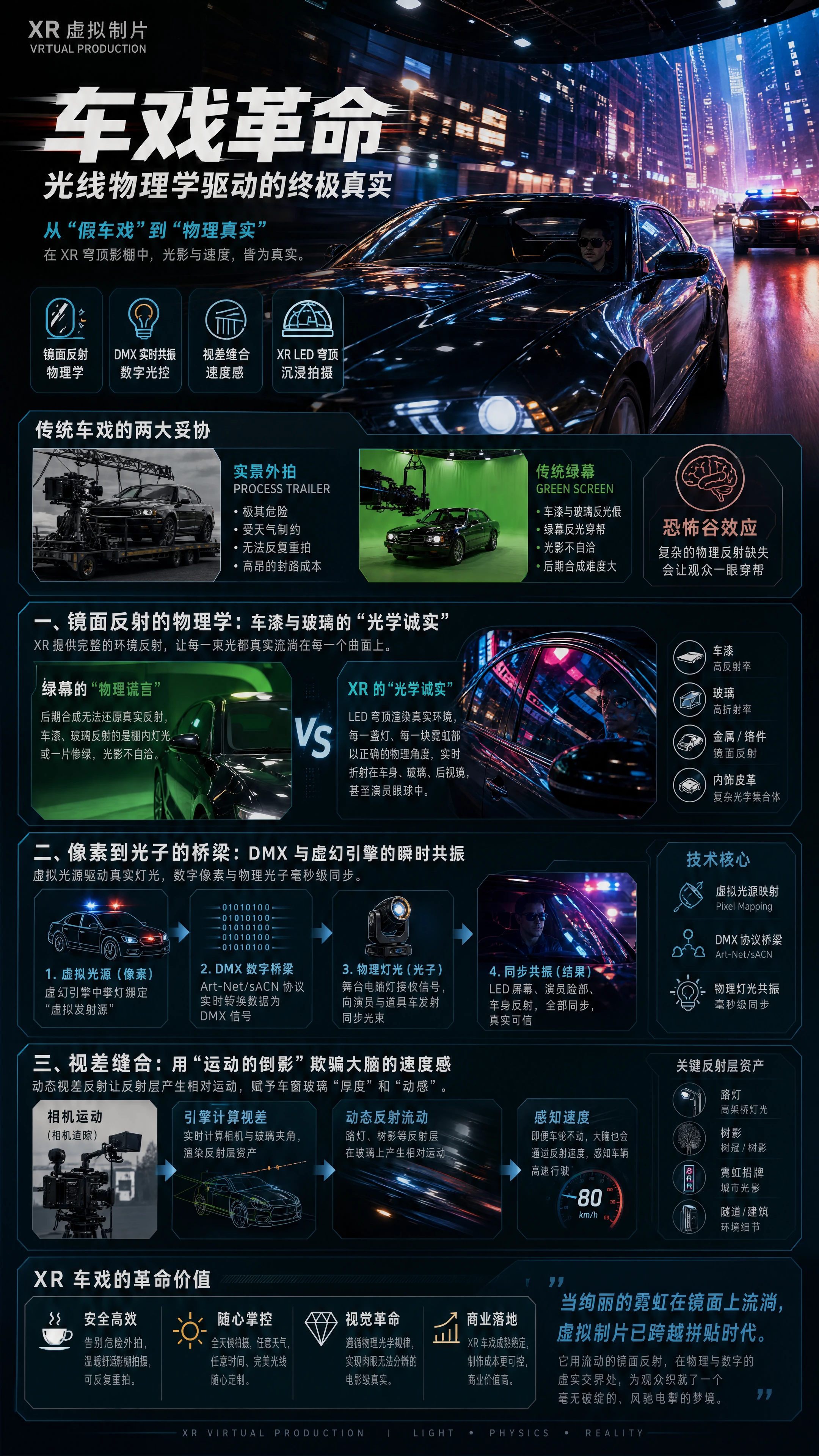
Digital pixels (LED wall) and physical photons (on-set lighting) are algorithmically locked together in that moment.
III. Parallax Stitching: Using "Moving Reflections" to Trick the Brain into Perceiving Speed“Besides lighting, the hardest thing to simulate in car scenes is”。
"the sense of speed"The human brain determines whether a car is moving at high speed not only by the scenery receding outside the window (background) but also by。
the reflections of rapidly passing tree shadows and streetlights on the windshield (foreground reflections)
- Inside the XR volume, using a high-precision camera tracking system, the Unreal Engine calculates the angle between the camera and the windshield in real time: Dynamic Parallax Reflection:When the camera moves forward or backward on a track, the "reflection layer assets" (such as highway overpass lights or tree canopies) specifically rendered on the LED top and side screens produce relative motion on the windshield according to the physical laws ofmotion parallax
- Eliminating the “Sense of Stillness”: This flowing reflection visually gives the windshield a sense of “depth” and “motion.” Even if the wheels aren't turning, the audience's brain fills in the idea that “this car is speeding at 80 km/h” based on the speed at which the streetlight reflections slide across the glass.
Conclusion
The car scene revolution is the most mature and commercially viable application scenario for XR virtual production.
It not only frees filmmakers from cold, dangerous night shoots, allowing them to work in a warm, comfortable studio while sipping coffee and controlling a “perfect golden hour sunset,” but also achieves a perfect tribute to the laws of physical optics in visual art.
When the dazzling neon streetscape flows like liquid, gliding smoothly across the lenses of actors' sunglasses and the glossy black car body, we know:
Virtual production has transcended the early stage of “collage imagery.” Using flowing specular reflections, it weaves a flawless, high-speed dream for the audience at the intersection of the physical and digital worlds.

 简体中文
简体中文  English