
At the site of ultra-large LED virtual production (ICVFX) and immersive giant screen stages, the computing power of a single GPU often falls short in the face of massive pixel counts.
To drive curved LED giant screens spanning tens of meters with resolutions up to 8K or even 12K, along with ceiling panels and side fill screens, the technical team must deploy a setup composed of multiple high-performance rendering workstations.Distributed Rendering Cluster (Multi-Node Clustering)。
However, within this “supercomputing beast” assembled from multiple machines lies the most fragile industrial pain point of the entire system:Non-deterministic State and Rendering Tearing:
- Millisecond-level Clock Drift in Network Clocks: Even if each machine is equipped with top-tier hardware, the crystal oscillators on their motherboards will produce subtle physical time differences during operation. At a frame rate of 60fps, the lifecycle of a single frame is only 16.6 milliseconds. A mere 1 millisecond of network communication jitter can cause a slight temporal misalignment in the virtual camera positions read by Node A (responsible for rendering the left half of the LED screen) and Node B (responsible for rendering the right half), resulting in glaring“Snap-like” Tearing at the screen's seam.。
- Chaos of Logic Execution (Game State Desync): In Unreal Engine 5 (UE5), the random seeds for particle systems, physics dynamics calculations, and timeline-based animations run independently on each machine by default. Without physical lock synchronization, two rendering nodes will calculate completely different trajectories for raindrops or falling leaves at the same moment. This leads to devastating“Particle Teleportation and Visual Breaks” at the junction of two LED walls.”。
- “Single Point Failure, Total System Collapse” Broadcast Disaster: In “zero-fault” scenarios like large-scale live galas or international summit broadcasts, if any rendering server in the cluster goes offline due to hardware overheating, VRAM overflow, or a loose network cable, the corresponding LED area will instantly go “black” or freeze, causing a catastrophic broadcast accident.
Aximmetry Leveraging its architecture rebuilt for broadcast-grade High Availability,“Rigid Cluster Lock & Active-Active Redundancy Pipeline”, it forges an unbreakable barrier of computing power and security among multiple physical workstations.
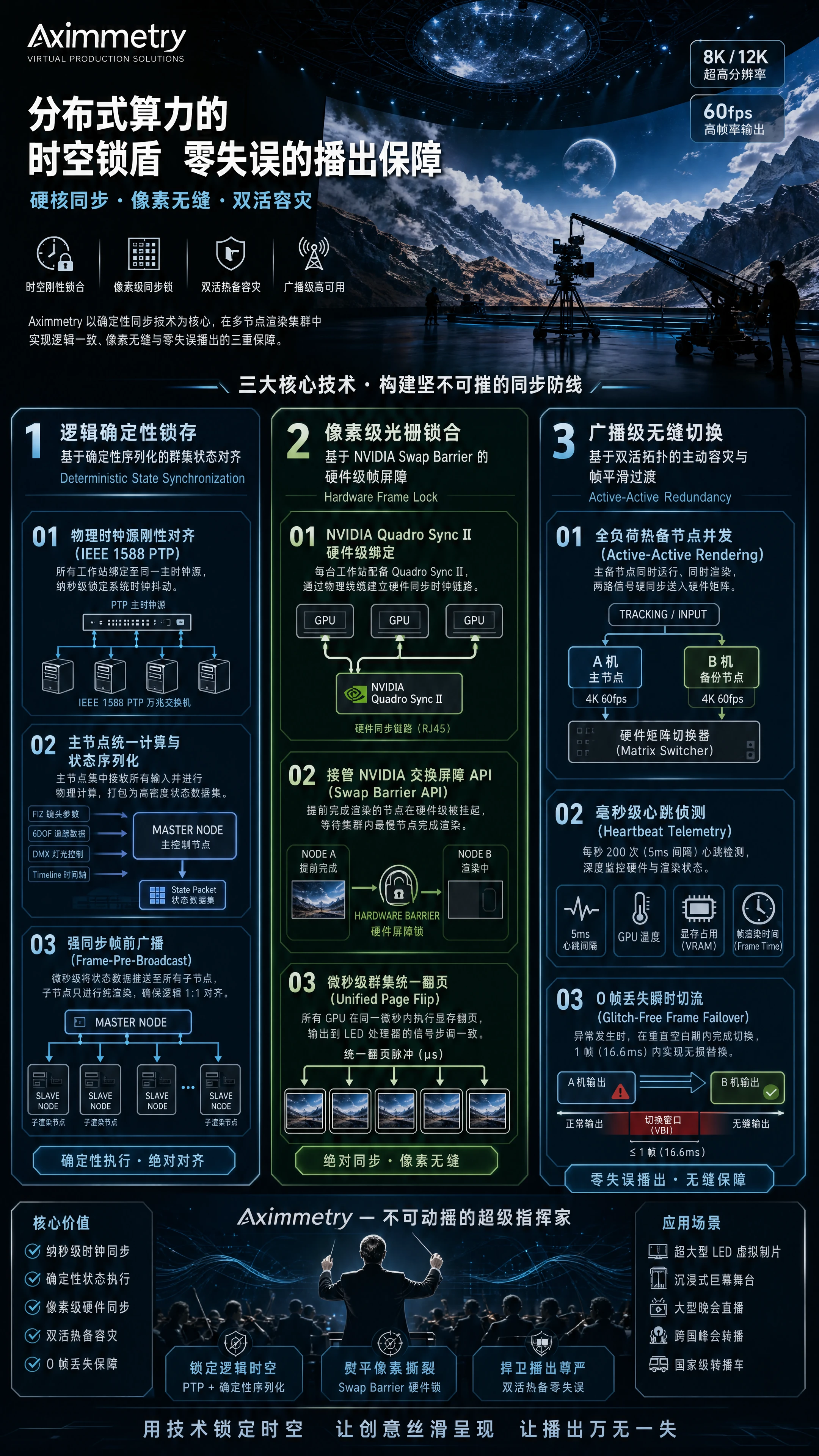
I. Logic Deterministic Locking: Cluster State Alignment Based on Deterministic Serialization
To eliminate “virtual-real splicing tearing” in distributed rendering, the primary task is to completely strip each sub-rendering node of its autonomous game logic computation power, achieving“Deterministic Execution” at the software algorithm layer.”。
Aximmetry establishes a high-frequency, tightly supervised“Master-Slave” Distributed State Communication Topology.:
Rigid Physical Clock Source Alignment (IEEE 1588 PTP)
All workstations within the cluster do not rely on Windows network time synchronization; instead, they are all bound to the same external broadcast-grade master clock source. Through a 10GbE fiber optic switch supporting IEEE 1588 PTP (Precision Time Protocol) , the system clock jitter of all servers is locked to theNanosecond level.。
Master Node Unified Computation and State Serialization
In the rendering pipeline, all external input signals (including FIZ lens parameters, 6DOF camera tracking data, DMX lighting control, and Timeline progress) are uniformly received and physically computed by Aximmetry's Master Node. The master node packages all logic computation results for the current frame, random number generation seeds, and initial particle states into a highly denseState Packet.。
Strong Synchronization Frame-Pre-Broadcast
In the microsecond gap before the rendering thread starts, the master node forcibly pushes the state packet to allSlave Nodes via a dedicated low-latency bidirectional ring network protocol.Upon receiving the data packet, the slave nodes directly overwrite their own UE5 logic state and perform only pure image rasterization and pixel shading. This mechanism ensures that when the entire cluster handles complex physics collisions, Niagara particle flows, or random animations, the 3D dreamscape within each server is an absolute 1:1 replica, absolutely alignedin both geometry and logic dimensions.
II. Pixel-Level Raster Lock: Hardware-Level Frame Barrier Based on NVIDIA Swap Barrier
Even if all nodes are logically aligned, if there is a slight asynchrony in the moment they send image data to the LED controller, physical tearing will still occur at the screen seams.
Aximmetry delves deep into the underlying GPU swap chain to construct a“Hardware-Level Pixel Sync Lock (Hardware Frame Lock)”.”:
NVIDIA Quadro Sync II Hardware-Level Binding
In terms of hardware configuration, each workstation in the cluster is equipped with a dedicated NVIDIA Quadro Sync II sync card, connected via physical RJ45 sync cables. This hardware establishes a direct, independent physical sync clock link between the GPU chips of each machine.
Taking Over the NVIDIA Swap Barrier API
Aximmetry intercepts the Present() swap buffer command of the DirectX 12 rendering pipeline at the GPU driver layer via NVAPI. When Slave Node A finishes rendering its assigned 4K frame early, its GPU write queue is forcibly suspended at the hardware level by the Quadro Sync II chip (Barrier Lock).
Microsecond-Level Unified Page Flip
Only when the slowest rendering node in the cluster (e.g., the camera rendering end with a more complex scene) sends a hardware pulse signal indicating “rendering complete” will all server GPUs simultaneously execute aVRAM buffer page flip within the same microsecond.。
This ensures that the multiple SDI/HDMI signals output to the LED processor (e.g., NovaStar / Brompton) achieveabsolute “synchronized step”in the physical dimension of photoelectric scanning. No matter how fast the camera moves, no visible optical tearing lines will appear at the seams of the LED giant screen.
III. Broadcast-Grade Seamless Switching: Active-Active Topology-Based Active Disaster Recovery and Smooth Frame Transition
In the extremely high-pressure environment of live broadcasting, disaster recovery capability is a hard metric for determining whether a system can enter a “national-level broadcast vehicle.” Aximmetry abandons the traditional “master-backup cold switching (requiring several seconds of black screen to reload the scene)” and deploys an“Active-Active Fault Tolerant Routing”system:
Full-Load Hot Standby Node Concurrency (Active-Active Rendering)
In Aximmetry's disaster recovery topology, the primary workstation (Machine A) and the backup workstation (Machine B) operatesimultaneously within the same physical cluster, receiving the same tracking data and concurrently rendering identical frames in the background.Two streams of 4K 60fps video signals, in hard sync, are continuously fed into a broadcast-grade hardware matrix switcher.
Millisecond-Level Heartbeat Telemetry
Aximmetry's cluster control software sends high-frequency heartbeat detection packets to all running nodes at a rate of 200 times per second (5ms interval). The system not only monitors hardware network connectivity but also deeply monitors GPU core temperature, VRAM usage, and current frame rendering time in real-time.
Zero-Frame Loss Instantaneous Stream Switching (Glitch-Free Frame Failover)
Once any hardware anomaly is detected on Machine A (e.g., a sudden increase in rendering time, impending frame drop), the Aximmetry controller issues a switching command to the external hardware matrix within the extremely briefVertical Blanking Interval (VBI).The system completes a lossless replacement from Machine A's output signal to Machine B's hot standby signal within the tiny gap of 1 frame (16.6 milliseconds). For the broadcast output audience, or even the film camera shooting live on set, the entire LED wall and final composited image experience not even 1 pixel of jitter, frame loss, or color change.
This “hardcore shield” reduces the technical risk of live broadcasting to the absolute physical minimum.
Conclusion: Seamlessly Coalescing Vast Computing Power
In the visual symphony of large-scale virtual production, the distributed rendering cluster is the massive orchestra composed of dozens of instruments. Without an extremely precise and strict conductor (clock synchronization) and stable score distribution (state synchronization), even the most expensive instruments playing together will only produce noisy, torn, and harsh sounds.
Unreal Engine 5 gives us the brush to create boundless digital miracles, but its underlying software and network logic cannot independently maintain the rigid spatiotemporal order of ultra-large clusters under immense pressure without the support of a professional broadcast-grade controller.
Aximmetry 's true confidence lies in its role behind the distributed computing lines as that“unshakable super conductor.”。
At the system level, it locks logic operation with PTP and deterministic serialization; at the GPU level, it smooths out pixel tearing with hardware swap barriers; on the broadcast link, it defends the industry's dignity of “zero faults” with an active-active hot standby pipeline. It is precisely because of Aximmetry's distributed cluster synchronization technology, which firmly locks computing power into a spatiotemporal cage, that the originally wild and disordered ultra-large-scale computing power of the digital world can merge into a smooth, resilient, and unbreakable visual monument on screens in millions of homes.

 简体中文
简体中文  English