
If you've ever tried using your phone to shoot your TV screen at home, or an outdoor LED billboard on the street, you've likely captured some eerie footage: slowly moving bands appear across the screendark bands (Scanlines), or the image shows strangeflickering and tearing。
For everyday life documentation, this is just a bad photo experience; but on an XR (Extended Reality) virtual production set costing hundreds of millions, if these dark bands appear in the cinema camera's monitor for even a single frame, the entire shot is ruined, and the daily shooting budget of hundreds of thousands of dollars goes down the drain.
In the film industry, this demon hiding in the cracks of time is called“sync tearing”。
To eliminate it, virtual production introduces the ultimate time order revered in broadcast television and aerospace tracking and telemetry—Genlock (Genlock synchronization)This is amicrosecond (one-millionth of a second)-scale “dark duet” between the camera shutter and LED pixel pulses.
I. The Rolling Gallows: The Conflict Between CMOS Sensors and LED Refresh Rates
To understand why the image tears, we must first uncover the “working secrets” of digital cameras and LED screens on a microscopic time scale.
- The Camera's “Rolling Shutter”: Most modern cinema cameras (such as ARRI Alexa, RED V-Raptor) use CMOS sensors. When capturing, they don't record the entire frame at the same instant, but rather scan like a photocopier,reading pixels row by row from top to bottom (Row-by-Row Scanning)Although this readout process is extremely fast (typically within a dozen or so milliseconds), there is still a time difference.
- The LED Screen's “Endless Flicker”: LED screens appear constantly lit, but at the microscopic level, they control brightness throughPulse Width Modulation (PWM), switching “on-off-on-off” at extremely high frequencies (e.g., 7680Hz, meaning 7680 flashes per second).
- The Time Mismatch: When the camera's row scanning speed collides with the LED screen's flicker cycle, tragedy strikes. When the CMOS scans the upper half of the sensor, the LED screen happens to be in the “on” state; when it scans the lower half, the LED screen is in the microsecond gap of being “off.” [Result]: The final captured image shows alternating bright and dark horizontal stripes.
On an XR virtual production set, if the camera and screen each run on their own timing, the monitor image will flicker wildly like an old TV, or even show a “tearing” effect where the top and bottom of the frame are out of sync.
II. The Absolute Conductor: Genlock's Microsecond-Level Control
To get the camera and screen to work in harmony, the crew must install an“absolute conductor”——sync signal generator (Master Sync Generator)。
This instrument uses an extremely stable crystal oscillator to generate an electrical signal called Genlock (Genlock synchronization) This signal, typically in the form of “Tri-Level Sync” or PTP (Precision Time Protocol), is forcibly sent to every digital device on set via SDI physical cables or network:
- Sent to the virtual engine (Unreal Engine): Forcing the engine to render a new frame at the exact moment it receives the signal.
- Sent to the LED video processor: Forcing the processor to project the new image onto the screen at that exact moment.
- Sent to the cinema camera: Forcing the camera's CMOS sensor tobegin the first row scan of a new frame at that exact moment.。
Through Genlock, all electronic devices on set sharethe same “heartbeat”。
The camera no longer shoots blindly, but acts like a strict drummer, precisely opening the shutter at the microsecond when the LED screen refreshes its image and brightness reaches its most stable point.
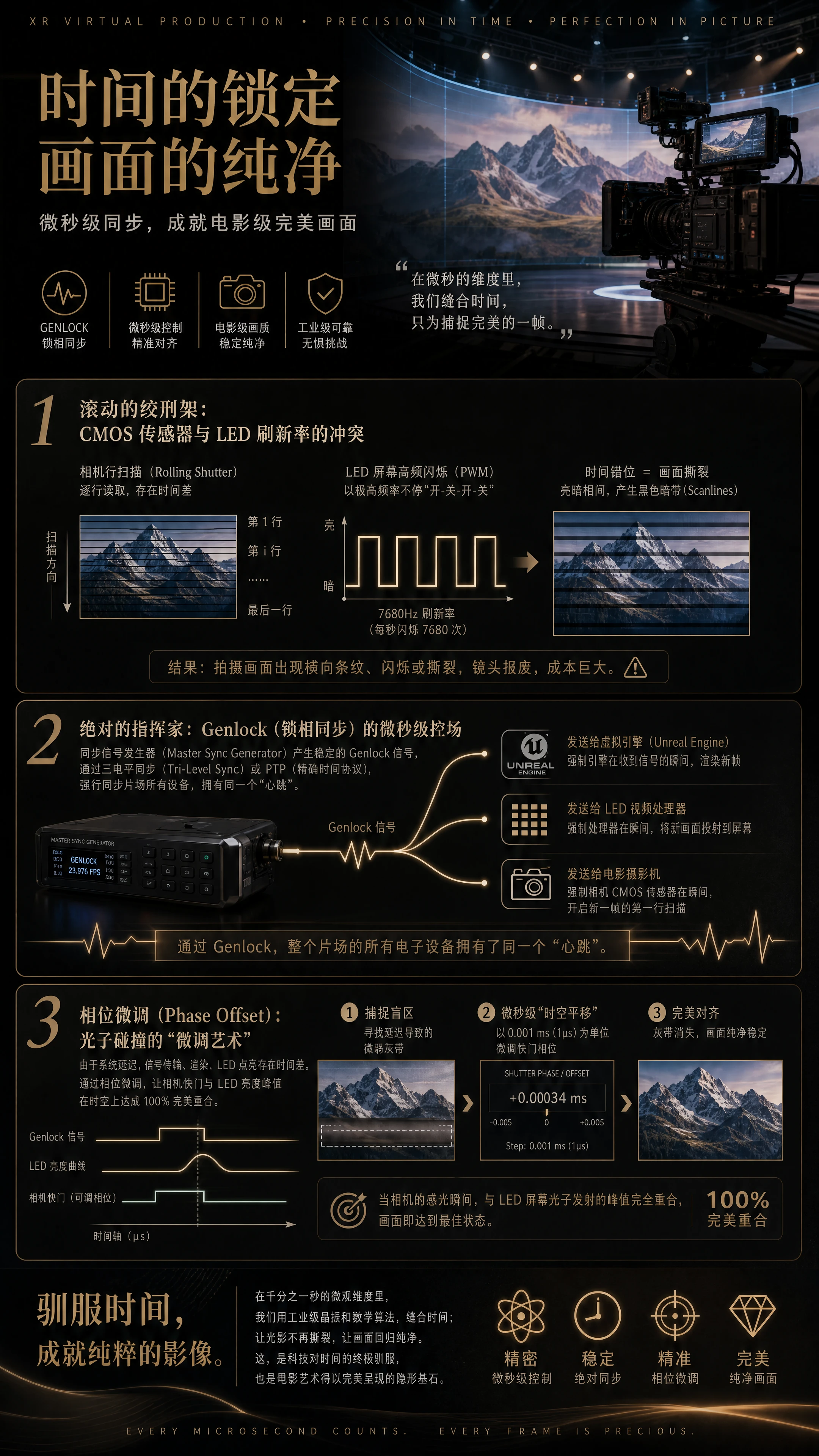
III. Phase Offset: The “Fine-Tuning Art” of Photon Collision”
However, having the same heartbeat alone is still not enough.
In the physical world, electrical signals take time to travel through copper wires and fiber optics, GPUs take time to render frames, and LED pixels have physical latency from receiving the electrical signal to fully lighting up.
This means that even if the camera and screen receive the “go” command simultaneously, due tosystem link latency, the camera shutter will often lag a few microseconds behind the LED screen's illumination. These few microseconds of error can still cause faint gray shadows at the edges of the frame.
To solve this last microsecond of deviation, on-set engineers perform a procedure calledphase tuning (Shutter Phase Tuning / Offset)—an extreme precision operation:
- Capturing the Blind Spot: Technicians aim the camera at the LED screen and search the monitor for that nearly invisible faint gray band caused by latency.
- Microsecond-Level “Time Shift”: In the camera settings, technicians adjust the camera's "shutter phase" in increments of 001 milliseconds (1 microsecond) This is equivalent to telling the camera: “After receiving the Genlock sync signal, deliberately delay the shutter by 0.00034 seconds before opening.”
- Perfect Alignment: As the value is fine-tuned, the gray band in the monitor slowly moves like a ghost. When the perfect value is reached, the gray band completely slides out of the camera's frame boundaries.
At this point,the camera's light-sensitive moment and the peak of the LED screen's photon emission achieve a 100% perfect overlap in time and space.
Conclusion
In the dazzling technology of XR virtual production, people often get lost in grand 3D virtual scenes and realistic light reflections. Yet few know that all these visual wonders are built upon a chain of cold, microsecond-level time locks.
Without Genlock, the silent conductor, precisely stitching time like a surgical procedure at the microscopic scale of one-thousandth of a second, all light and shadow would dissolve into flickering noise, and every image would crumble into torn fragments.
This is humanity's ultimate taming of the time dimension using industrial-grade crystal oscillators and mathematical algorithms.
When the camera races along the track, the shutter elegantly weaves through thousands of flashes per second, and brings back that clean, stable, flawless cinematic image, what we are witnessing is a technological poem born from time being precisely formatted.

 简体中文
简体中文  English