
In the film and television production industry, there is a “industry jargon” that has been circulating for decades, and it is also the beginning of every VFX artist's nightmare—
“Don't worry, we'll fix it in post.”
Wind too strong on set causing continuity errors? Fix it in post. Lighting doesn't match? Fix it in post. Actor's expression not quite right? Fix it in post, frame by frame. For a long time, “post-production” has been like a bottomless pit, silently bearing all the mess left behind by on-set shooting. VFX artists work overtime late into the night in dark server rooms, sacrificing their hair and health to patch up the flaws from production.
However, in the last couple of years, this mantra is rapidly disappearing.
Becausethe daily reality ofis completely restructuring the film workflow, bringing a revolutionary cognitive shift to the entire film and television industry:
Don't rely on post-production, because “post-production” has been moved to pre-production.
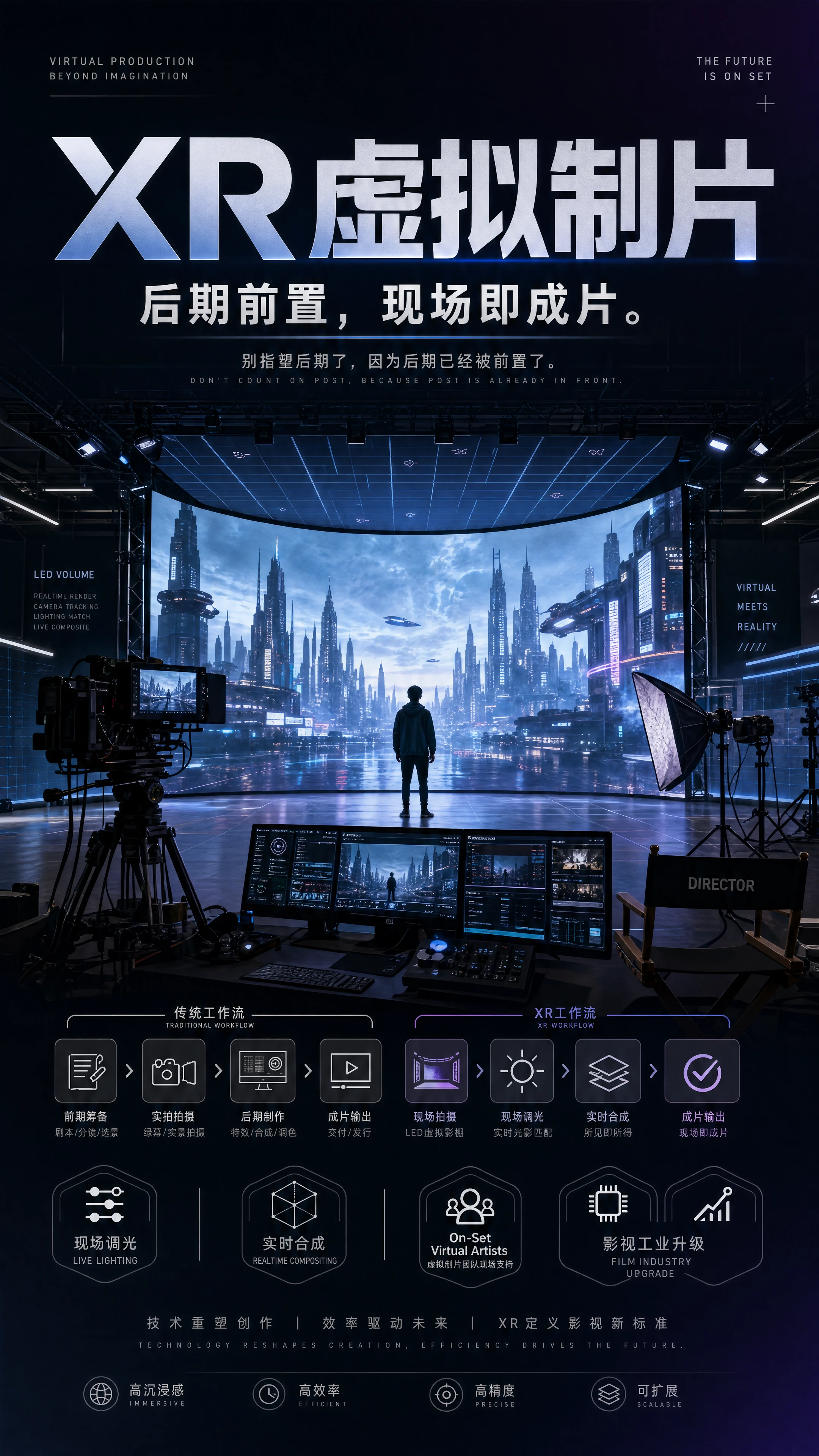
I. The “Vicious Cycle” of the Traditional Workflow”
To understand why “fix it in post” is disappearing, we first need to look at the long, linear pipeline of traditional filmmaking:
Script → Shooting (Green Screen) → Editing → VFX (Post-Production) → Final Cut
In this pipeline,post-production VFX is at the bottom of the food chain。
- Blind Box Shooting: When directors and cinematographers shoot against green screens on set, they can't see the final image at all; they are essentially “shooting blind.”
- The Endpoint of Pressure: When pre-production goes over budget or schedule, the time and budget left for post-production are ruthlessly compressed. VFX artists must solve various lighting mismatches and continuity errors left over from production in an extremely short time.
- Disastrous Rework: If the director is unsatisfied with the finished VFX, the cost of revision is extremely high, sometimes even requiring actors to be called back for reshoots.
This model of “pre-production digs the hole, post-production fills it” is not only highly inefficient but is also the root cause of countless visual effects blockbusters ultimately suffering a “visual collapse.”
II. The XR Workflow: Turning “Post-Production” into "Pre-Production"
The advent of XR virtual production uses a physically grounded“What You See Is What You Get”approach to directly fold and restructure this linear pipeline.
In an XR studio, the workflow becomes:
3D Scene Creation (Pre-Production) → On-Set Virtual Shooting (Compositing) → Final Cut
Shooting IS the “Final Product”
In an XR studio, when an actor performs in front of an LED wall, the image captured by the camera already merges the actor, real props, and the virtual world displayed on the LED screen. What appears on the monitor isa near-final cut with over 80% of the effect completedAre there any continuity errors on set? Is the lighting reasonable? The director and cinematographer can see it all clearly at the moment of shooting.
From “Fix in Post” to “Adjust on Set”
What previously required VFX artists days of rendering on a computer can now be adjusted in real-time on set:
- “Move that building in the background a bit to the left.” — The art director taps on a keyboard on set, and the building on the giant screen moves instantly.
- “The reflection on the ground isn't strong enough; make it brighter.” — The lighting technician fine-tunes parameters on set, and the image updates in real-time.
All “revision decisions” are made right there on the set.“The buck-passing of ”fix it in post“ is replaced by the satisfaction of ”solving it on set."
III. The “Major Status Upgrade” for Visual Effects Artists”
For visual effects artists, who have long been on the periphery,VFX Artiststhis change represents an unprecedented “redemption” and career transformation.
They are no longer post-production workers “cleaning up messes” in dark server rooms. Instead, they transform into“On-Set Virtual Artists”:
- who determine the very direction of a film. Shifting Authority Forward:
- They must get involved months before filming begins, working with the director to conceive and create every detail of the virtual world. Fighting Side-by-Side:
On the shooting set, they sit right next to the director and the director of photography, acting as "virtual set designers" and "lighting control officers," using algorithms and 3D engines to safeguard every shot in real-time.
Conclusion
For the first time, they are truly integrated into the creative core of the production team, breathing and creating together on set.
The best outcome of technology is to allow every role to return to its original dignity.The most profound contribution of XR virtual production to the film industry is not how much money it saves, but that it“。
ends the “abnormal era” of relying on exploiting post-production to cover up pre-production mistakes
When "fix it in post" becomes history, the creation of every shot becomes more rigorous, respectful, and composed.

 简体中文
简体中文  English