
On the ledger of the traditional film and television industry, there are two hidden costs that trouble producers the most yet have long been unavoidable: one is called “waiting,” and the other is called “traveling.”
To capture the mere 20-minute “Magic Hour” in a day, a crew of a hundred might have to endure the cold wind from noon until dusk doing nothing; and if the weather turns foul and a single dark cloud drifts in, the entire day's call sheet fees and equipment rental fees go up in smoke.
The previous scene was in the wastelands of Iceland, the next in a cyberpunk neon city. Flights, hotels, and visas for hundreds of cast and crew, customs clearance for dozens of tons of equipment crossing borders, and unpredictable overseas co-production costs—before the film even starts shooting, tens of millions of yuan have already been devoured from the budget.
For a long time, the film and television industry seemed to have accepted this costly “physical wear and tear.” However, as global film and television production enters an era of deep premiumization and stock competition, the era of “extensive cash burning” is gone for good.
当 LED Volume + real-time rendering engine (Unreal Engine 5) + camera spatial tracking system constitute XR virtual production (In-Camera Visual Effects, ICVFX) has matured, and what it brings to the industry is by no means merely a “visual effects upgrade,” but afundamental restructuring of the return on investment (ROI) of the film and television industry。
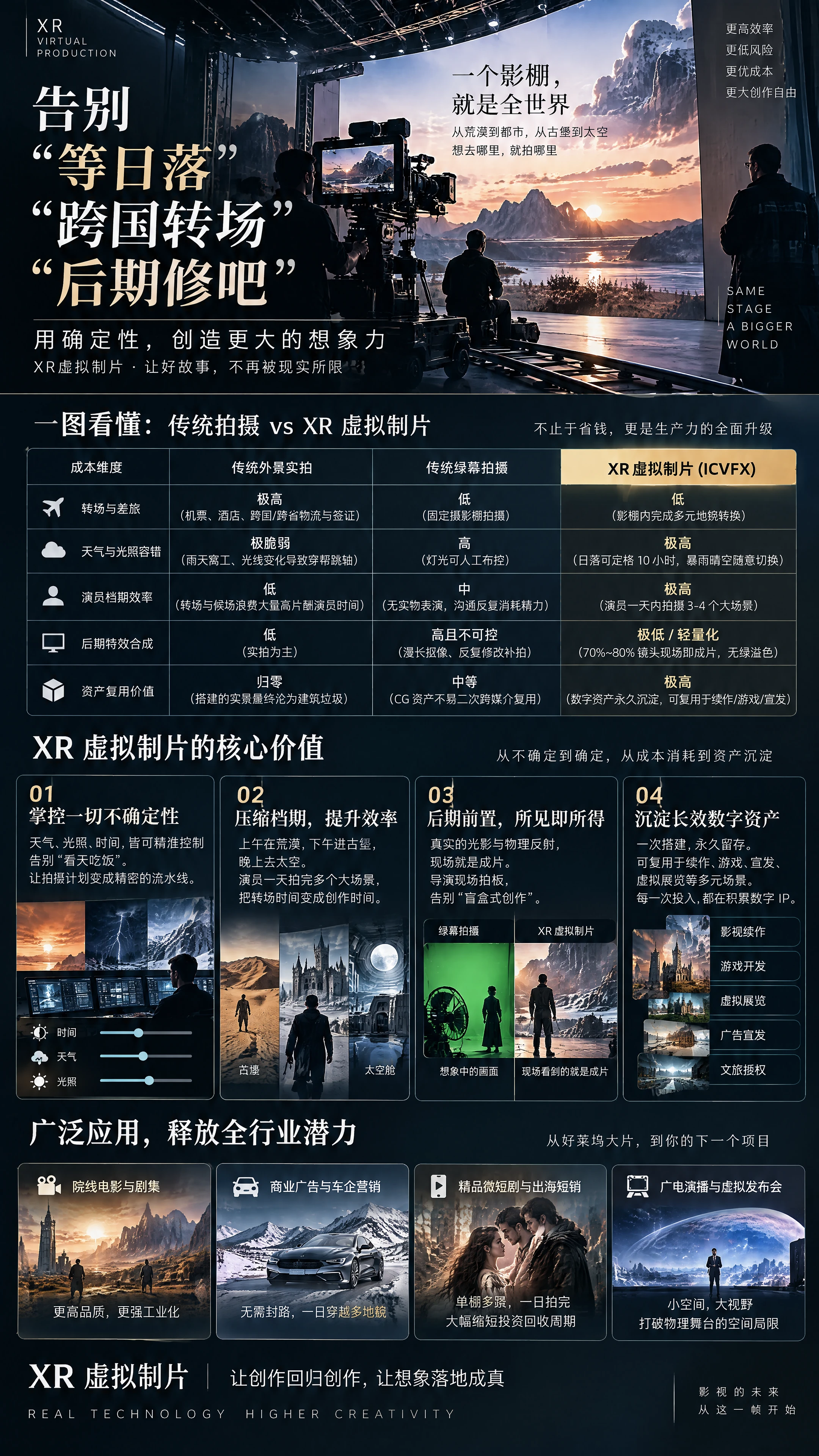
I. Doing the Math: Traditional Location/Green Screen vs. XR Virtual Production
Many producers, when first encountering an XR studio, are often deterred by the cost of the hardware and the daily studio rental: “XR studios charge a hefty daily rate—how can you say it saves me money?”
The true business ledger can never look at isolated costs alone; it must look atthe comprehensive delivery cost across the full lifecycle。
| Cost Dimension | Traditional Location Shooting | Traditional Green Screen Shooting | XR Virtual Production (ICVFX) |
|---|---|---|---|
| Relocation & Travel | Extremely high(flights, hotels, cross-border/cross-province logistics and visas) | 低(fixed studio shooting) | 低(diverse terrain transitions completed within a fixed studio) |
| Weather & Lighting Tolerance | Extremely fragile(rain delays, lighting changes causing continuity errors and axis jumps) | 高(lighting can be manually controlled) | Extremely high(sunset can be frozen for 10 hours; rainstorms and clear skies can be switched at will) |
| Cast Scheduling Efficiency | 低(relocations and waiting waste large amounts of highly paid actors' time) | 中(performing against nothing, repeated communication drains energy) | Extremely high(actors shoot 3-4 major scenes in a single day, fully immersed in performance) |
| Post-production VFX Compositing | 低(primarily live-action) | High and uncontrollable(lengthy keying, reflection replacement, repeated revisions and reshoots) | Extremely low/lightweight(70%–80% of shots are final in-camera, no green spill) |
| Asset Reuse Value | Zero(built practical sets ultimately become demolition construction waste) | Medium(green screen CG assets are difficult to reuse across media) | Extremely high(digital assets permanently retained, reusable for sequels/games/marketing) |
Converting “Uncertainty” into “Certainty”
The biggest cost killer in film and television shooting is uncertainty. Sudden rainstorms at location, flight delays, overseas co-production disputes… every unexpected event burns money by the minute.
In an XR studio,the physical environment is thoroughly codified and parameterizedSunset can be precisely “frozen” at 5:45 PM for up to 12 hours; gale-force winds, heavy snow, auroras, fiery clouds—the operator simply clicks a mouse on the control console. The crew's shooting schedule shifts from “depending on the heavens” to a highly precise assembly-line operation.
Compressing Cast Schedules and Relocation Downtime
For top-tier productions, lead actors“ time is billed by the hour. In traditional shooting, a single relocation easily consumes two or three days. In an XR studio, however, in the morning the actor is navigating dangers in ”the Namibian desert,“ by afternoon already walking through ”a medieval castle,“ and by evening switching to ”a futuristic space capsule."
Converting all the time originally spent in airplane cabins and on highways into high-density camera operating time—this is the ultimate extraction of actor fee utilization efficiency.
II. Disrupting the Production Paradigm: “Post-production Front-loading” Eliminates the VFX Bottomless Pit
For a long time, a terrifying industry saying has circulated in film and television post-production: “It's fine, fix it in post”。
The price of this compromise is the infinite extension of post-production VFX timelines and frequent budget overruns. More fatally, the“Green Spill”from green screen shooting is every VFX supervisor's nightmare:
- Car windows and actors' sunglasses reflect glaring green light everywhere;
- The green ambient light reflected off metal armor and glossy props requires frame-by-frame manual replacement in post;
- Keying the stray light at the edges of blonde hair, sheer fabric, and semi-transparent smoke consumes hundreds to thousands of person-months of labor.
What You See Is What You Get—Capturing the Final Image on Set
The core logic of XR virtual production is“Pre-visualization to Final Pixel”:
- Realistic environmental diffuse reflection and specular highlights: The wraparound LED screen is not just a background—it is a set offull-spectrum ultra-large softboxesThe snow-capped mountains, neon lights, or blazing fire in the scene cast physically accurate light directly onto actors' faces, curved car paint surfaces, and glass props, inherently possessing physically realistic texture—no manual post-production relighting needed.
- Camera Tracking and Real-time Parallax: The tracking system synchronizes the real camera with the virtual camera in Unreal Engine at millisecond-level precision. During pans and pushes, background depth of field and perspective shifts are generated naturally—what you see on the on-set monitor is the realistic, complete final image (In-Camera VFX).
- The Director Calls the Shots On Set—No More Blind-Box Creativity: Under traditional green screen, the director can only rely on imagination; the final film is often delivered six months later, and if unsatisfied, reshoots are extremely costly. On an XR set, however, the director and cinematographer (DP) can intuitively see the final composition and lighting, making decisions and approving takes on the spot—completely eliminating “goods not matching the order” at delivery.
III. From “One-time Consumption” to “Long-term Digital Assets”
If XR is merely viewed as a money-saving tool to “save a few plane tickets and catering costs,” its commercial potential is still underestimated.It is transforming film and television production spending from “Expense” to “Asset.”
In traditional film and television set construction, palaces, spaceships, and street scenes built at a cost of millions of yuan often face high demolition or storage fees after wrapping, ultimately becoming piles of useless construction waste.
In the XR production system, however:
- Scene digital assets can be permanently retained: Build a realistic Tang-Song dynasty ancient street or sci-fi space station UE5 scene, and after shooting is complete, the assets are saved on the server—subsequent seasons, sequel films can directly retrieve and reuse them at near-zero cost.
- Full-chain commercial extension (multiple revenue streams from one asset): This set of high-precision digital assets can not only be used for shooting but also exported with one click as:
- Marketing interactive materials: virtual immersive interactive exhibitions, metaverse launch events;
- Games and derivatives: directly imported into game engines to become film-tied interactive games or VR experiences;
- Cross-industry licensing: licensing digital assets to advertisers, cultural tourism parks, or virtual digital human performances.
Every investment in a scene is no longer mere cost consumption, but rather accumulating a long-term digital IP asset library for the production company.
IV. Industry Breakthrough: From Hollywood Exclusive to the “Dimensionality-Reduction Weapon” for Mid-tier Productions and Short Dramas”
Many people's understanding of virtual production remains stuck on Hollywood blockbusters like "The Mandalorian" with hundreds of millions of dollars in investment. But in fact, domestic virtual production is completingmodularization, miniaturization, and democratization at an extremely rapid pace。
Today, not just theatrical films and top-tier series—the following sectors are enjoying the explosive dividends brought by XR virtual production:
- Commercial Advertising and Automotive Marketing: No road closures, no waiting for the sunset glow—a confidential new car model not yet launched can traverse snow-capped mountains, deserts, and urban forests within an 8-hour studio session, ensuring top-secret security while delivering theatrical-grade quality at maximum efficiency.
- Premium Micro-Dramas and Overseas Short Dramas: Short dramas have extremely high demands for “short shooting cycles and dramatic visual contrast between themes (battle temples, sci-fi apocalypse, European castles).” XR studios enable “multiple scenes in a single studio, shot in one day,” dramatically shortening the investment recovery cycle.
- Broadcasting Studios and Virtual Launch Events: Breaking the spatial limitations of physical stages, XR set extension allows a studio of just a few dozen square meters to display the visual depth of a stadium for tens of thousands or even a galaxy.
Conclusion: Embracing the Dawn of a New Industrialized Era in Film and Television
Film and television is the art of dream-making, but what sustains this dream is always the harsh logic of business and industrial efficiency.
From film to digital cinematography, from traditional editing benches to non-linear editing systems, every leap in technology—on the surface a replacement of tools—is essentiallya liberation of productivity and creative freedom。
Say goodbye to “waiting for sunset,” goodbye to “cross-border relocations,” goodbye to “the bottomless pit of fix it in post.” What XR virtual production brings is not just more dazzling visual effects, but anew industrial productivity system for film and television with higher risk resilience, better time management, and higher asset reuse rates。
For today's producers and creators, understanding and embracing XR virtual production one step earlier means grasping the core competitiveness of the next film and television cycle one step earlier.

 简体中文
 English