With the rapid advancement of computer graphics, real-time rendering engines, and spatial tracking technologies, virtual production (VP) and virtual-real fusion live broadcasting are rapidly penetrating from top Hollywood production studios and national-level broadcasters into commercial advertising, brand launch events, e-commerce livestreaming, esports events, and virtual human/VTuber studios. Among numerous virtual studio system solutions, the European-made Aximmetry With its unique dual-engine architecture, top-tier real-time keying algorithms, comprehensive hardware ecosystem compatibility, and high cost-effectiveness, it has become a cornerstone of the global virtual production industry. This article systematically analyzes Aximmetry's core technical architecture, delves into its specific applications and implementation workflows in green screen studios, LED curved screen xR (Extended Reality) shooting, and multi-scenario commercial live broadcasting, and provides practical best-practice guidance for engineering technicians and director teams.
I. Aximmetry Overview and Core Technical Positioning
1 What Is Aximmetry?
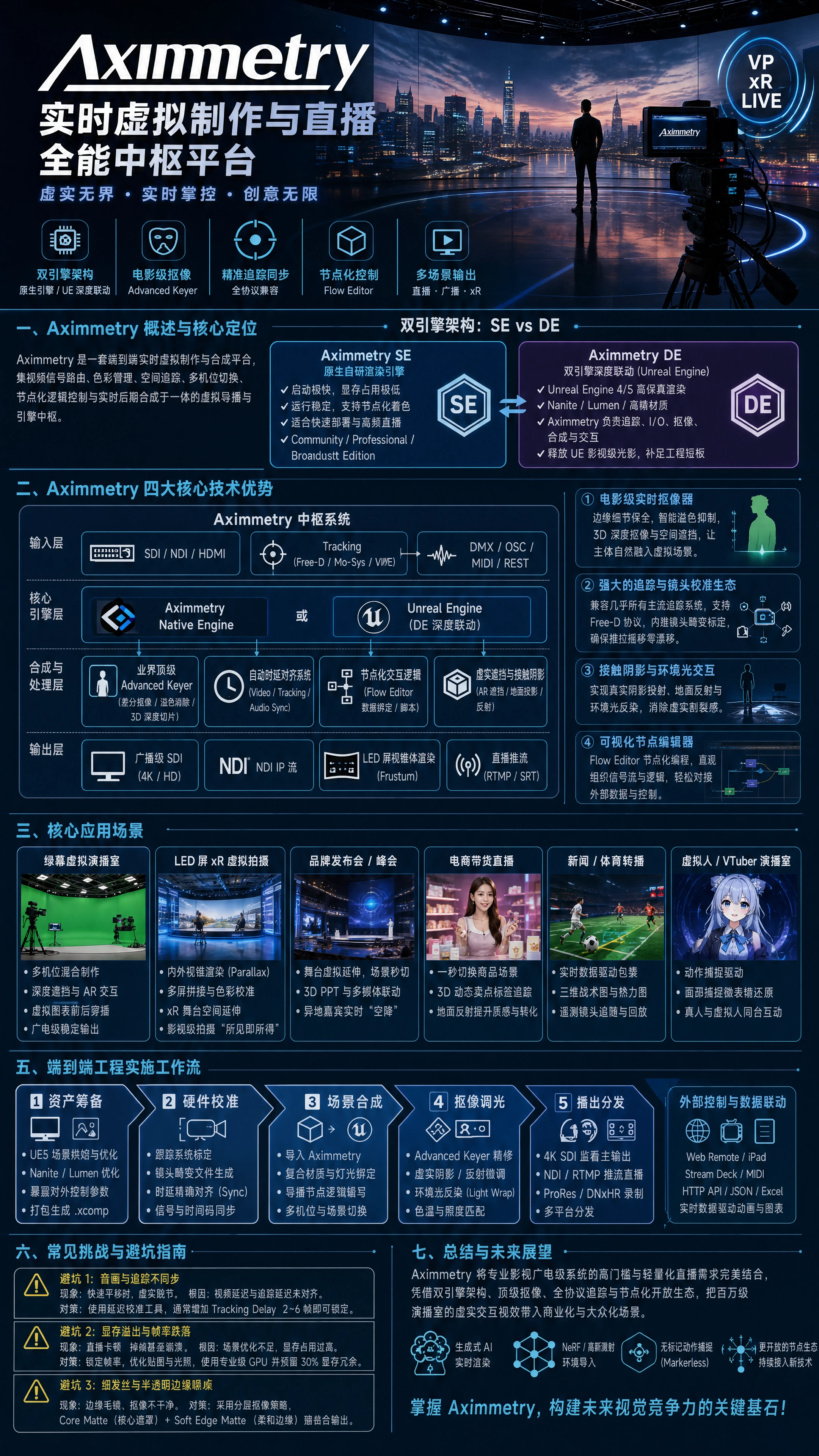
Aximmetry is an end-to-end real-time virtual production and compositing platform designed specifically for broadcast studios, film and television virtual production, stage performances, and live broadcasting.It is not merely a rendering player, but a comprehensive “virtual director and engine hub” encompassing video signal routing, advanced color management, spatial tracking synchronization, multi-camera switching, node-based logic control, and real-time post-production compositing.
2 Core Editions and Dual-Engine Architecture (SE vs DE)
Aximmetry offers two primary product forms in its design, fully balancing flexibility and the ceiling of image quality:
- Aximmetry SE (Community / Professional / Broadcast Edition): Based on Aximmetry's proprietary in-house rendering engine. It features extremely fast startup, minimal VRAM usage, and exceptional stability, supporting custom shaders and 3D model rendering via node graphs (Flow Editor). It is suitable for rapid deployment, high-frequency daily live broadcasting, or lightweight studios.
- Aximmetry DE (Dual Engine with Unreal Engine): Deeply integrated with Epic Games' Unreal Engine 4 / Unreal Engine 5It adopts a dual-engine collaborative mode:Unreal Engine handles physically-based high-fidelity rendering (Nanite, Lumen, high-precision materials, and complex particle dynamics), while Aximmetry handles tracking data injection, video I/O pipelines, real-time keying, compositing layer control, and external interactionThis decoupled architecture unleashes UE5's ultimate cinematic lighting while avoiding UE's own engineering shortcomings in complex broadcast interfaces, audio-video synchronization, and multi-channel video compositing.
II. Four Core Technical Advantages of Aximmetry
+-------------------------------------------------------------------------------+
1 The Widely Acclaimed “Cinematic” Real-Time Keyer (Advanced Keyer)
In green screen production, keying quality directly determines the reveal rate and realism of the final image. Aximmetry's built-in Advanced Keyer is widely recognized as top-tier among industry peers:
- Edge Detail Preservation: Accurately extracts challenging materials such as flowing hair strands, semi-transparent gauze clothing, smoke, and glass reflections.
- Intelligent Despill (Clean Despill): Automatically eliminates green/blue spill reflections on actor skin and clothing edges, and supports “Light Wrap” using the virtual environment's average ambient light on actor edges, allowing subjects to naturally blend into the virtual scene's color temperature.
- 3D Clean Plate & Depth Slicing: Allows the creation of 3D garbage mattes based on camera spatial position. Even when ceiling structures, lighting rigs, or workbenches are exposed beyond the green screen, they can be automatically clipped in 3D space without tedious manual frame-by-frame masking.
2 Powerful Spatial Tracking and Lens Calibration Ecosystem
The system natively supports virtually all mainstream camera tracking systems on the market:
- Broadcast/Cinematic Optical and Mechanical Tracking: Mo-Sys StarTracker, stYpe (RedSpy / Follower), NCam, TrackMen.
- Cost-Effective Motion Capture and Indoor Positioning Systems: HTC VIVE Mars CamTrack, OptiTrack, Vicon, Antilatency.
- Protocol Standardization: Full support for the Free-D protocol (UDP) and various vendor proprietary protocols.
- Lens Calibration: Built-in comprehensive lens calibration tools that precisely calibrate focal length, center shift, and radial/tangential distortion coefficients, ensuring that virtual backgrounds and foregrounds do not drift or disconnect during PTZ or large camera movements.
3 Contact Shadows, Ground Reflections, and Ambient Light Interaction
The biggest giveaway in virtual-real fusion often occurs “underfoot”:
- Virtual-Real Shadow Casting: Aximmetry can extract the shadow silhouette cast by a real actor on the ground and dynamically map it as a mask onto the virtual 3D floor; alternatively, based on the virtual key light direction, it can use the keying Alpha channel to calculate and project realistic geometric shadows matching the virtual lighting angle in real time.
- Planar and Curved Mirror Reflections: Supports real-time reflection rendering of real actors on virtual marble, water surfaces, and mirror floors, greatly enhancing immersion and spatial weight.
4 Visual Node Editor (Flow Editor)
Aximmetry adopts a fully data-orientednode graph programming modelUsers can intuitively organize video signal flows, audio routing, tracking parameters, variable transformations, triggered animations, and external control signals through connections. Whether creating logic that changes background color based on a host's button press, or interfacing with OSC/MIDI mixing consoles or reading external match score APIs, everything can be easily built in the Flow Editor.
III. Core Application Scenarios of Aximmetry in Virtual Production
1 Green Screen Virtual Studio
In film previs, TV program production, and small-to-medium film and television studio shoots, green screen studios are the most mature and cost-flexible solution.
- Multi-Camera Workflow: Aximmetry can support mixed production of 3 to 8 cameras on a single machine (depending on GPU compute power), with tracked cameras and fixed cameras (PTZ/Virtual Cam) deployable in combination. When the director switches between cameras, virtual and real scenes jump synchronously with smooth camera movement interpolation compensation.
- Virtual-Real Occlusion (AR and 3D Depth Layering): In studios, virtual 3D graphics, floating holographic screens, or virtual characters often need to appear in front of, behind, or even surrounding the actor. Aximmetry supports millimeter-level depth interleaving through depth buffers or 3D bounding boxes, completely eliminating the traditional rigid limitation of “virtual scenes can only be placed behind people.”
2 LED Screen Extended Reality and Virtual Production (xR & In-Camera VFX)
With the proliferation of LED screen walls in film and television production, Aximmetry has fully evolved into an xR playback control and rendering hub.
- Inner Frustum & Outer Frustum Rendering:
- Inner Frustum (within camera frustum): Renders high-precision UE5 imagery with perspective parallax in real time based on camera tracking perspective, including motion blur and realistic depth of field.
- Outer Frustum (other areas of LED screen): Renders environment panoramas or low-poly ambient light reflection fields, providing physically accurate ambient light and reflections for on-set actors and props.
- Multi-Screen Stitching and Color Calibration: Supports heterogeneous stitching and UV unwrapping for right-angle screens, folded screens, ceilings, and floor tile screens, providing precise 3D LUT color transformation, grayscale gamma correction, and edge feathering, enabling “what you see is what you get” for on-set camera output.
- xR Stage Set Extension: When the camera pans beyond the physical LED screen boundary, Aximmetry seamlessly blends the 3D virtual scene with the LED screen boundary through soft edges, instantly extending the image outward into an infinitely vast world, greatly expanding the visual scale of limited studio space.
IV. Cutting-Edge Applications of Aximmetry in the Modern Live Broadcasting Ecosystem
The live broadcasting industry has near-stringent requirements for“real-time performance,” “interactivity,” and “low failure rate”Aximmetry's applications in the live broadcasting sector are flourishing in diversity:
| Live Broadcasting Application Areas | Core Technical Highlights and Business Enablement | Typical Implementation Cases |
|---|---|---|
| Brand Product Launches / Summits | • Virtual stage extension and instant switching to sci-fi scenes • Real-time 3D PPT / floating multimedia asset linkage • Remote guests “teleporting” to the venue via real-time green screen keying |
Tech/digital brand online launches, automotive new car metaverse launches, financial industry annual summits |
| E-commerce Livestreaming | • One-second switching of shelf environments based on product being presented (e.g., switching to snowy mountains for down jackets, beaches for sunscreen) • 3D dynamic selling-point labels tracking product movement • Ground reflections and premium texture boosting conversion rates |
Beauty brand immersive livestream rooms, light luxury digital 3D immersive showrooms |
| Broadcast News and Sports Broadcasting | • Real-time data-driven graphics packaging (HTML5/JSON/Excel/API) • 3D formation diagrams, heat maps, tactical board spatial sandbox presentations • High-dynamic telemetry camera tracking and replay integration |
Football/esports world championship broadcast analysis studios, election live vote count data visualization |
| Virtual Human / VTuber Studios | • Motion capture (Noitom / Xsens / Vicon) skeletal data real-time driving • Facial capture (Live Link Face / ARKit) micro-expression reproduction • Real host and virtual human on-stage spatial dialogue and interaction |
Virtual idol concerts, official game collaboration livestreams, digital human e-commerce studios |
1 Dynamic Data Binding and Interactive Control in Live Broadcasting Scenarios
In traditional broadcast production, expensive standalone graphics packaging systems (such as Vizrt, Chyron) are typically required. Aximmetry has built-in comprehensive external data interfaces:
- External Control Bus: Single-operator one-touch playback control via Stream Deck, MIDI control panels, Web Remote control panels, and iPad UI touch control.
- Dynamic Data-Driven: Supports reading real-time news data, weather APIs, e-commerce inventory, or tipping leaderboards via HTTP requests, and automatically triggering particle effects or generating chart animations in 3D scenes, greatly enriching the visual information density and conversion effectiveness of livestream rooms.
V. End-to-End Engineering Implementation Workflow
[Phase 1: Asset Preparation] ──> [Phase 2: Hardware Calibration] ──> [Phase 3: Scene Compositing] ──> [Phase 4: Keying & Color Grading] ──> [Phase 5: Broadcast & Distribution]
Step 1: Asset Preparation and Scene Engineering Optimization
- Build or purchase 3D scenes in Unreal Engine.
- Install and enable the Aximmetry Unreal Engine Integration Plugin。
- Expose dynamic assets in the scene (such as light intensity, text labels, camera switch triggers) as Pins recognized by Aximmetry through Blueprints.
- Run the Aximmetry dedicated packaging tool (Cook Editor) to generate lightweight, efficient
.xcompand resource packages.
Step 2: Hardware Connection, Tracking, and Lens Calibration
- Signal and Timecode Synchronization (Genlock): In professional-grade configurations, video capture cards (such as Blackmagic DeckLink 8K Pro, AJA Kona 5) and cameras must be connected to a tri-level sync signal (Genlock) to eliminate screen tearing and dropped frames.
- Calibrating lens distortion: Use a calibration checkerboard to collect feature points at the wide-angle and telephoto ends in Aximmetry Camera Calibrator, and calculate the distortion mesh file (
.xconf/.dlens)。 - Latency Matching: Real video signal transmission typically has 2~5 frames of hardware latency, while tracking data transmitted over network UDP typically has only 10~30ms. In Aximmetry, use the visual calibrator (Flash Sync / Clapperboard) to fine-tune the tracking buffer frames (Tracking Delay), so that the motion of the virtual camera and the physical camera achieveabsolute synchronization。
Step 3: Keying refinement and virtual-physical optical matching
- Sampling background color: Pick the green screen reference color in the Advanced Keyer node, and use the hue histogram to trim high-frequency edge noise.
- Trimming garbage mattes: Configure a 3D mask box to cut out non-green-screen areas.
- Light matching: Measure the color temperature and illuminance of the on-set physical lighting, and align the virtual sky light and directional light in the UE/Aximmetry scene. Open the Light Wrap node to slightly bleed the highlight color of the virtual background onto the actor's edges, eliminating the “sticker” look.
Step 4: Playback control interaction and external streaming
- Share the control panel to the director's iPad or the switcher workstation via Aximmetry's Web Server function.
- The main output sends a high-quality SDI signal to broadcast monitors or large screens, while the auxiliary output pushes RTMP/SRT streams via a hardware encoder to major live streaming platforms (such as YouTube, Bilibili, WeChat Channels, Douyin, etc.), while simultaneously recording ProRes/DNxHR high-bitrate masters internally for post-production refinement.
VI. Common Practical Challenges and Professional Pitfall Avoidance Guide
Symptom: When the camera pans quickly, the foreground characters and the background virtual architecture become “disconnected,” with the background moving too fast or too slow.
Root cause: Video Latency and Tracking Latency are not calibrated and aligned.
Solution: Use the precise latency calibration test tool provided by Aximmetry. Wave a finger or use a clapperboard in front of the green screen, and compare frame by frame the starting point of physical image movement with the jump point of the tracking coordinate curve. Typically, increasing Tracking Delay by 2~6 frames achieves microsecond-level locking.
Symptom: Occasional stuttering, dropped frames, or even crashes during live streaming.
Root cause: The UE5 scene is not specifically optimized (texture sizes not limited, Lumen bounce count too high, dynamic shadows excessively consuming VRAM).
Solution: Force-lock the frame rate of the virtual production scene (typically 50fps or 59.94fps) and disable smooth frame rate fluctuation. Keep non-core environment textures within the 2K/4K range and make good use of Virtual Texturing. Core workstations must use professional-grade GPUs (such as NVIDIA RTX 4090 24GB, RTX A6000 48GB, or Ada Generation graphics cards), reserving at least 30% VRAM headroom.
Solution: Avoid simply raising the global sensitivity (Master Gain); instead, adopt a layered keying strategy. Aximmetry allows two Keyers to be connected in parallel—one for extracting a solid inner core matte (Core Matte, ensuring the person does not punch through), and the other for softly extracting edge hair details (Soft Edge Matte), then merging the outputs.
VII. Summary and Industry Future Outlook
Aximmetry has successfully built a bridge betweenthe high barrier of professional film/TV broadcast-grade systems与and the lightweight needs of independent creators/live streaming teamsWith its seamless command of Unreal Engine, world-class real-time compositing keyer, and comprehensive tracking protocol support, it brings the virtual-physical interactive visual effects that previously required million-dollar studios into the reach of mass-market commercial production.
Looking ahead, withgenerative AI real-time neural rendering, NeRF/3D Gaussian Splatting environment importand the evolution of markerless visual motion capture (Markerless Tracking), Aximmetry's node-based open architecture will surely integrate more cutting-edge technology nodes, continuing to lead the industrial transformation of real-time virtual production and immersive live streaming. Whether you are a filmmaker pursuing ultimate visual effects or a digital live streaming pioneer exploring next-generation interactive experiences, mastering Aximmetry will be the key cornerstone for building future visual competitiveness.

 简体中文
 English