
If one word were used to describe the micro-drama market of the past, it would be “fast.”
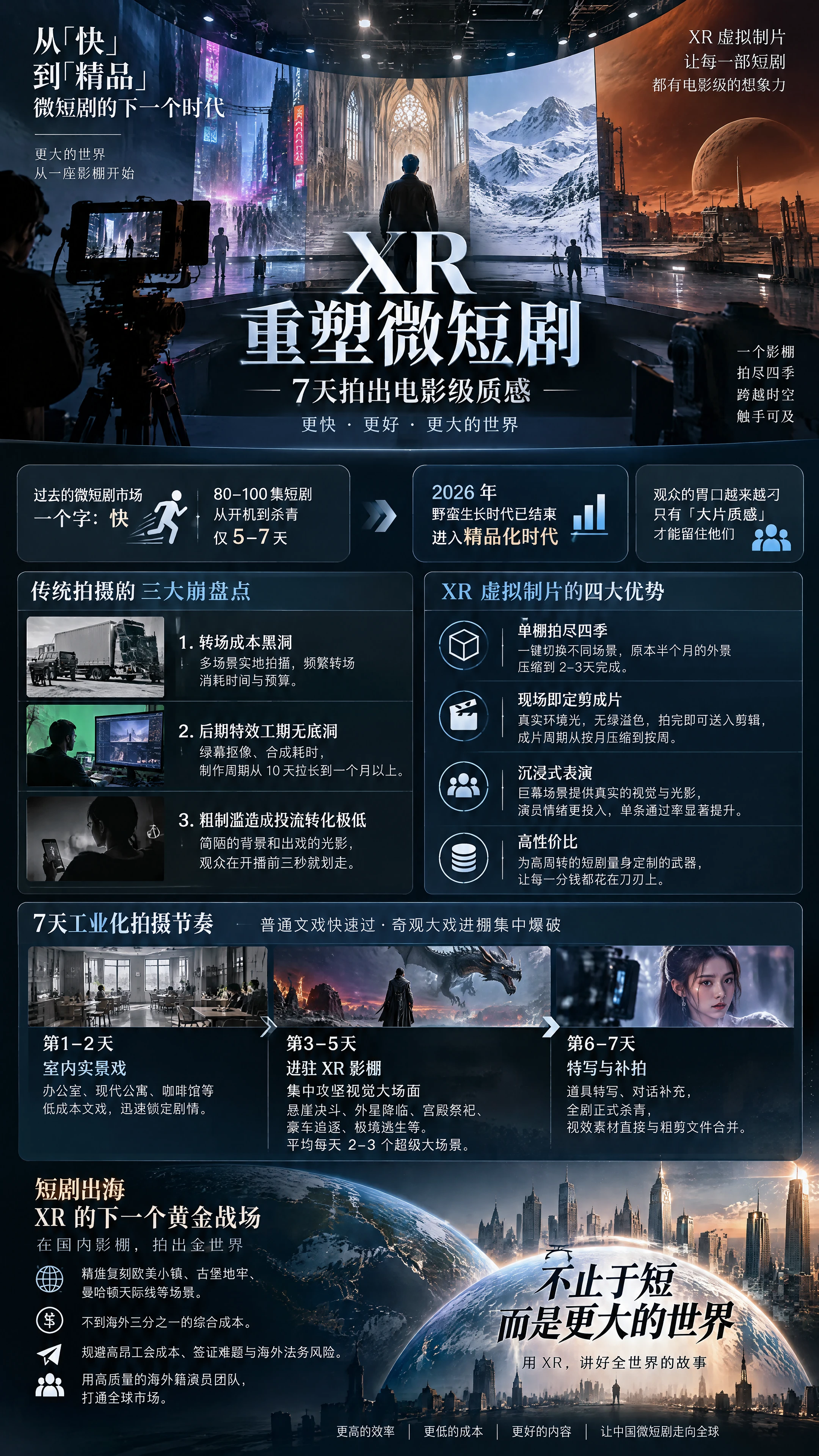
An 80-to-100-episode short drama typically goes from first day of shooting to wrap in just 5 to 7 days. To ensure high turnover and return on investment, short drama production in the past often followed a nearly ruthless set of cost-saving rules: modern romance was shot in ordinary office buildings and coffee shops, "war god" and CEO dramas borrowed unfinished suburban shell buildings or abandoned structures, and period palace intrigue could only squeeze into the cheapest leftover courtyards in film studio backlots.
However, entering 2026, the era of unchecked wild growth for micro-short dramas has come to a definitive end.
Domestic platforms“ traffic bias toward premium content, along with short dramas going overseas and achieving cultural penetration into European, American, and Southeast Asian markets, is forcing short dramas to deliver ”blockbuster-quality“ visuals. Sci-fi mecha, post-apocalyptic wasteland, medieval werewolves and vampires, Eastern fantasy cultivation... audiences” appetites are growing ever more demanding, and traditional "five-cent VFX" and crude sets earn nothing but viewers decisively swiping away in the first three seconds.
Short drama producers are trapped in a new dilemma: without visual upgrades, there's no completion rate; with visual upgrades, scene transitions and post-production VFX drag down the turnover cycle.
The key to breaking this deadlock is precisely XR virtual production, which is now rapidly becoming accessible at scale.
I. Under the Premiumization of Short Dramas, Three Major Breakdown Points for Traditional Production Crews
Why is the traditional film and television shooting model increasingly strained in the face of fast-paced short dramas? The core reason is that the time density of short dramas is inherently at odds with the industrial logic of traditional film and television.
First, the cost black hole of scene transitions and location rentals. For a short drama featuring modern urban settings, wealthy estates, and abandoned factories, if traditional on-location shooting is used, the crew must change locations at least twice a day. Every bump along the road for buses, prop vehicles, and actors' makeup and costumes consumes precious budget by the hour. For short drama crews shooting more than 14 hours a day, scene transitions are tantamount to directly cutting into shooting progress.
Second, post-production VFX becomes a bottomless pit for delivery deadlines. The lifeline of short dramas lies in “racing to launch and run ad traffic.” If traditional green screen is used for a fantasy lightning strike or sci-fi spaceship scene, the lengthy keying, compositing, and repeated fixing of goofs will stretch the production cycle from 10 days to over a month. By the time the VFX is finally done, the market's hot trend for that genre has long cooled.
Third, shoddy production leads to extremely low ad traffic conversion. In the second-by-second ad buying and traffic running model, the visual impact of a short drama's first three episodes directly determines the paid conversion rate. Crude backgrounds and distracting lighting and shadows cause viewers to drop off before they even reach the first dramatic twist.
II. How XR Stages Enable Short Dramas to Achieve a “Dimensional Strike”
Many short drama teams once mistakenly believed that XR stages were a luxury only affordable to theatrical blockbusters. But when they ran the numbers to the last page, everyone was surprised to find: XR virtual production is a weapon tailor-made for high-turnover short dramas.
- Shoot All Four Seasons in a Single Stage, Achieving Ultimate Time Compression
In an XR virtual stage, spatial and geographic barriers are completely erased. At 8 AM, the circular LED screen lights up as a rain-soaked cyberpunk neon street; at noon, the scene switches with one click to a classical medieval European cathedral, with natural daylight pouring down through stained glass; at 4 PM, the screen transforms into a snowstorm-swept frozen tundra, with the floor LED screen perfectly blending with real artificial snow in the foreground; at 8 PM, the scene changes again, and the protagonist stands in the command cabin of a deep, unknown Mars base.
The crew doesn't need to move a single camera outside, and cast members' makeup and costumes transition seamlessly within the stage. What originally required traveling across multiple cities and half a month of location shooting is compressed into just two to three days of high-density stage work.
- Completely Eliminate Green Spill, Final Cut on Set
Short dramas can't afford to wait for post-production. The core of XR virtual production is in-camera VFX. The real ambient light emitted by the surrounding LED screens maps directly onto actors' skin, clothing, and metal weapons—there's no harsh green spill, and no need for frame-by-frame keying and edge refinement in post.
What the director sees on the monitor is the final footage with realistic depth of field and physical perspective. Once a take is shot and confirmed, that footage can go straight into the rough cut that same night. The delivery cycle is compressed from months back to weeks, perfectly matching the lifeline of short drama ad traffic.
- Immersive Performance, Fully Liberating Short Drama Actors
Short drama performances demand intense emotional explosiveness and fast-paced dialogue. In front of a traditional green screen, actors often face nothing but an empty green cloth and a few tracking markers, making it hard to instantly enter emotions of grief, fear, or shock.
But inside an XR stage, a giant hundred-meter screen with realistically circling dragons, whistling meteor showers, and shifting light and shadow all around provides actors with a nearly immersive physical reality. Actors don't need to imagine everything against nothing—emotions come more directly and precisely, single-take pass rates improve significantly, and shooting delays caused by actors repeatedly breaking character are greatly reduced.
III. A 7-Day Industrial Production Rhythm for a Short Drama in an XR Stage
When a mature virtual production workflow is applied to short drama production, the 7-day shooting rhythm can be precisely structured as follows:
Day 1 to Day 2: Concentrated shooting of traditional interior practical scenes. Complete low-cost basic dialogue scenes in offices, modern apartments, coffee shops, etc., quickly warm up, and lock in most of the plot setup.
Day 3 to Day 5: Move into the XR virtual stage and focus on tackling major visual spectacle scenes. Within these 72 hours, complete all high-difficulty spectacle sequences. For example, cliffside duels, alien landings, palace rituals, luxury car chases, and extreme-environment escapes. On average, conquer 2 to 3 super-large scenes per day, producing the most eye-catching paid cliffhanger climaxes of the entire drama.
Day 6 to Day 7: Close-ups, detail pickups, and partial green screen inserts. Wrap up prop close-ups and dialogue supplements, officially wrap the entire drama, and merge on-set VFX assets directly with the rough cut files.
This approach of “quickly getting through ordinary dialogue scenes and concentrating spectacle scenes for blitz shooting in the stage” strictly holds the total budget red line while spending every cent where it matters most, giving the entire drama a theatrical-grade quality that far exceeds competing titles.
IV. Short Dramas Going Overseas: The Next Golden Battleground for XR Virtual Production
On the new gold-rush path of short dramas going overseas, XR virtual production's role even surpasses cost control itself, becoming a breakthrough tool for cultural localization.
Overseas users are more accustomed to the visual aesthetics of mainstream European and American film and television, and have a particular fondness for fantasy genres such as vampires, werewolves, apocalyptic zombies, and wasteland mecha. However, if domestic overseas teams fly to Europe or America for on-location shooting, they will face high union costs, visa difficulties, and uncontrollable overseas legal risks.
Through high-standard domestic XR virtual stages paired with high-quality foreign actor teams, domestic production companies can, within stages in the Yangtze River Delta or Greater Bay Area, precisely replicate authentic European and American small towns, castle dungeons, or Manhattan high-rise skylines at less than one-third the comprehensive cost of going overseas.
This industrial dimensional strike—low cost, high image quality, fast turnover—is becoming the core killer advantage for Chinese short drama overseas brands as they conquer foreign markets.
Conclusion: The Transformation Moment of a New Species of Film and Television
Micro-short dramas are by no means a downgrade of film and television art, but a new species of content born under extreme commercial efficiency.
When this species, which pursues turnover efficiency to the extreme, meets XR virtual production, which is moving toward lightweight setups, what collides is not only lower bills and faster speeds, but also a thorough liberation of film and television industrial productivity.
In this era where content competes for eyeballs by the second, whoever is first to bring theatrical-grade visual spectacle onto a 7-day industrial assembly line will stand invincible in the great reshuffle of micro-short drama premiumization.

 简体中文
 English