
In the world of cinematography, the moments that leave cinematographers feeling most powerless often happen in front of a green screen.
Facing four massive fluorescent green screens, the lighting technician racked his brains to set up countless soft light flags and high-power lighting positions, attempting to simulate out of thin air the light effects of “sunset piercing through treetops” or “cyberpunk rainy night neon.” But no matter how seasoned, the cinematographer knew full well: the actor's cheeks, hair strands, and even the leather jacket and metal buttons on their body in the frame were being mercilessly wrapped in green light bouncing from every direction.
Even more frustrating was the blind-box feeling. On the monitor there was only a monotonous expanse of green; the cinematographer could not fine-tune focus based on the composition of the distant background, could not confirm whether the horizon line cut across the actor's neck, and could only rely on the VFX supervisor's word over the walkie-talkie: “Don't worry, we can composite it all in post.”
And when this cinematographer first stepped into a top-tier LED virtual studio, that shock often did not come from technical jargon, but from the purest optical intuition: the light before his eyes was all real.
I. Farewell to Green Spill: The LED Screen Is the World's Most Luxurious Softbox
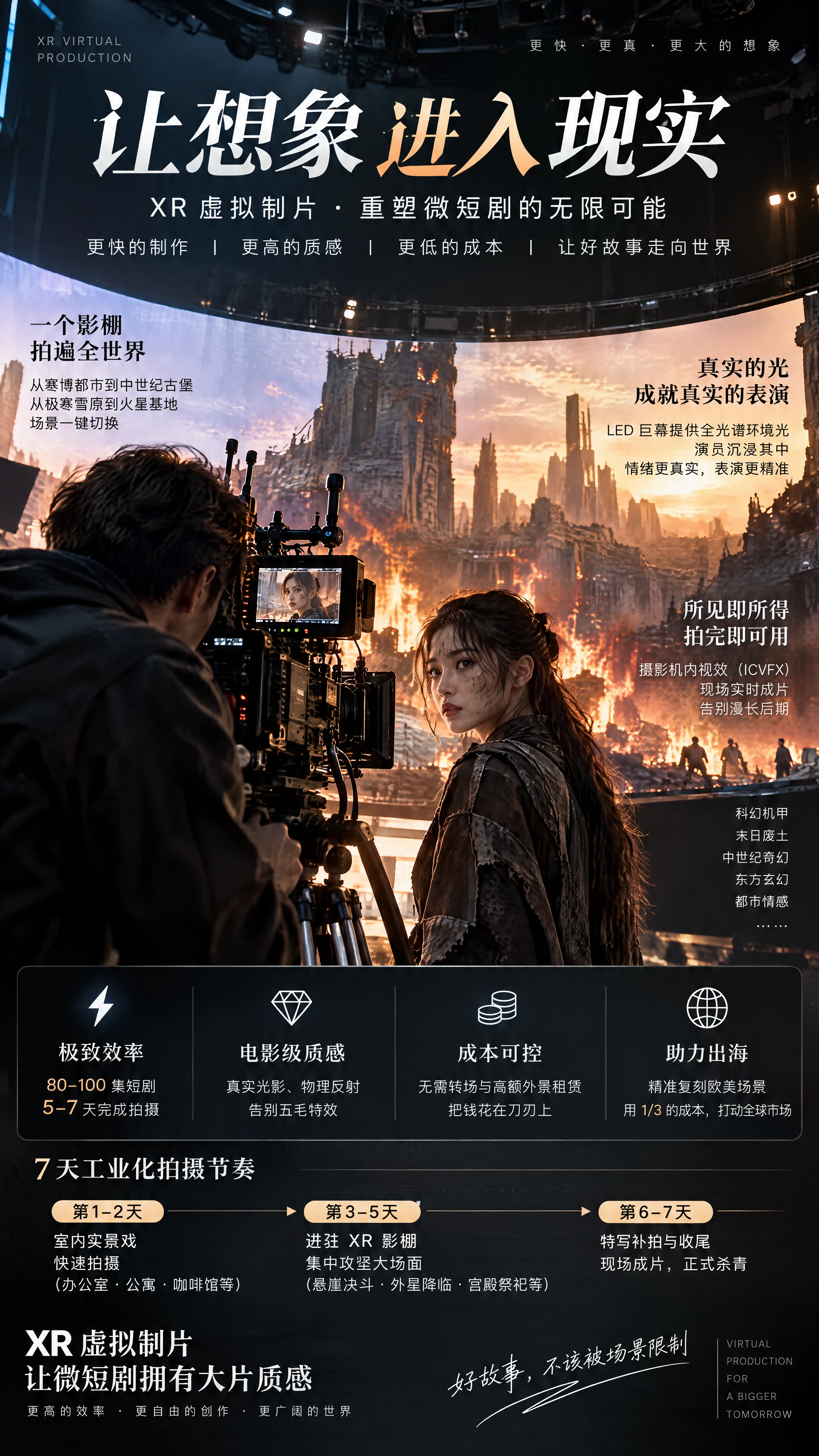
Many who have never worked with XR mistakenly assume that an LED wall is just a fancy background wallpaper. But in the eyes of cinematographers and lighting technicians, a circular LED screen is essentially an array of ultra-high-precision physical light emitters.
In traditional green screen shooting, to solve green spill, post-production teams had to deploy massive algorithms to erase green edges, which often damaged the semi-transparent details of actors' hair strands and even produced unnatural hard-cut edges around skin.
In an XR studio, however, this pain instantly drops to zero:
- True full-spectrum diffuse reflection. If the background is a raging sea of fire, the leaping orange-red warm light emitted by the screen will sweep directly across the actor's cheeks, shoulders, and floor props with millisecond-level dynamics; if the background is a gloomy Nordic snowfield, the cool blue diffused skylight will naturally envelop the entire performance area. This is by no means a texture achievable through post-production color grading, because the subsurface scattering of light on the tiny pores and fine hairs of human skin is a purely physical optical reaction.
- Redemption for Mirrors and Transparent Materials. In the past, shooting cars, space suit helmets, crystal goblets, or wet rainy-night asphalt roads was almost a death trap for green screens. These highly reflective materials would mirror large areas of glaring green screen. But in an LED studio, what reflects on a helmet visor is a vast galaxy, and what reflects in rainwater puddles are the flickering signs on both sides of the street. The specular refractions captured by the camera are perfectly established the moment the shutter is pressed.
II. Camera Spatial Tracking: Giving the Background Physically Accurate Parallax
Many cinematographers encountering virtual production for the first time ask a core question: since the background is a flat screen, why doesn't it look like a flat PowerPoint slide?
The answer lies in the precise synergy between the camera tracking system and the real-time rendering engine.
On the studio ceiling, dense infrared coded markers or optical tracking cameras are distributed; on top of the live-action cinema camera, high-precision spatial sensors are mounted. From the camera's three-axis coordinates and rotational tilt in 3D space, to the lens's current focal length, focus distance, and lens distortion parameters, everything is transmitted to Unreal Engine with millisecond-level low latency.
This gives rise to the most magical optical phenomenon in virtual production: parallax.
When the cinematographer moves the camera two meters to the left, the virtual foreground, mid-ground buildings, and distant mountains on the screen shift relative to each other strictly according to the laws of perspective: nearby pillars move quickly, distant snow mountains move extremely slowly. In the camera's viewfinder, the flat LED screen instantly possesses unfathomable depth.
More importantly is the use of inner frustum technology. The engine renders ultra-high-precision parallax perspective imagery in real time only within the specific area visible to the camera lens; on the vast screen outside the lens's field of view, a panoramic environment map is displayed, responsible for providing 360-degree environmental lighting for the entire shooting set.
III. On-Set Light Control and Virtual-Real Integration: The Lighting Technician's New Arsenal
XR virtual production has not put lighting technicians out of work; instead, it has given lighting teams unprecedented control. On a mature virtual production set, the lighting technician is no longer just hauling light stands, but has become a master dispatcher of virtual and real light and shadow.
First, seamless blending of virtual and real lighting. The LED screen provides ambient skylight and diffuse reflection, but to sculpt the three-dimensionality of an actor's facial bone structure or create strong hard-light contrast, physical film lights (such as spotlights and follow spots) are still needed on set. Excellent teams will fully bind the on-set DMX lighting console to the sun parameters of the virtual engine scene. When the engine operator lowers the virtual sun's elevation angle by 5 degrees on the computer, the corresponding physical spotlight's angle and color temperature on set will also be fine-tuned synchronously, achieving complete consistency between virtual and real light sources.
Second, boundary disappearance technique: the virtual-real junction between ground and background. The place where audiences are most likely to spot flaws in virtual production is the seam where the practical ground meets the LED screen. Experienced cinematographers and art teams have their own set of invisible rules: lay real soil, gravel, broken walls, or puddles identical to the virtual scene at the base of the LED wall; use subtle terrain undulations and foreground dead trees or ruins to conceal the seam; then combine focal length selection to lock focus firmly on the foreground actor, letting the seam naturally fall outside the depth of field. The virtual-real boundary blends completely into one within the frame.
IV. Three Practical Cognitive Hurdles Every Cinematographer Must Overcome
Although XR virtual production is full of allure, it places higher demands on the cinematographer's technical foundation. To achieve a pure cinematic texture, cinematographers must master three key pitfall-avoidance techniques:
- Beware the Ghost of Moiré. LED screens are composed of tiny light-emitting diode grids. When the camera's sensor pixel array and the screen's pixel grid produce geometric interference at specific focal lengths and distances, extremely ugly colored ripples appear in the image—namely, moiré. Seasoned cinematographers strictly follow anti-moiré rules: always keep focus on foreground actors or props, leaving the background screen slightly out of focus; rigorously calculate safe lens distances; or install custom optical low-pass filters at the front of the camera.
- Respect the Full-Pipeline Integration of Color Science. Why does the screen look normal to the eye, yet the actor's skin tone comes out grayish-purple when captured by the camera? Because the human eye's spectral perception and the cinema camera sensor's spectral response are fundamentally different. Professional virtual production must establish a full-pipeline color management system. From digital asset materials in the virtual engine, to the calibration curves loaded by the LED processor, to the color space inside the camera, everything must be brought under a unified standard. Only when color science is fully connected can you ensure highlights don't blow out, shadows don't crush, and actor skin tones remain translucent and natural.
- Abandon the Wishful Thinking of Post-Production Retouching; Embrace the Dignity of On-Set Finalization. In the green screen era, cinematographers were often stripped of the right to determine the final image; but in an XR studio, the cinematographer returns to the authoritative status of the traditional film era. Because what you see on the monitor is the final pixel—whether the focal length is right, whether the lighting ratio is appropriate, whether the composition has a sense of pressure—all are decided on the spot during shooting.
Conclusion: Technology Is Not a Betrayal of Film, but the Road Home to Audiovisual Freedom
From the natural light of location shoots in years past, to three-point lighting inside the studio; from heavy film magazines to the large-format sensors of digital cinema cameras. In the hundred years of film technology's journey, every innovation has expanded the boundaries of humanity's dream-making.
XR virtual production does not replace the artistic spirituality of cinematography with cold code; on the contrary, it thoroughly liberates cinematographers from the torment of harsh weather, the exhaustion of long location moves, and the bewilderment of facing a green screen.
The moment you press the record button, the sunset no longer falls, the storm stays for you, and light and shadow flow before the lens. This is the golden moment belonging to every creator, and the most moving evolution of cinematic audiovisual language in the digital age.

 简体中文
 English