
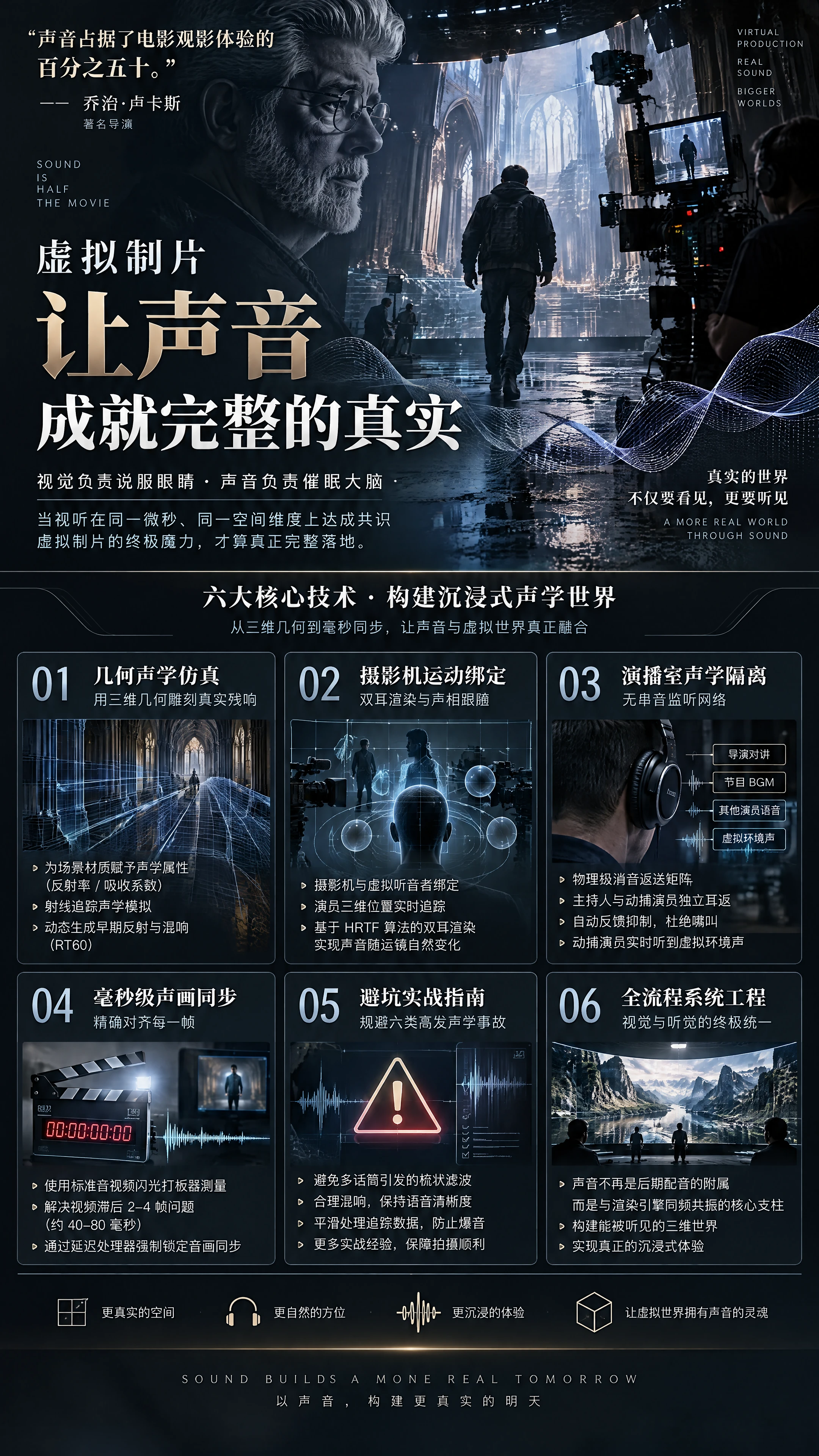
Renowned director George Lucas once pointed out: “Sound occupies fifty percent of the cinematic experience.” However, in the current virtual production boom, the vast majority of teams have their attention locked firmly on the visual dimension—top-tier graphics cards purchased, screen pixel pitch reduced to the minimum, color management calibrated to micron-level precision. Yet the moment the final cut plays, audiences still experience an indescribable sense of dissonance: on screen, an actor is walking through rain in an empty abandoned factory, but the sound that comes out is dry and lifeless, like a telephone voice recorded in an announcer's booth; as the actor walks toward the camera from a distance, the acoustic attenuation curve of the footsteps has no logical correlation with the spatial depth of field in the image. Vision is responsible for convincing the eyes; sound is responsible for hypnotizing the brain. If auditory information is not geometrically bound to the virtual three-dimensional space through acoustic integration, the so-called “immersion” is merely a half-finished product that cannot withstand scrutiny. This article will comprehensively unveil the ultimate secrets of virtual production audio engineering—from geometric acoustics simulation, tracking-driven dynamic panning, multi-channel crosstalk-free monitoring networks, to nanosecond-level audio-visual synchronization.
I. Audiovisual Disconnection: Three Major Flaws of Traditional Studio Audio in Virtual Environments
To reshape realism, one must first recognize the fatal disconnection of traditional linear audio workflows in the virtual world:
The first is “the schizophrenia of acoustic environment characteristics.” Physical studios, in order to ensure recording clarity, typically undergo heavy acoustic sound-absorbing treatment, with reverberation time (RT60) suppressed to an extremely dry state of under 0.2 seconds. When an actor stands in a European cathedral, underground bomb shelter, or glass-curtain-wall conference room rendered with UE5, their eyes see a physical sound wave reflection field lasting 2 to 4 seconds, while their ears hear dry audio with no reverberation whatsoever. This audiovisual perceptual dissonance (Cognitive Dissonance) instantly sounds an alarm bell of falsity in the audience's mind.
The second is “the complete decoupling of sound image positioning from camera perspective.” In traditional film and television shooting, boom microphones always follow the actor's movement, and the sound image is typically centered; but in virtual production, the camera's freedom of movement is completely unleashed. When the camera performs a 360-degree orbiting shot around two conversing actors, if the stereo positions of the left and right channels remain static, the audience's spatial orientation system will completely collapse—their eyes see the character move to the left side of the frame, yet their ears still hear his voice firmly welded to the right channel.
The third is “the absence of dynamic occlusion and air absorption effects.” In the real world, sound waves undergo diffraction and high-frequency absorption blocking when encountering walls, pillars, or vehicles; at different distances, air humidity also produces progressive attenuation of high frequencies above 4kHz. In virtual production, if only simple volume fader adjustments are made without dynamic filtering based on the physical occlusion of virtual 3D assets, the sound will appear insubstantial and lacking in texture.
II. Unreal Engine Physical Acoustic Simulation: Sculpting Realistic Reverberation with 3D Geometry
The fundamental approach to solving “acoustic environment schizophrenia” is to upgrade audio processing from static plugin patches to “dynamic acoustic computation driven by 3D scene geometry.”
- Acoustic Material Property Assignment When building virtual scenes in UE5, one must never assign only visual materials to models. • Physical damping and absorption coefficients: Through the Unreal Audio Engine or third-party acoustic simulation middleware, define physical acoustic materials for different surfaces in the scene. • Physical characteristic parameters: Marble and concrete are assigned high reflectivity of up to 0.95; wooden furniture and fabric sofas are assigned porous sound-absorbing characteristics that absorb mid-to-high frequencies; water surfaces and glass are assigned sharp early reflection characteristics.
- Ray-Tracing Acoustic Simulation Using the microphone listening point and the sound-emitting subject as origins in the scene, cast hundreds of virtual audio rays into the surrounding space in real time. • Calculate early reflections: Based on the distance and material of ray collisions with virtual walls, dynamically calculate the arrival time and azimuth of reflected sound waves within milliseconds; • Dynamically generate late reverberation: When an actor walks from a narrow corridor into an open hall, the spatial volume detected by rays instantly surges, and the engine's underlying layer automatically smoothly interpolates and adjusts the reverberation time (RT60) and frequency response curve—no manual fader adjustments by the recording engineer needed—achieving millisecond-level physical self-consistency between the sound's spatial texture and the visual camera movement.
III. Camera-Motion-Bound Binaural Auditory Rendering and Sound Image Tracking
In high-end productions pursuing ultimate experience, sound must not only have environmental presence but also possess dynamic spatial awareness absolutely locked to the camera lens.
- Spatial Coordinate Data Injection into the Audio Engine The tracking system must not only send the camera's six degrees of freedom coordinates to the rendering host, but also synchronously inject them into the audio workstation in parallel via the Open Sound Control (OSC) protocol over the network. • Listening perspective bound to lens: In the acoustic engine, precisely bind the “virtual listener” to the imaging origin of the camera sensor; • Sound source points bound to actor tracking: Have actors wear hidden ultra-wideband (UWB) miniature positioning tags, or track their head physical coordinates via optical motion capture, mapping real-time positions to 3D virtual sound source points.
- Head-Related Transfer Function (HRTF) and Binaural Rendering When the live-action camera performs large push-pull pan-tilt movements, lateral traversal, or orbiting rotation: • The system calculates in real time, via HRTF algorithms, the interaural time difference and intensity difference of sound reaching both ears based on the relative 3D vector difference between the actor's sound source point and the camera's listening point; • Whether the audience wears ordinary stereo headphones or is in a multi-channel cinema, they can clearly perceive sound naturally producing near-large-far-small, left-right traversal, and azimuth rotation in 3D space along with the camera movement trajectory.
IV. Studio Acoustic Anti-Crosstalk Isolation and Howl-Free Monitoring Network
Virtual production studios are often high-density acoustic-electrical convergence environments, where multiple microphones and on-site monitoring can easily trigger catastrophic acoustic feedback loops and high-frequency howling.
- Physical-Level Silencing Monitor Return Matrix In the studio, director scheduling commands, on-site live host audio, motion capture actor voices, virtual scene sound effects, and background music must follow a strictly isolated bus architecture: • Host's dedicated ear monitor: Mix in director intercom audio, program BGM, and motion capture actor voices, while forcibly stripping the host's own microphone signal; • Motion capture actor's dedicated ear monitor: Mix in director intercom audio, BGM, and on-site host voice, while forcibly stripping the motion capture actor's own microphone signal; • On-site speaker amplification management: In immersive performances pursuing presence, on-site speakers must absolutely never point directly along the actor's microphone pickup axis. Supercardioid headworn microphones must be used, combined with automatic acoustic feedback suppressors, to filter out potential howling frequencies with extremely narrow notch filters.
- Realistic Environmental Sound Return for Virtual Actors Many motion capture actors perform flatly inside green-screen soundproof booths because they cannot hear the acoustic feedback of their “surrounding environment.” • Advanced operation: Route the dynamic acoustic reverberation computed in real time by UE5 through a zero-latency DSP processor and return it in real time to the motion capture actor's in-ear headphones. When the performer hears their own voice “echoing in a valley” or “reverberating in a cathedral,” their vocal intensity, pacing, and rhythm will automatically make the most instinctive artistic adjustments in response to the acoustic space, multiplying the release of performance tension.
V. Millisecond-Level Audio-Visual Synchronization Phase-Lock System
In virtual production systems, audio signals travel through physical analog links at extremely fast processing speeds (typically only a few milliseconds), while video signals undergo capture, rendering, and compositing, incurring an inherent delay of several frames. Audio-visual desynchronization is the most insidious killer of final output quality.
- Industrial-Grade Audio-Visual Latency Measurement Method Never rely on the naked eye and ear to estimate latency! A standard audio-video flash clapperboard must be used: • Clap the clapperboard in front of the camera and microphone; at the moment of closure, the clapperboard simultaneously emits a high-frequency beep and lights up a high-brightness LED; • In the final composited recording project file, zoom in on the timeline and observe the onset point of the audio waveform transient jump, and the earliest frame in which the LED light illuminates in the video image; • Record the millisecond difference between the two.
- Hardware and Software Dual Delay Queue Alignment Typically, the video signal lags behind the audio signal by 2 to 4 frames (approximately 40 to 80 milliseconds). • Solution principle: Mount precise delay processors globally on the master output channel of the main control digital mixing console and all monitoring return buses; • Forced lock: Force-delay the audio signal by the corresponding number of milliseconds, ensuring that on the first frame the actor's lips close, the plosive waveform strikes exactly on the same vertical line of the timeline.
VI. Practical Pitfall Avoidance Checklist: Six Major High-Incidence Acoustic Accidents
- Actor's voice fluctuates in volume while walking, accompanied by hollow metallic phase sound • Root cause analysis: Multiple fixed boom microphones were used on site for pickup; when the actor walks into the overlapping coverage area of two microphones, the tiny microsecond time difference of sound waves reaching the two microphones triggers severe comb filtering cancellation. • Solution: In virtual production, resolutely prohibit multi-fixed-microphone pickup; all personnel must use high-quality bodypack wireless lavalier microphones or ultra-miniature headworn microphones to ensure the uniqueness and constant distance of a single person's pickup source.
- After adding reverberation to the virtual scene, the voice becomes muddy and blurred, making dialogue details unintelligible • Root cause analysis: The reverberator is fed the full frequency band signal, and low-frequency energy excessively lingers and bloats in the virtual space. • Solution: Before sending to the reverberation bus, apply a low-cut filter to the audio signal (cutting the muddy sound below 120Hz), and apply a slight dynamic boost to the speech intelligibility frequency band around 3kHz, so that the direct sound always remains solid and forward, with reverberation serving only as background ambiance.
- During large camera movements, severe clicking and popping sounds are heard in the headphones • Root cause analysis: The refresh rate of OSC tracking data packets received by the spatial audio engine is uneven, causing the spatial sound image interpolation algorithm to experience division-by-zero breaks or coordinate jumps. • Solution: Enable lightweight smoothing filtering on the incoming camera coordinates in the audio middleware, limit the maximum change threshold per millisecond, and smoothly erase network jitter spikes.
VII. Conclusion
Virtual production is by no means merely a technological revolution about visual deception—it is a systems engineering endeavor aimed at constructing a holographic perceptual world. A realistic 3D wall must not only reflect the correct photons before the lens, but also bounce back physically plausible reverberation when sound waves strike its surface; a virtual character with soul must not only have vivid micro-expressions, but also possess a sound field radiation that matches its physical space down to the finest detail.
Liberate sound from its subordinate status in post-production dubbing and elevate it to a core pillar resonating in sync with the rendering engine on the shooting set; let sound waves reverberate with genuine air texture within halls constructed of virtual geometry. Only when the eyes and ears reach seamless consensus in the same microsecond and the same spatial dimension can the ultimate magic of virtual production truly be fully realized.

 简体中文
 English