
Over the past three decades on China's film and television landscape, the rise of almost every film and television base has followed a highly similar “city-building myth.”
Enclosing thousands of mu of land and spending hundreds of millions or even billions of yuan, building brick by brick a one-to-one scale replica of the Forbidden City, a realistic Republican-era old street, or a scattered and well-arranged Tang-Song-style neighborhood. Under this runaway model, film and television bases are essentially a special kind of cultural real estate developer: on one hand, they rent physical shooting sets to various production crews and collect rental fees and supporting service charges; on the other hand, they rely on the halo effect brought by celebrity productions to sell sightseeing tickets to ordinary tourists, spawning a massive cultural tourism consumption market.
However, as time moves to today, this once reliably successful business flywheel is emitting a heavy grinding sound.
Fluctuating production start rates, tightening investment in period dramas and historical dramas, severe homogenization of exterior sets, and the irresistible weathering and renovation costs faced by antique building complexes spanning millions of square meters—many traditional film and television cities that once bustled with visitors are now sinking into the double quagmire of persistently high vacancy rates and maintenance losses.
Meanwhile, a completely opposite scene is quietly spreading across major industrial parks: in cultural core cities such as Beijing, Qingdao, Wuxi, Hengdian, Chengdu, and Shenzhen, high-standard LED virtual studios ranging from several hundred to over a thousand square meters in area, internally equipped with cutting-edge photonic chips and rendering servers, are lighting up one after another.
No more massive construction, no more digging lakes and building mountains. Film and television bases across the country are collectively making a U-turn with unprecedented urgency, turning to XR virtual production.
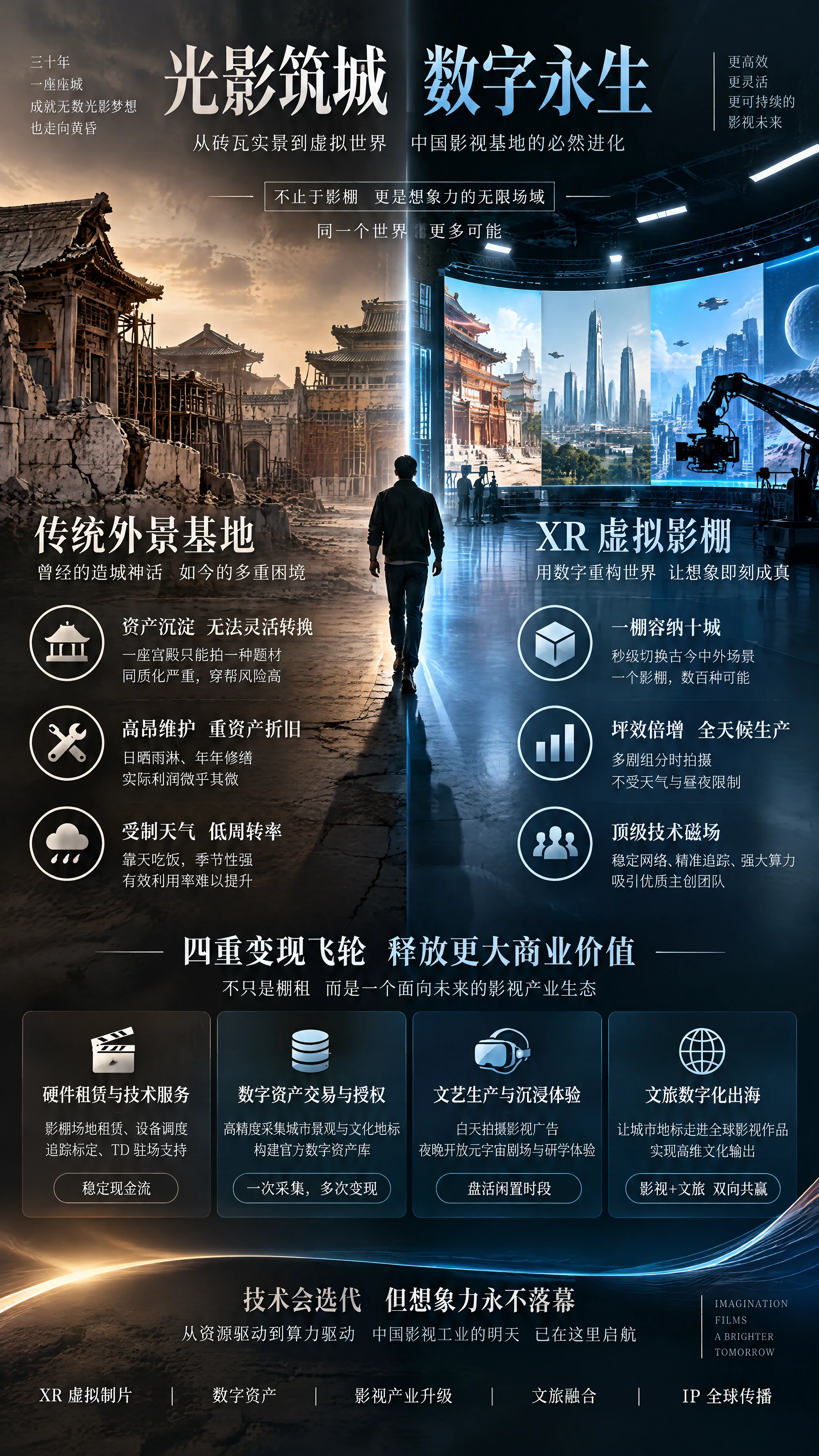
I. The Dusk of Traditional Exterior Bases: Three Irresolvable Structural Fatal Flaws
Why are physical exterior bases that once enjoyed boundless glory finding it increasingly difficult to make money? This is not because practitioners are not working hard enough, but because the old business model has hit physical limits.
First, the physical exclusivity of asset sedimentation. When a traditional film and television base builds a Tang Dynasty palace, it can only take on Tang Dynasty-themed productions for the next decade. Once the market trend in recent years shifts to science fiction, suspense, micro-dramas, or modern suspense urban dramas, this costly physical palace becomes a cold, immovable sculpture. Even more awkward is the set-recognition effect: because the same palace has been filmed too many times, audiences recognize “this is the same pillar from Hengdian” as soon as the show starts, severely damaging production quality.
Second, high and irreversible depreciation of heavy assets. Wood rots, plaster cracks, paint peels. Under year-round sun and rain, the annual waterproofing, fireproofing, and renovation maintenance costs of open-air antique building complexes are astronomical. Many bases appear to have good revenue on the surface, but after deducting enormous property depreciation and security inspection expenses, actual profits are negligible.
Third, low turnover rates constrained by weather and geography. Exterior locations are still essentially “dependent on the heavens.” Rainy and humid conditions in the south frequently force productions to halt passively, while severe cold in the north makes filming impossible for half the year. This seasonal and climatic instability makes it extremely difficult for traditional studios to break through the upper limit of effective utilization rates.
II. The Dawn of New Digital Bases: From “Tile Rental Merchants” to “Computing Power Operators”
The core reason LED virtual studios have become the strategic lever for base transformation across the country is that they completely shatter the lock-in of physical space, restructuring film and television bases from a “real estate economy” into a “digital asset and computing power economy.”
- One Studio, Ten Film Cities
Inside a high-spec LED virtual studio, the definition of space is completely rewritten. In the morning, it is at the foot of the Heavenly Pivot in flourishing Tang Dynasty Luoyang; at noon, it switches to a misty rain-painted boat in Jiangnan during the Ming and Qing dynasties; in the afternoon, it transforms into a cyberpunk-style near-future underground city; at night, it becomes a desolate, vast alien wasteland. Film and television bases no longer need to enclose dozens of mu of land for construction to cater to a single genre. A standard 2,000-square-meter soundstage paired with a highly modular digital asset library is sufficient to support the filming needs of hundreds of productions spanning ancient and modern, Chinese and foreign themes within a single year.
- Geometric Explosion of Space Efficiency and Turnover Rate
For park managers, space efficiency is the core metric for measuring commercial value. A traditional practical-set base's 200-mu exterior street district can typically only accommodate one large production crew per day for exclusive filming; whereas a modern virtual studio equipped with a main screen, side screens, and a vehicle-mounted turntable, relying on second-level loading of scene assets, can be divided by time slots within a single day among a car commercial, the climax scenes of two micro-dramas, and an evening commercial product launch. Studio utilization is pushed to near its limit, free from any interference from day or night, blizzards, or plum rain season, achieving truly all-weather industrialized continuous production.
- Generational Shift in Production Crew Stickiness
In the past, the logic by which production crews chose a base was “where sets are cheaper, where there are more extras”; today, the core demands of top-tier production crews when choosing a base are becoming “who can provide the most stable network bandwidth, the most precise optical tracking calibration, and the highest computing power real-time rendering cluster.” Parks possessing top-tier virtual studios are forming a new technological magnetic field, firmly attracting high-budget, quality-seeking elite creative teams around themselves.
III. Business Model Reshaping: Breaking Out of Single Studio Rental with a “Four-Fold Monetization Flywheel”
Many places, when building virtual studios, often fall into a cognitive trap: assuming that once a studio is built, the only way to recoup investment is by charging production crews daily studio rental. This traditional sub-landlord mentality greatly limits the commercial potential of virtual production.
In the eyes of mature digital base operators, an XR virtual studio is a comprehensive engine with four-fold monetization logic:
First revenue stream: Hardware rental and technical services as the foundation. Basic studio space rental, LED processor scheduling, tracking calibration services, and on-site technical director (TD) support. This constitutes the park's stable and predictable base cash flow.
Second revenue stream: Localized digital asset trading and licensing. Bases can collaborate with local cultural tourism departments, using drone oblique photography, LiDAR scanning, and 3D Gaussian splatting technology to conduct high-fidelity digital capture of locally unique natural landscapes, historical sites, and distinctive architecture, building a copyright-protected official digital asset library. Out-of-town production crews arriving at the studio only need to pay an asset usage fee to “transport” a precipitous grand canyon five hundred kilometers away into the studio and start filming directly. This digital asset library can be reused infinitely and sold across platforms, with marginal costs approaching zero.
Third revenue stream: Arts production by day, immersive experience by night. The greatest commercial charm of virtual studios lies in their cross-boundary extensibility. Monday through Friday, the studio can be fully enclosed for commercial advertising, film and television drama, and micro-drama shooting; on weekends or specific holidays, the studio can transform into a “metaverse immersive theater” or large-scale naked-eye 3D educational experience space for mass consumers. Tourists don lightweight devices and can experience thrilling interactions shuttling through Tang Dynasty Chang'an or interstellar adventures in front of the giant screen, thoroughly revitalizing the studio's idle time slots.
Fourth revenue stream: Digital “going global” of regional cultural tourism and reverse investment attraction. Previously, to promote a city's natural scenery, the cultural tourism bureau had to spend heavily on promotional events in various locations; now, simply by producing the city's iconic landscapes as standard Unreal Engine assets, production crews from across the country and even around the world can naturally incorporate the city's landmarks into popular films and TV dramas when filming in the studio, achieving high-dimensional cultural export of regional cultural tourism resources.
IV. Calm Reflection: Guarding Against a New Round of “Hardware Stacking Great Leap Forward”
However, amid this vigorous wave of transformation, a measure of rational clarity must still be maintained.
Some places, lacking technical reserves and operational capabilities, blindly launch massive LED screens and buy the most expensive servers, only to find that “once powered on, they don't know who to get to film,” ultimately becoming flashy vanity projects for political achievement.
Three brutal objective laws must be clearly recognized:
First, the screen itself does not constitute a barrier; operational processes are the core. Hardware is continuously dropping in price and iterating—the top-tier screen bought today may become standard configuration in three years. The true moat of a film and television base is whether there is a composite service team on site that understands audiovisual language and is proficient in engines, and whether there is an efficient filming process tempered through actual combat.
Second, there must be deep integration with the local industrial ecosystem. If a park has neither mature film and television production crew resources nearby nor thriving commercial advertising and short drama production capacity, a lone large studio will struggle to survive. Small, refined, high-turnover, modular small studios often have higher risk resistance than blindly pursuing super-giant studios of several thousand square meters.
Third, the depth of the digital asset library determines the park's lifeline. An empty studio is cold hardware, but a studio possessing thousands of ready-to-use, high-quality compliant scene assets is the production hub that production crews cannot bear to leave. Whoever is first to accumulate massive scene assets will thoroughly win in stock competition.
Conclusion: Building Cities with Light and Shadow, Digital Immortality
Looking back at a century of film history, from early Hollywood building wooden sets in open deserts to the concrete antique cities spread across the globe at the end of the twentieth century, humanity has paid incalculable material and labor costs to preserve fleeting dreams on screen.
Today, as physical bricks and stones gradually weather and erode with time, those high-precision digital assets transformed into code, polygons, and photons are gaining immortality in the glow of circular LED screens.
This great migration of film and television bases across the country is by no means a blind trend-following chase of concepts, but an inevitable evolution from traditional resource-driven to digital computing power-driven.
When someday in the future, we no longer need to move mountains and fill seas, undertake massive construction for a single production; when the myriad phenomena of the world exist entirely within the millisecond breath of each compact studio; only then will the modernized landscape of China's film and television industry truly welcome the dawn's first light.

 简体中文
 English