In a virtual studio worth tens of millions, every rendering server, every LED screen sending card, and every high-precision camera is essentially a fragile silicon-based precision instrument. However, on most film and television shooting sets, what people most easily overlook is the most primitive lifeline—the power supply and distribution system. We have seen far too many cases where a slight current surge caused the core of an RTX 4090 graphics card to break down, and far too many disasters where common-mode interference on the ground line caused SDI video streams to frequently flash black screens. A true virtual production studio's stability comes not only from the optimization of software algorithms, but also from an almost obsessive control over power quality. This article will take you beyond the misconception of “one power strip handles everything” and systematically build a professional-grade studio power and safety protection system.
I. Why Power Safety in Virtual Studios Is So Fragile
The core logic of ordinary office or household power supply system design is “ensure nothing blows up, ensure lighting, ensure appliances run.” But in a virtual production environment, the challenges we face go far beyond this:
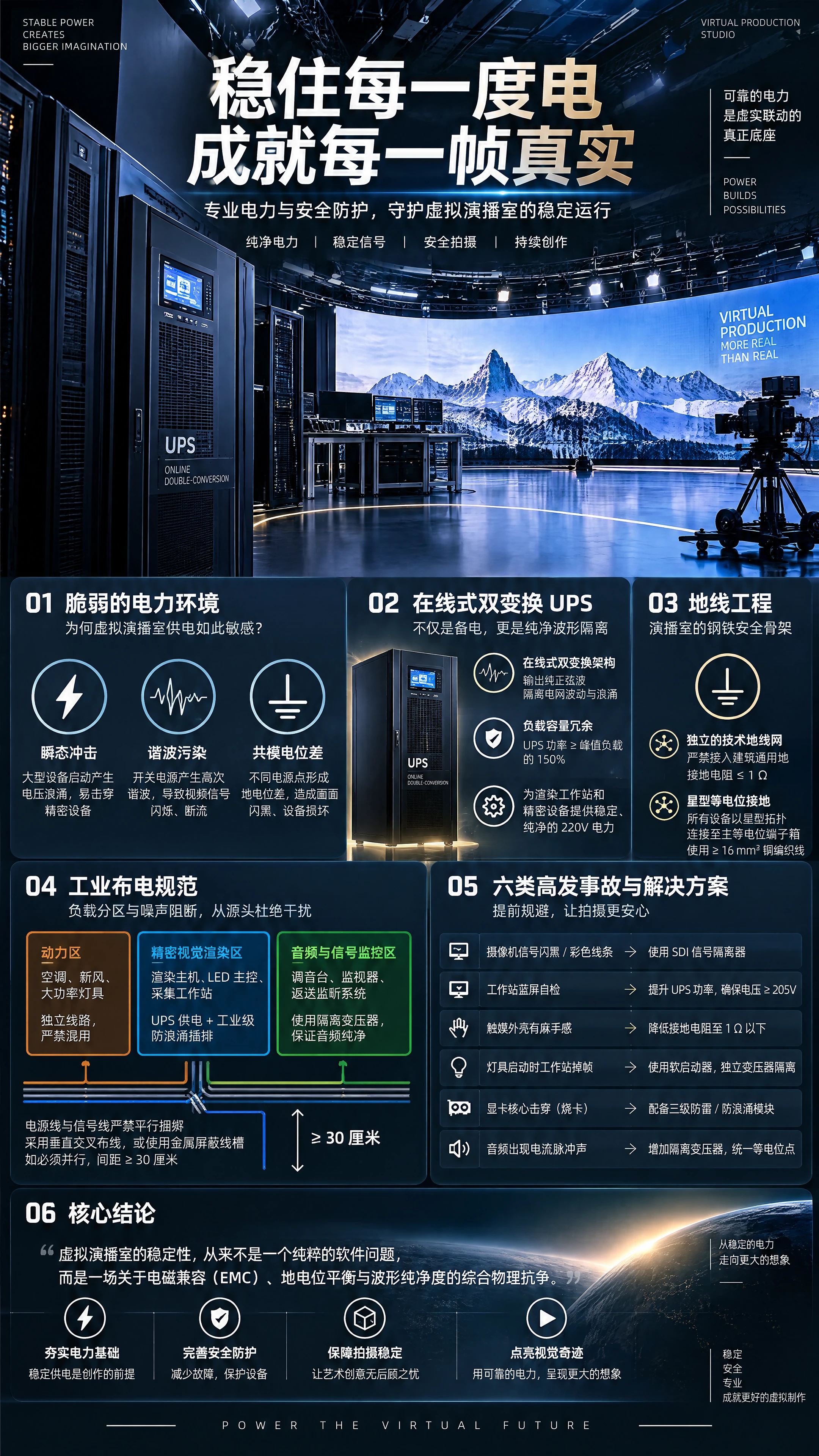
The first is transient impact sensitivity. High-power equipment such as large LED screens, cinema-grade spotlights, and air conditioning compressors inject enormous reverse peak voltage surges into the power grid at the moment of startup. If they directly share the same physical circuit with sensitive rendering workstations and precision recording equipment, such surges can easily break down the power supply unit (PSU) capacitors of precision equipment, causing graphics cards to mysteriously overheat, motherboards to crash, or even hardware to burn out.
The second is severe harmonic pollution. LED screen driver controllers and high-power switching mode power supplies (SMPS) generate large amounts of high-order harmonic currents during high-speed switching. These harmonics pollute the grid waveform, causing clock jitter in digital video processors, which in turn triggers SDI signal flickering or occasional interruptions in live streams.
The third is fatal common-mode potential difference. When cameras, video capture cards, rendering hosts, switchers, and other equipment are distributed across different wall outlet power points, a “ground potential difference” easily develops between them. When these devices are connected together via coaxial SDI cables or network cables, current attempts to find the lowest-impedance return path, and signal cables become the “drain pipe” for current, causing severe image flickering, electric shocks when touching grounded equipment, or even SDI interface burn-through.
II. Building the Defense Line: The Isolation Principle of Online Double-Conversion UPS
Do not simply understand UPS (Uninterruptible Power Supply) as a “power outage emergency battery.” In virtual production, the core value of a UPS is “pure waveform voltage stabilization” and “transient isolation.”
- Online double-conversion UPS must be used. Backup-type or line-interactive UPS are strictly prohibited—they have conversion delays of tens of milliseconds during mains fluctuations, and output waveform purity is far from sufficient. An “Online Double-Conversion” architecture must be selected. Its working logic is: mains power is first rectified to DC to charge the battery, then an internal inverter converts the DC into a standard pure sine wave with stabilized frequency and voltage for output to equipment. This process is equivalent to installing a “physical isolation fence” for the workstation—regardless of how the external mains voltage fluctuates or surges, the output end always maintains an absolutely pure 220V constant sine wave.
- Load capacity redundancy strategy. Rendering workstations and LED processors are high-precision and must have sufficient redundancy. The UPS output power should be at least 150% greater than the total peak load. If the studio's total power is 10kW, an online UPS system of at least 15kVA must be deployed to avoid output voltage collapse caused by long-term full-load operation.
III. Grounding Engineering: The Steel Safety Skeleton of the Studio
“The ”technical ground line" is the most core yet most commonly cut-corner hidden element in virtual studio engineering by construction contractors.
- Install an independent technical ground grid. It is strictly prohibited to connect studio equipment ground lines to the building's general lightning protection ground or power electrical ground! At the beginning of studio construction, a deep, independent copper pipe ground grid must be installed underground, with grounding resistance strictly controlled within 1 ohm. This is an independent acoustic and electrical isolation layer that can maximally direct all equipment casing static electricity and interference currents to the earth.
- Star-type equipotential grounding principle. All server racks, SDI matrix housings, and display screen metal frames must use copper braided wire of 16 square millimeters or larger to connect in a “star topology” to the studio's main equipotential bonding terminal box. Never use “series grounding”—series grounding causes the ground potential of far-end equipment to be higher than that of near-end equipment, forming current backflow, which is the culprit behind SDI signal black flashing and static interference.
IV. Industrial Power Distribution Standards: Load Zoning and Noise Blocking
Reasonable planning of studio power supply is an “anti-interference engineering” task that must be done well from the design stage.
- Physical power separation. Forcibly physically split the studio power supply circuits into three independent major zones: • Power zone: air conditioning compressors, fresh air systems, high-power spotlight arrays. These devices use independent air switch circuits and must never share main cables with precision equipment. • Precision visual rendering zone: rendering hosts, LED main control machines, capture workstations. Powered through UPS systems, equipped with independent industrial-grade surge-protection power strips, and the cable routing path should be kept away from the wiring conduits of air conditioning power lines. • Audio and signal monitoring zone: mixing consoles, monitors, return monitoring systems. Audio circuits should use isolation transformers for power supply, thoroughly filtering high-frequency interference from the grid to ensure clean noise floor in return monitoring.
- Electromagnetic shielding wiring rules. • Power cables and signal cables must never be bundled and routed in parallel! The magnetic field generated by power cables during transmission will induce into parallel-running SDI coaxial cables or network cables, causing data packet loss. • “Perpendicular crossing routing” must be adopted, or metal shielded conduits used for separate laying. If space is limited and parallel routing is necessary, the spacing must not be less than 30 centimeters.
V. Practical Pitfall-Avoidance Checklist: Six Types of High-Incidence Power/Grounding Accidents
- Camera signals frequently flash black or show colored lines. • Fault point: Ground potential mismatch between camera rig and machine room matrix. • Solution: Check the camera rig ground line connection, use an SDI Ground Isolator for optoelectronic physical isolation, and cut off the ground loop.
- Workstation memory frequently blue-screens with self-test errors. • Fault point: Severe power supply voltage fluctuation, insufficient UPS power causing voltage collapse. • Solution: Connect a multimeter to monitor supply voltage at peak load; if below 205V, it indicates a higher-power UPS is needed.
- Touching metal casing produces a tingling sensation (precursor to electrostatic breakdown). • Fault point: Ground grid resistance too high, static electricity cannot be effectively discharged. • Solution: Measure grounding resistance, ensure it is reduced below 1 ohm; install anti-static brushes or anti-static flooring for the rack.
- Workstation frame drops when large studio lighting fixtures start up. • Fault point: Instantaneous voltage drop in the grid caused by high-current inductive load startup. • Solution: Use “soft starters” to control high-power lighting fixtures, or physically isolate such lighting circuits through independent transformers.
- Graphics card core breakdown (card burning). • Fault point: Surge protector at the end of the power strip has failed. • Solution: Equip each precision workstation with a dedicated three-stage lightning/surge protection power adapter module.
- Regular current pulse sounds in audio monitoring. • Fault point: Ground loop interference with office network or air conditioning controller. • Solution: Add isolation transformers to the audio chain, and unify the audio ground line and low-voltage signal ground line at the same equipotential point.
VI. Summary
The stability of a virtual studio has never been a purely software problem, but a comprehensive physical struggle involving electromagnetic compatibility (EMC), ground potential balance, and waveform purity.
Behind a virtual scene worth tens of millions is a rock-solid power distribution blueprint, a copper bar extending deep into the earth, and an online double-conversion UPS operating silently. While others worry about whether to overclock or undervolt their graphics cards, smart engineering managers have long since kept the most fundamental “electricity” in perfect order. Because they know: only by solidifying the most foundational power energy safety can the visual miracle of virtual-real integration bloom stably on screen.

 简体中文
 English