
In the annual industry research report of a certain film and television university, a piece of data appeared that made the school administration break out in a cold sweat:
Although schools invest millions annually in purchasing top-tier film cameras, outfitting full sets of classical film lighting equipment, and hiring seasoned industry cinematographers to teach on campus, the employment rate of graduates in related fields is declining year by year. Meanwhile, many digital media art students who have never even touched a film camera lens—yet are proficient in Unreal Engine, can write shader code, and understand Python script automation—are being snapped up at high salaries by China's top virtual production studios and VFX companies upon graduation.
This is a painfully striking microcosm of our times.
As Hollywood and top domestic production crews are shutting down green screen stages in bulk and fully pivoting to LED virtual production, our proud traditional film education system seems to remain stuck in the old era of “teaching students how to haul the heaviest light stands.”
The fundamental character of film talent is undergoing an unprecedented restructuring.
I. The Underlying Technological Displacement: When “Physical Sensation” Becomes “Computational Logic”
The core logic of traditional film education is based on “physical simulation.” We teach students how to set up three-point lighting to simulate sunlight through a window; we teach students how to use complex filters and gel sheets to mimic the cool tones of early morning and the warm tones of dusk. The essence of all this is “empiricism”—relying on countless live shoots and countless failures to build an intuitive perception of light and shadow, composition, and focal length in the mind.
But XR virtual production has completely overturned all of this.
On a virtual production set, light and shadow are no longer simulated by “moving light stands,” but “computed” by the GPU's parallel processing power within the engine.
A traditional lighting technician who only knows how to set up lights—if they don't understand what HDRI (High Dynamic Range Imaging) is, what a linear workflow is, or what real-time ray tracing sampling is—will find themselves completely at a loss in front of that massive LED screen. Because what they face is no longer the physical feedback of optics, but strings of abstract data, layers, and parameters.
The pain point of film education is that we are still teaching students how to fumble in the dark, while the industry has already evolved to require them to construct worlds directly at the “photon level.”
II. What Should Film Schools Teach? From Tool Training to Logic Formation
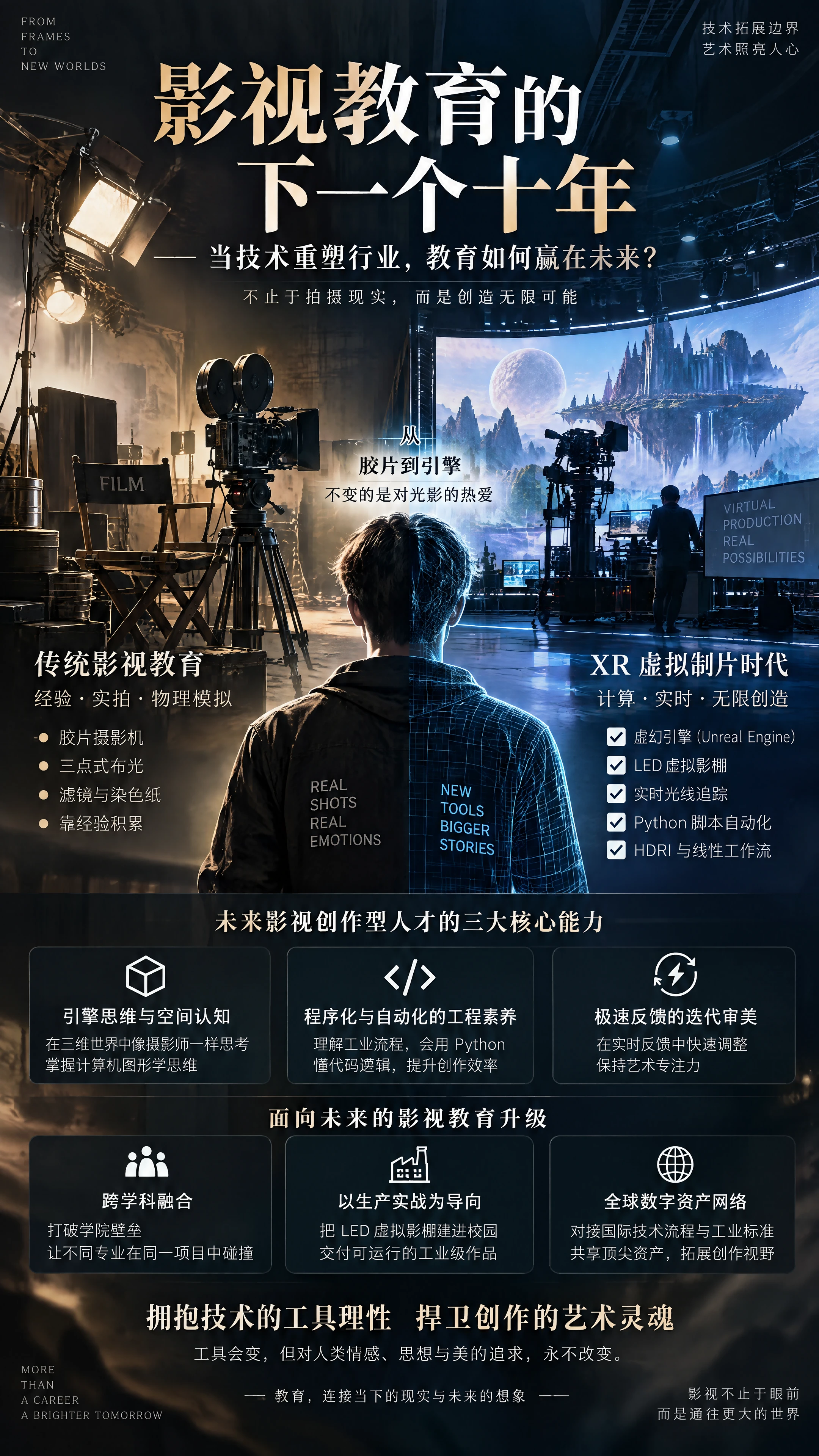
In the face of XR virtual production, film schools do not need to abandon traditional cinematography and directing arts, but they must thoroughly restructure students“ ”underlying cognitive architecture." Future film creative talent must possess a three-dimensional integrated capability:
First, engine thinking and spatial cognition. This is no longer simple software usage, but true “spatial logic.” In Unreal Engine, how a light source is occluded by virtual objects, how a shadow attenuates in a non-linear color space—this requires fundamental computer graphics thinking. Today's students must become accustomed to “thinking like a cinematographer” within a 3D modeling environment, setting up virtual frustums in software rather than merely sketching flat storyboards on paper.
Second, procedural and automated engineering literacy. In the past, film professionals only needed to handle “artistic creation”; today's technical directors must understand the “pipeline.” Why is the scene loading slowly? Because textures and materials haven't been optimized. Why is tracking jittering? Because network bandwidth is being squeezed. Knowing how to use Python scripts to automate asset management, understanding simple code logic to automate device integration—these areas once considered “computer science” in traditional film education have now become fundamental skills for every newcomer in film technology.
Third, rapid-feedback iterative aesthetics. Traditional cinematography education emphasizes “slow work produces fine results,” while XR education emphasizes “rapid iteration.” On a virtual set, errors must be perceived and corrected within seconds. Students need to train the ability to maintain artistic focus under real-time feedback loops—completely different from the old rhythm of waiting through lengthy film processing to know success or failure.
III. The Great Career Transformation Collision: Who Will Win in This Reshuffle?
When a paradigm shift occurs in film education, who will survive this storm, and who will be completely eliminated?
Those “old-school craftsmen” who can only memorize aperture and shutter speed combinations by rote but know nothing about digital color pipelines are losing their voice; conversely, those “hybrid newcomers” who possess solid artistic cultivation while also being curious about graphics technology and willing to humble themselves to learn the underlying logic are entering the golden period of their careers.
The dividend of this talent pool doesn't even belong exclusively to film schools.
In fact, those “outsiders” from game engines, computer graphics, or even interactive media design are crossing over into the core territory of film. What they bring is not just engine technology, but an extremely high industrial iteration efficiency and a “systems operations mindset.”
As the film industry is forced to absorb this group of “outsiders,” the sense of crisis in traditional film education has finally reached its peak.
IV. Building a New Talent Development Model: No Longer “Master-Apprentice”
The traditional “master-apprentice system” has completely failed in the XR industry, where technology updates on a monthly basis. Because the masters themselves are fumbling in anxiety.
Truly visionary film education institutions must complete three key upgrades:
First, powerful interdisciplinary integration. Tear down the physical walls between the VFX school, the cinematography school, and the animation school. Let cinematography students play with engines, and let programming students delve into cinematic language. Let these people with different DNA collide within the same virtual project.
Second, an experimental factory oriented toward “production实战.” Reject laboratories that build behind closed doors—build LED virtual production stages directly into teaching buildings. Every assignment students complete during their studies must be an “industrial-grade sample” that can run through the full pipeline and contain complete digital assets. The purpose of education is no longer to write papers, but to deliver a runnable Unreal Engine project.
Third, build a global digital asset exchange network. Technology can be rapidly popularized, but aesthetics cannot be rushed. Establishing a teaching network capable of accessing the world's top virtual production technical pipelines, sharing the latest rendering assets, and connecting to global film industry standards—that is the confidence schools need to survive in this era.
Conclusion: Embrace the Instrumental Rationality of Technology, Defend the Artistic Soul of Creation
For newcomers navigating the film industry and young students passionate about cinema, there is no need to feel disheartened about film art because of the rise of XR virtual production, nor to worry about being replaced by AI or computing power.
The essence of film has always been a profound insight into human emotions, feelings, and thoughts. No matter how far technology evolves—whether from film to digital, or from live-action shooting to engine rendering—tools will always remain merely extended fingers of the creator.
The reform of film education is not about turning directors into programmers or cinematographers into rendering engineers; it is about ensuring that when we pick up that “digital magic wand,” we can not only precisely orchestrate complex technical components, but also preserve in our hearts the most devout faith in the art of light and shadow within that virtual world constructed of 0s and 1s.
When film schools finally begin teaching “logic and algorithms,” that is precisely the moment when film art transitions from single-dimensional recording to multi-dimensional universe creation.

 简体中文
 English