
Over the past three years, one of the most brutal capital traps in the film and television industry has been the blind rush to build various small and medium-sized LED virtual studios. Many investors bought into the grand narrative of “cost reduction and efficiency gains” and “disruptive Hollywood technology,” spending three to five million yuan on high-refresh-rate LED screens, RTX 4090 render clusters, and optical tracking systems. But after opening, reality hit them hard: major film crews found the studio dimensions awkward and were unwilling to move in, traditional advertising clients found the prices too high and turned to practical locations, and the empty studio devoured high rent, electricity bills, and equipment depreciation every day, ultimately becoming an expensive “industrial showroom.” Virtual production is an advanced productivity tool, but without a matching commercial monetization loop, it quickly degenerates into a black hole that devours cash flow. This article does not discuss vague future visions or pure spec sheets, but deeply examines the business strategies that small and medium virtual studios on the front lines are currently using to actually achieve profitability, systematically breaking down client profiles, tiered pricing mechanisms, and asset reuse models to help you win this survival battle of computing power and capital.
I. The Fatal Blind Spot After the Hype Fades: Why Most Small and Medium Studios Become Negative Assets?
Reviewing virtual studios that have fallen into operational trouble or even gone bankrupt or been transferred over the past two years, their business logic generally made three fatal mistakes:
The first is “size awkwardness caused by positioning mismatch.” Many studios are only a dozen or so meters long and wide with a ceiling height of less than five meters, yet they fantasize daily about taking on Hollywood or top-tier domestic theatrical blockbusters. Large film and television productions require scheduling for teams of dozens, operation of heavy telescoping crane arms, and a viewing distance of at least tens of meters to pull apart the depth of field within the inner frustum—small and medium studios simply cannot satisfy these physical space requirements. Meanwhile, for ordinary still-life flat photography priced at a few thousand yuan per day, the high startup electricity costs and technical team costs of a virtual studio deter clients, leaving these studios stuck in the awkward dead zone of being “too high-end for small jobs, too low-end for big ones.”
The second is “ignoring the invisible hidden operational costs.” The hardware expenditure of buying screens and host machines is only the tip of the iceberg. A 200-square-meter LED screen wall plus dozens of top-spec rendering workstations and on-site lighting arrays can reach peak power loads of tens of kilowatts or even over a hundred kilowatts, with a single day's industrial and commercial electricity bill reaching thousands of yuan. More fatal is the labor cost—to ensure normal operation, the studio must have engine operators, tracking engineers, virtual and practical lighting artists, and hardware maintenance engineers on standby. Even if not a single day of work is done in a month, tens of thousands of yuan in fixed salaries must be paid monthly.
The third is “single-point sales thinking, selling high-end computing power as a cheap bare-bones space.” The traditional studio business model is “collecting venue rent”—the client rents the space, shoots, and walks away. Many virtual studios have continued this thinking, renting out screens and space at a fixed daily price. However, pure venue rental lacking digital 3D asset reserves and front-to-back-end technical packaging capabilities has extremely thin commercial added value. Once clients encounter asset clipping or color mismatches, not only will they not feel they saved money, but they will pin all responsibility for post-production delays on the studio, leading to reputational collapse and zero repeat business.
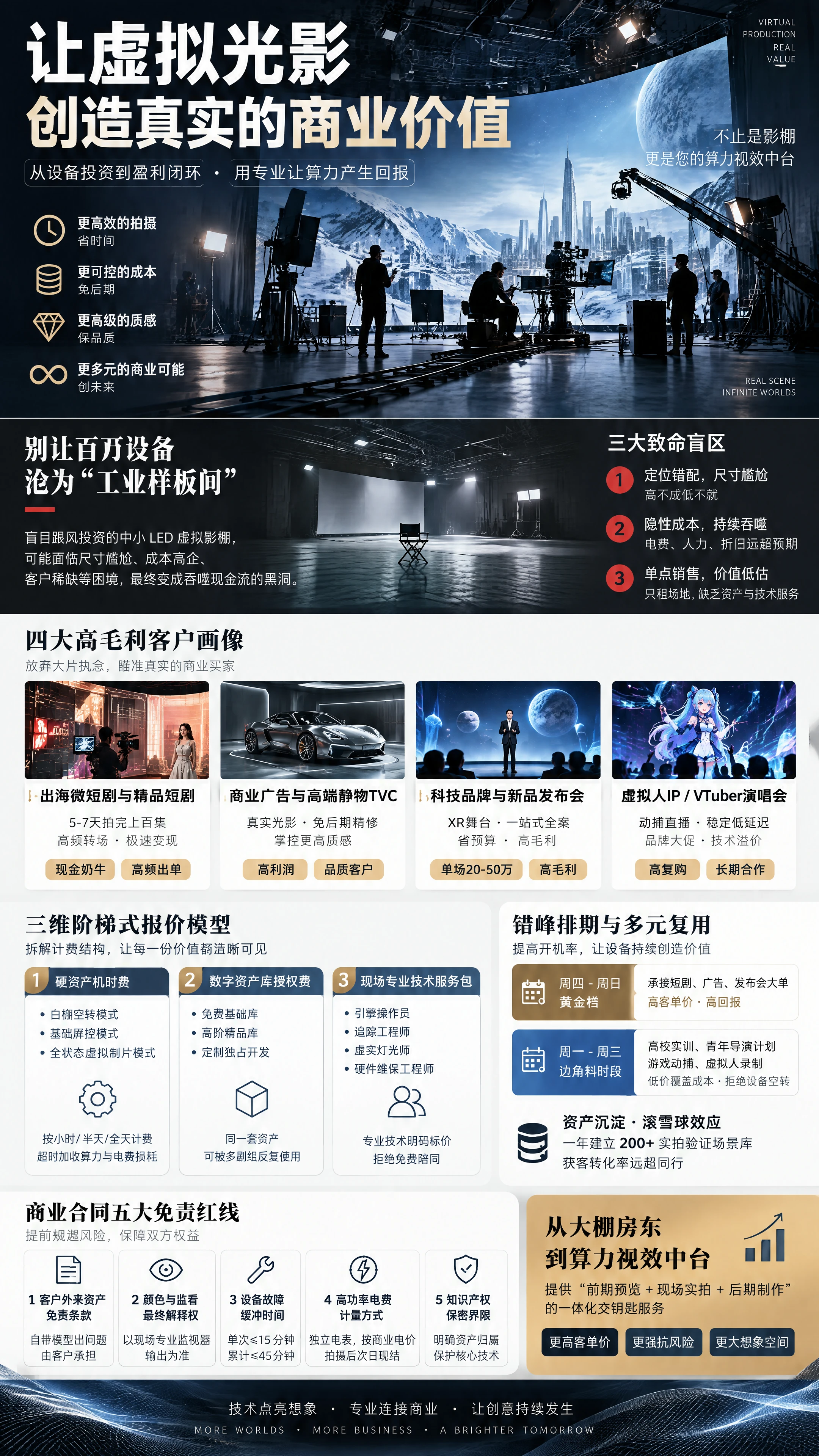
II. Who Is Actually Paying for Virtual Production? Four High-Margin Commercial Client Profiles
For small and medium virtual studios to survive, they must first abandon unrealistic “blockbuster obsessions” and turn to real commercial buyers with extremely short cycles, high frequency, and acute sensitivity to pain points. The four core client groups with the most abundant cash flow in the current market include:
- Overseas short dramas and fast-paced premium short dramas. This is currently the most stable and most aggressive order-generating “cash cow” for small and medium virtual studios. • Core pain points: Short dramas need to shoot hundreds of episodes within five to seven days, involving massive high-frequency scene changes such as European and American mansions, exotic castles, luxury airplane cabins, and nighttime car scenes. Chartering flights for on-location shooting or going abroad for filming is prohibitively expensive and visas cannot be arranged in time; traditional green screen compositing post-production takes up to a month, completely incompatible with the ultra-fast monetization rhythm of short dramas—“finish shooting next week, go online for testing and ad spending within half a month.” • Delivery strategy: The studio must pre-stock dozens of standard UE5 fine-tuned assets such as “overseas mansions, offices, private jets, dark dungeons.” After short drama crews enter the studio, there is no need for on-the-spot temporary production—they directly call up ready-made scenes, achieving “shoot the White House presidential suite in the morning, shoot the California coastal highway in the afternoon,” complete everything in five days under a full package deal, with a single project contributing over a hundred thousand yuan in pure gross profit.
- Commercial advertising and high-end still-life/automotive TVC. Traditional automotive commercials and high-end cosmetics TVCs fear two things most: uncontrollable weather causing crew downtime, and reflective materials under green screen requiring post-production reflection cleanup until breakdown. • Core pain points: Automotive paint surfaces and premium perfume glass bottles have extremely strong specular reflection characteristics. Shooting in an LED virtual studio, the light spots and flowing light reflected from the screen can create silky texture directly on the product surface, saving hundreds of thousands in post-production retouching costs. • Delivery strategy: What is sold to advertising clients is not “screen area” but “post-production-free and premium lighting determinism.” Quoted per shot or as a full-case package, the profit margin is far higher than traditional film and television.
- Tech brands and listed companies“ online new product launches. As global online launch events become mainstream, demand from major companies for ”XR stage space extension“ and ”executives in another dimension presenting 3D PPTs“ has surged. • Core pain points: Traditional offline events renting a 10,000-person stadium involve security approvals, travel and setup, and large screen rental, with a single event budget reaching millions; while all-green-screen launches appear extremely cheap and plastic. • Delivery strategy: Provide one-stop full-case launch services combining ”inner frustum live action + AR extension beyond stage edges," charging 200,000 to 500,000 yuan per event as a full package—saving clients two-thirds compared to offline events, while being an extremely high-margin lucrative category for the studio.
- Virtual human IP / VTuber concerts and major e-commerce promotions. Providing quarterly promotional livestreams or virtual idol commercial performances featuring real and virtual humans interacting on the same stage for top brands or MCN agencies. These clients value the studio's mature motion capture and low-latency streaming pipeline, and are willing to pay high technical service premiums for zero-failure on-site stability.
III. Farewell to One-Size-Fits-All: Three-Dimensional Tiered Pricing Model in Practice
Small and medium virtual studios must never adopt crude “how much per day” pricing—that not only scares away small-budget clients but also lets big projects take massive advantage. It must be broken down into a three-dimensional tiered model consisting of “pure venue machine-time fee + asset licensing fee + on-site technical engineering package”:
- Basic hard asset machine-time fee • White studio bare mode (space and basic power only): For senior teams bringing their own technical team and equipment, lowest charge, mainly to cover the rent baseline. • Basic screen control mode (LED screen + basic background streaming playback, no spatial tracking): For car scenes or flat background shooting, billed per half-day (4 hours) or full day (8 hours), including basic screen electricity. • Full-state virtual production mode (full screen wall + spatial tracking + top-tier render cluster + Genlock synchronization): Billed per strict hourly or daily package, with each overtime hour subject to standard surcharges for overtime computing power and electricity loss compensation, completely eliminating crews endlessly dragging sessions and slacking off.
- Digital asset library tiered licensing fee. Assets are the studio's most valuable moat and must be decoupled from venue billing: • Free basic library: Conventional modern office buildings, plain natural exteriors, given as package inclusions to attract clients in. • Premium boutique library (self-developed or commercially fine-tuned assets): Such as high-precision sci-fi spaceships, hyper-realistic rainy night car scene flowing light assets, charged per session as asset licensing fees. Clients need not pay hundreds of thousands in customization fees for scene production, while the studio achieves high-margin amortization of the same asset set purchased repeatedly by ten crews. • Custom exclusive development: For clients requiring exclusive assets, quoted separately based on technical artist person-day hours, with production for the client's exclusive use, but with the stipulation that shooting must be completed in that studio.
- On-site professional technical person-day service package. Never let technical personnel accompany for free! The contract must clearly price “machine room Brain Bar engineers,” “tracking calibration specialists,” and “on-site Unreal lighting artists” as independent service packages with explicit pricing. This is not only the realization of professional technical value but also an important economic constraint that prompts clients to assign knowledgeable producers to efficiently advance the on-site schedule.
IV. Computing Power Payback Formula and Scheduling Amortization Rules
Many studio owners only calculate income, not depreciation. A 3-million-yuan hardware system, calculated at a 3-year depreciation period for industrial equipment, has a pure hardware physical depreciation cost of 83,000 yuan per month even without a single job; plus monthly venue rent and personnel expenses, the monthly break-even baseline is often around 150,000 yuan.
How to raise the utilization rate from a dangerous 20% to a healthy 75% or above? The core lies in establishing “staggered scheduling” and “cross-industry reuse” mechanisms:
- Time-sharing reuse of golden hours and leftover hours • Thursday to Sunday (golden slots for film and advertising blockbusters): Take on high-ticket, schedule-strict short dramas, commercials, and launch event big orders, earning high full-package profits. • Monday to Wednesday (leftover idle slots): Cut prices in half, open to local university digital media programs as training bases, provide to young director support programs for shooting short film samples, or rent to game companies for recording character motion capture and virtual human short videos. Better to cover electricity and labor at low prices than let equipment sit idle and depreciate.
- Snowball effect of asset accumulation. Assets customized or modified by each crew in the studio, provided exclusive agreements are not violated, should be negotiated wherever possible to settle into the public library. After a year of operation, a mature commercial studio should own at least 200 plug-and-play scene libraries verified through actual shooting that absolutely will not drop frames or reveal errors. When new clients come for quotes, you can directly switch on the big screen within a dozen seconds to five completely different styles of highly realistic worlds for them to choose from—your client conversion rate will directly crush competitors who rebuild assets every time.
- Expanding downstream derivative revenue: from selling machine time to selling finished films. Relying purely on studio rental offers extremely low risk resistance. Mature teams often incubate their own lightweight production middle platform, extending downstream to provide turnkey integrated services of “pre-visualization + on-site live action + final editing and color grading.” For brands new to virtual production, what they fear most is buck-passing among multiple parties. This full-process contracting model can directly raise per-client budgets from tens of thousands in venue rent to hundreds of thousands in full-case production fees, increasing profit margins by more than three times.
V. Commercial Contract Practical Mine-Sweeping: Five Major Liability Exemption Red Lines That Must Be Written into Terms
Since virtual production is an emerging technology deeply interwoven with software and hardware, it is extremely prone to on-site contract disputes arising from materials, networks, or aesthetic differences. When signing commercial contracts, the following five major risks must be thoroughly locked down with legal terms:
- Client external asset exemption and damage waiver clause. If clients bring third-party 3D scene packages into the studio without studio technical review, the contract must clearly stipulate: “The studio bears no downtime losses or compensation liability for on-site frame drops, stuttering, or crashes caused by excessive polygon counts, unoptimized texture batching, or format compatibility issues in client-supplied 3D model assets, and any resulting machine-time delays shall be borne by the client.”
- Final interpretation rights for color and monitoring. Due to color gamut differences across terminal screens, a single legal monitoring reference must be specified in the contract: “The color reference for shot footage shall be based on the output of the on-site director's monitor calibrated with professional chromaticity. After the client signs to confirm on-site monitoring, any post-production objections based on color deviation of their own mobile display devices shall not constitute grounds for breach of contract.”
- Buffer repair time agreement for unexpected equipment failures. Film-grade equipment operates at high frequency, and no high-end server can guarantee 100% freedom from blue screens. The contract must include force majeure and technical buffer clauses: “During shooting, technical debugging time caused by sudden hardware thermal protection, instantaneous network disconnection, or system restart, not exceeding 15 minutes per occurrence and not exceeding 45 minutes cumulatively per day, falls within normal industrial maintenance windows. The studio need not pay penalty fees for this, and the corresponding time shall be made up by extension at wrap.”
- High-power electricity metering and settlement method. Due to the enormous power consumption of virtual production, if not stipulated in the contract, electricity bill differences of thousands of yuan at settlement can easily trigger disputes. It must be clearly agreed: “Basic venue rent includes only rated power electricity. High-power LED screen startup electricity shall be billed according to actual readings from independent meters, settled in cash the next day after shooting at commercial electricity rates.”
- Intellectual property and asset confidentiality boundaries. Clearly define which assets belong to the client and which underlying general assets (such as lighting presets, lens distortion configuration files, general natural environment plugins) belong to the studio's R&D asset library, preventing clients from forcibly demanding the studio's core engineering underlying plugin code after wrap under the pretext of full-case buyout.
VI. Summary
Virtual production is absolutely not a get-rich-quick myth where you just need money to buy equipment and then lie back earning profits. It is a modern precision industry that severely tests business insight, cost accounting, and composite technical service capabilities. Hardware configuration is only the entry threshold; the true moat is always using an efficient asset circulation system to amortize costs and using highly specialized industrial processes to hit clients“ rigid pain points of ”saving time, eliminating post-production, and ensuring texture."
Upgrade from a mere “studio landlord” to a “computing power visual effects middle platform” with a high-fidelity digital asset library and one-stop full-case delivery capabilities; calculate the marginal revenue of every kilowatt-hour and control the profit leverage of every asset reuse. Only by meshing the gears of the commercial closed loop tightly with real business logic can brilliant virtual light and shadow truly settle into a steady stream of real gold and silver.

 简体中文
 English