
In the film and television production industry, what producers fear most is not a high budget, but “uncontrollability.”
Traditional film and television shooting is essentially an extreme gamble in an environment full of “unknowns”: sudden changes in actor performance, uncooperative weather, slow lighting adjustments, transition delays caused by on-set scheduling... Every deviation in these factors is silently consuming the budget.
For producers, this is a “probability-based gamble,” while virtual production (XR Virtual Production) offers a “data-based actuarial calculation.”
If we view virtual production merely as “a more advanced screen,” we completely miss its core value. For savvy producers, its core value lies in: it transforms unpredictable “on-set costs” into calculable “pre-production R&D investment.”
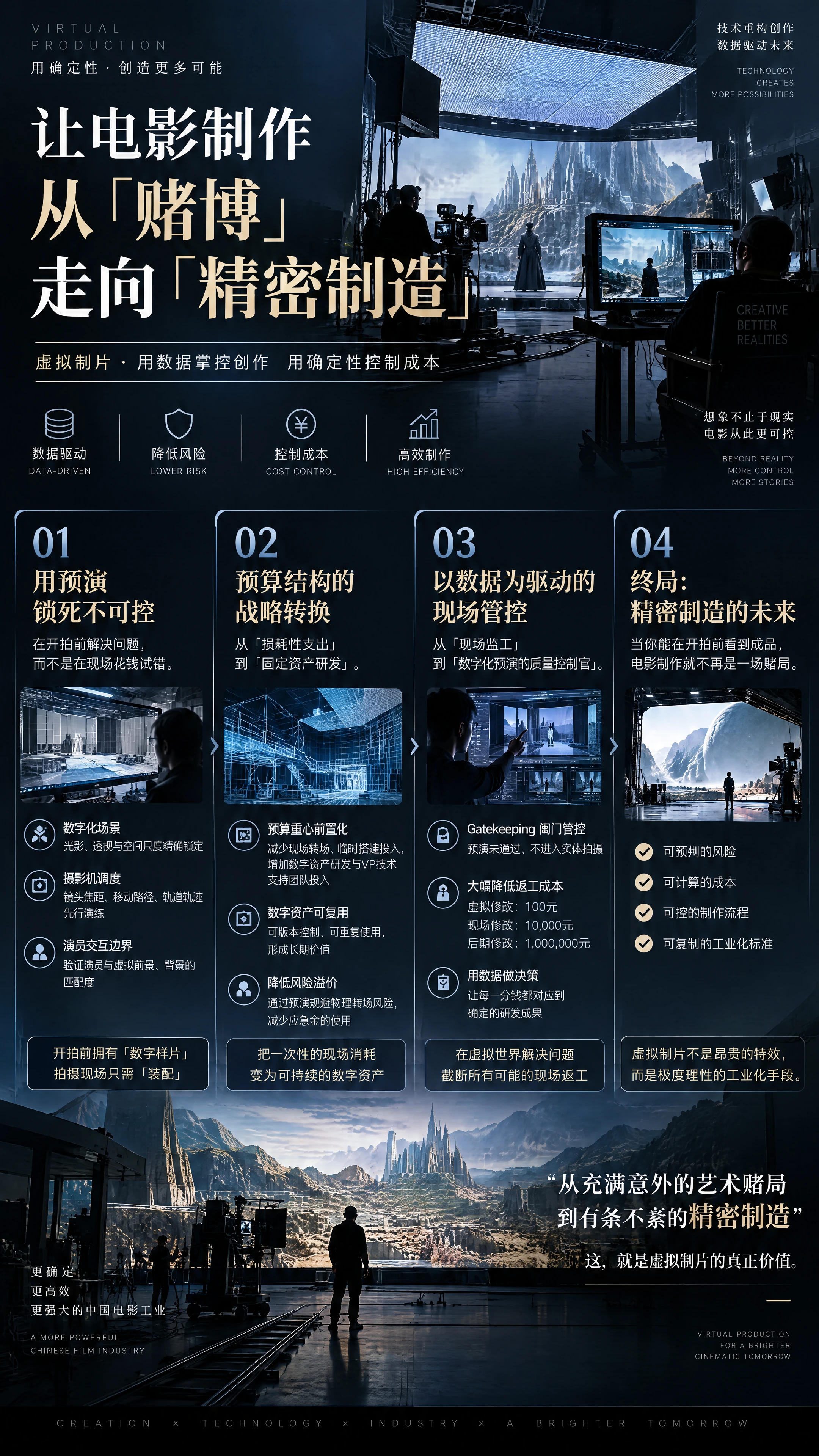
I. The Key to Breaking Through: Using “Previs” to Lock Down the Uncontrollable
In traditional workflows, the shooting set is where the most cost overruns occur, because we always try to solve problems on set: — The scene lighting is wrong, fix it on set; — The composition and perspective are off, the crew moves equipment and repositions; — The director's creative ideas change on the fly, the whole crew waits.
This “on-set R&D” model causes costs to grow exponentially, because at this point the entire crew is on the clock.
The “previs-driven” virtual production workflow requires us to immediately enter a fully digital, high-precision previs phase after project kickoff. Through the UE5 rendering engine, we already have a “digital rough cut” before shooting begins.
Producers need to lock down several key assets here:
- Digital scenes: Lighting, perspective, and spatial scale are precisely locked in three-dimensional space.
- Camera scheduling: The focal length, movement paths, and track trajectories of all shots are rehearsed in virtual space beforehand.
- Actor interaction boundaries: The alignment of actors' positions in space with virtual foreground and background elements is verified.
This means that when we enter the shooting stage with this “digital plan,” we no longer need to “feel things out” on set—we only need to “assemble.”
II. The Transformation of Budget Structure: From “Consumable Expenditure” to “Fixed Asset R&D”
Traditional production budgets are filled with countless “consumable expenditures”: expensive equipment rented to achieve good lighting, temporary sets repeatedly built to meet location requirements, and ineffective labor costs caused by poor scheduling. This money disappears once shooting wraps, leaving no trace.
In the virtual production pipeline, we have restructured the budget priorities:
First, front-loading budget priorities. We reduced investment in on-set transitions and temporary builds, and instead increased investment in “digital asset R&D” and “VP technical support teams.” These funds are no longer directed at fleeting on-set labor hours, but at digital scenes and lighting presets that can be version-controlled and reused.
Second, reducing the “risk premium.” Any professional investor knows that film budgets typically include a substantial “risk contingency fund.” Under the virtual production system, because we preemptively mitigate a large number of physical transition risks through previs, the probability of drawing on this contingency fund drops significantly. In other words, the project's risk premium is reduced.
III. The Producer's New Weapon: Data-Driven On-Set Control
Once the virtual production workflow is established, the producer's focus also shifts.
They are no longer merely supervisors monitoring on-set attendance, but have transformed into “quality control officers” of digital previs. Before shooting begins, the producer reviews the previs results: if the plan hasn't been validated in virtual space, it is not allowed to proceed to the physical shooting set.
This “Gatekeeping” mechanism is the core logic behind virtual production's cost reduction. The cost of modifying a scene in the virtual world is $100, the cost of modifying it on a physical shooting set is $10,000, and the cost of modifying it in post-production is $1,000,000.
Through previs, producers forcibly cut off all possible “on-set rework.”
IV. The Endgame: From “Gambling” to “Precision Manufacturing”
Virtual production is not a technology that pursues expensive visual effects—it is an extremely rational industrialized approach.
Its most profound insight for producers is: the future of film and television production does not depend on how many cameras we have on set, but on how much digital control we have over the entire production process before shooting begins.
When you can see the finished product before shooting begins, when you can predict all risks in digital space, when every dollar on the budget sheet corresponds to a confirmed R&D outcome, film and television production transforms from “an artistic gamble full of surprises” into “a methodical precision manufacturing process.”
This is the most valuable asset that virtual production brings to the industrialization of Chinese cinema.

 简体中文
 English