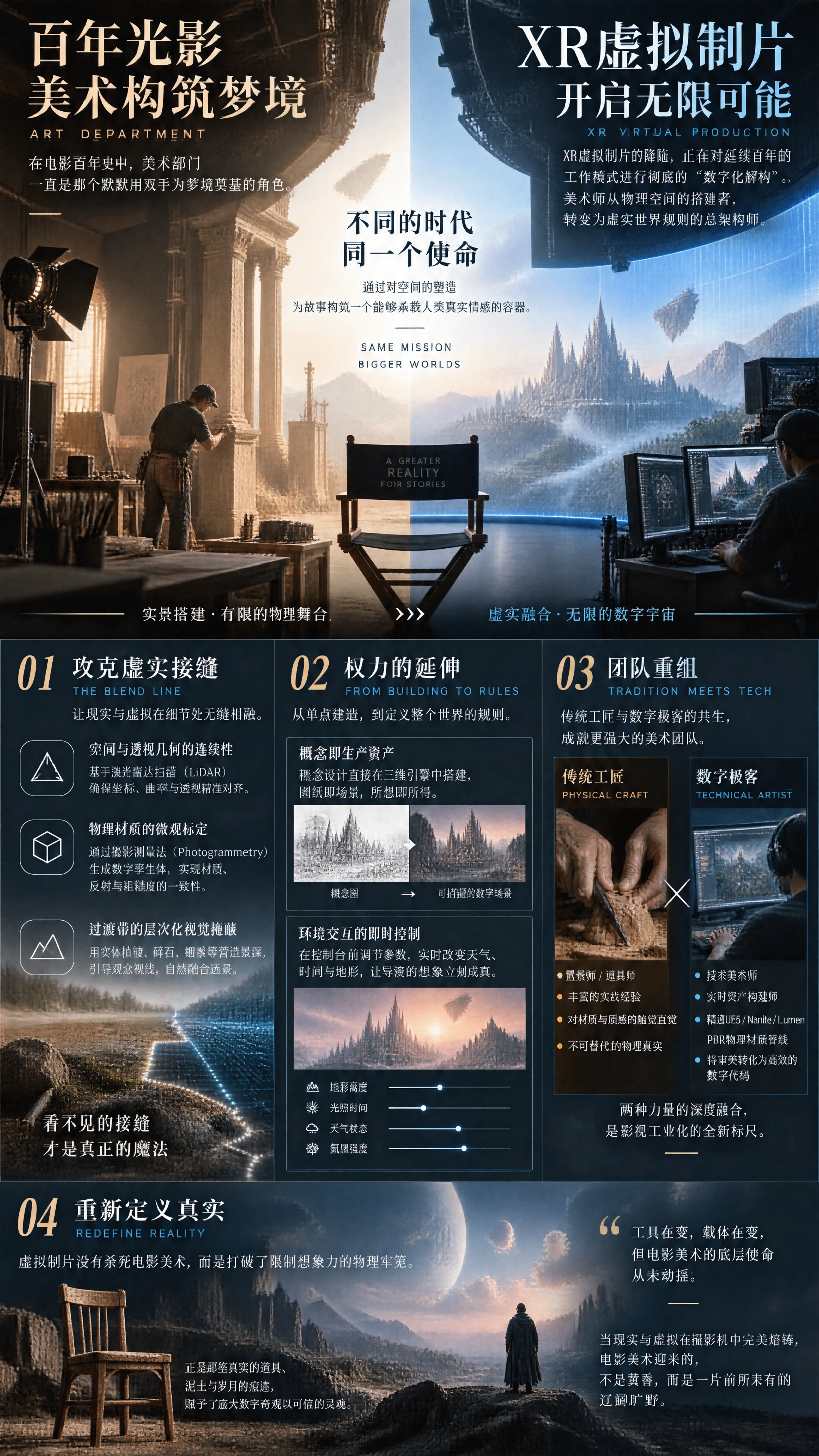
In the century-long history of cinema, the Art Department has always been the one quietly laying the foundation for dreams with its own hands.
From drawing concept art and finalizing color palettes, to quarrying stone and felling timber, plastering and distressing, and dressing props, the work of art directors carries a strong physical character and craftsman's spirit. Once the physical set is completed, the clapperboard snaps shut, and the camera's red light comes on, the traditional art department's job is largely done—the rest is handed over to the cinematography and lighting departments.
However, the arrival of XR virtual production (ICVFX) is carrying out a thorough “digital deconstruction” of this century-old working model.
Inside the virtual studio, the boundary between physical sets and digital backgrounds is infinitely compressed. Rather than being dissolved by the LED screen, the art director's role has expanded from a limited physical stage to an infinitely extending digital universe. Art directors are no longer merely “builders of physical spaces”—they are transforming into “chief architects of the rules governing the virtual and real worlds.”
I. The Core Battleground Shifts: Conquering the Fatal “Blend Line”
Anyone who has worked in a virtual production studio knows that the most critical point determining the success or failure of an entire shoot often focuses on the narrow zone where the ground meets the LED screen—an area the industry calls “The Blend Line.”
If the blend line is handled crudely, the audience will be pulled out of the illusion in a thousandth of a second: the sand and gravel of the physical floor cut off abruptly at the screen's edge, the digital terrain on screen disconnects from reality in color, reflectivity, and perspective angle, and the entire space instantly collapses into a flat sticker.
Eliminating this seam is the first severe test facing the virtual production art department, and it requires rigorous scientific logic:
- Continuity of Spatial and Perspective Geometry The slope of the physical floor and the height of the horizon must maintain millimeter-level symmetry with the frustum parameters of the 3D camera in Unreal Engine. When placing practical terrain on set, art directors must build according to the coordinate system returned by LiDAR scanning, ensuring that a tire track or a section of railway track, when crossing between the screen and the physical world, has its curvature and vanishing point fully conform to the laws of perspective.
- Micro-Calibration of Physical Materials A piece of wet granite in reality has its specular reflection and roughness changing in real time with the angle of illumination. If the corresponding digital model in the engine uses only generic texture presets, the difference in material quality between the virtual and real portions will be exposed the moment the camera moves or zooms. Modern film art departments must master digital scanning technology, using photogrammetry to convert real props collected on set into one-to-one digital twins, so that the micro-physical properties inside and outside the screen are perfectly aligned.
- Layered “Visual Masking” of the Transition Zone The best art design does not fight physical limits head-on but knows how to play with optical illusion. By using low physical shrubs, toppled broken walls, scattered rubble, or even Tyndall-effect haze released by a smoke machine, multiple interleaved layers of depth are created at the seam, guiding the camera's focus onto real objects rich in detail and allowing the background to blend naturally into the distance.
II. The Extension of Power: From “Single-Point Construction” to “Rule-Making”
In the traditional model, an art director's influence is strictly limited by physical gravity and construction budgets. You can build an exquisite Victorian living room on a soundstage, but the entire fog-shrouded city of London outside the window can only be handed over to a post-production VFX company months later to “fill in the blanks.”
In the virtual production pipeline, however, the world outside that window is equally defined entirely by the art director.
- Concept Design Directly Transformed into Production Assets In the past, concept art was often merely a “visual intention” for the post-production team, passing through layers of outsourcing, and the final film's fidelity often diverged from the original vision. Now, concept designers can build asset prototypes directly in a 3D engine, or even use high-quality digital model libraries directly for spatial lighting. The moment a concept image is produced, it is already the prototype of a digital scene ready for shooting.
- Instant Control over Environmental Interaction Inside the virtual production studio, the art director's authority is amplified. When the director says, “I want the distant mountains to be taller, to create a stronger sense of oppression,” or “Can the sunset on the skyline enter its afterglow state ten minutes earlier,” the art team no longer needs to wait for lengthy re-dressing or post-rendering—instead, they adjust parameters of digital assets at the control console and reconstruct the physical rules of the entire world within seconds.
III. Team Restructuring: The Symbiosis of Traditional Craftsmen and Digital Geeks
The broadening of the art department's boundaries inevitably comes with a profound reshuffling of the team's knowledge structure.
In the top film art teams of the future, a new hybrid talent structure is emerging:
On one side are experienced veteran craftsmen, set builders, and prop makers. They possess an unparalleled tactile intuition for the grain of wood, the corrosion of metal, and the drape of fabric—an experience distilled from the physical world that no algorithm can conjure out of thin air in a short time.
On the other side are Technical Artists and real-time asset builders. They are proficient in UE5's Nanite geometry architecture, Lumen lighting system, and PBR physical material pipeline, and are responsible for losslessly translating the aesthetic intuition of physical craftsmen into digital code that can render stably at 60 frames per second on GPU clusters.
The deep dialogue and integration between these two types of talent is becoming a new benchmark for measuring the industrialization level of a film and television production company.
IV. Redefining Reality: The Essence of Art Has Never Changed
In the face of rapidly iterating digital technology, some pessimistic voices in the industry once argued: when screens can present everything, traditional sets and art props will eventually be eliminated.
The truth is quite the opposite. In the practice of virtual production, the deeper the industry explores, the more it discovers the irreplaceability of physical reality. It is precisely the solid wood chair in the foreground with its years of wear and tear, and that handful of soil with real moisture, that give the vast digital spectacle behind them a credible soul.
Virtual production has not killed film art—it has merely broken the physical cage that limited the art director's imagination.
From physical sand and soil to digital nebulae, from sculpting clay to adjusting algorithm parameters, the tools are changing and the medium is changing, but the underlying mission of film art has never wavered—that is, through the shaping of space, to build a vessel for the story that can carry genuine human emotion.
When reality and the virtual are perfectly fused into a single beam of light within the camera, what film art welcomes is not dusk, but an unprecedentedly vast wilderness.

 简体中文
 English