
Film is the art of light.
On traditional film sets, the Gaffer is the mastermind behind the magic of light and shadow. Using tungsten lamps, HMI lights, LED spotlights, and massive diffusion cloths, they recreate sunrise, noon, dusk, and storms inside a dark soundstage.
In the early days of XR virtual production (ICVFX), a radical argument emerged: since the entire soundstage is wrapped in hundreds of square meters of ultra-high-definition LED screens, and the screen itself is essentially a giant soft light box, does that mean traditional physical lighting fixtures can exit the stage of history?
Practice quickly shattered this illusion.
Frontline production teams soon discovered that relying entirely on LED screens for lighting often resulted in actors with flat faces, dull eye lights, and a lack of dimensional shadows—and even bizarre color casts due to spectral deficiencies in LED chips.
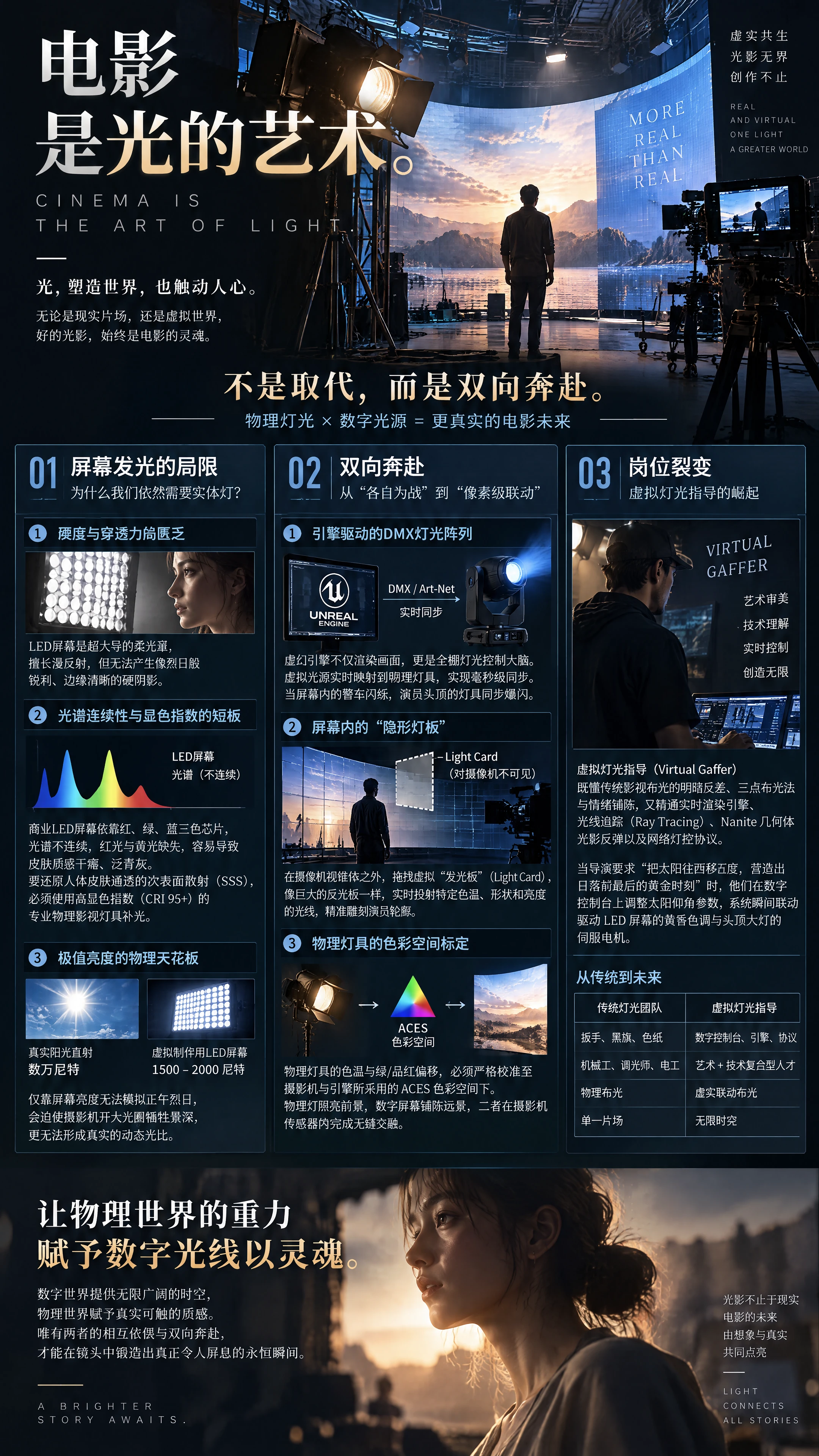
True virtual production is by no means “screens replacing fixtures,” but rather a two-way convergence of “physical lighting” and “digital light sources.”
I. The Limitations of Screen Emission: Why Do We Still Need Physical Lights?
To understand the lighting logic of virtual production, one must first confront the physical limitations of LED screens as light sources.
First, the lack of hardness and penetration. An LED screen is a diffuse reflective surface composed of thousands of tiny light-emitting diodes. In terms of physical characteristics, it is essentially an oversized softbox. It excels at providing delicate diffuse ambient skylight and environmental reflections, but it can never produce hard shadows as sharp and clearly edged as harsh sunlight. To achieve the hard-edged quality of noon sunlight piercing through window lattices, high-power physical spotlights must be involved.
Second, shortcomings in spectral continuity and color rendering index (CRI). Commercial LED displays are designed to “look good to the human eye,” not to “serve as a light source for high-dynamic-range cinema cameras.” They rely on mixing red, green, and blue monochromatic chips, producing a discontinuous spiky spectrum. When this narrow-band light falls on an actor's complex skin tissue, the absence of red and yellow wavelengths causes skin texture to appear dry and even sallow gray. To reproduce the translucent subsurface scattering (SSS) of human skin, professional physical film lighting fixtures with high color rendering index (CRI 95+) must be introduced for fill light.
Third, the physical ceiling of extreme brightness. Although LED screens dedicated to modern virtual production can reach peak brightness of 1,500 to 2,000 nits or more, in the real world, ground surfaces under direct sunlight often reach tens of thousands of nits. Relying solely on screen brightness to simulate the noon sun not only forces the camera to open up the aperture and sacrifice depth of field, but also fails to create realistic dynamic lighting ratios.
II. Two-Way Convergence: From “Fighting Separately” to “Pixel-Level Synchronization”
The solution is not choosing one over the other, but building a control network that enables millisecond-level bidirectional synchronization between physical lighting fixtures and the digital engine.
- Engine-Driven DMX Lighting Arrays. In advanced virtual production pipelines, Unreal Engine is no longer merely a tool for rendering images—it simultaneously serves as the brain controlling all stage lighting. Through DMX or Art-Net protocols, virtual light sources within Unreal Engine (such as moving torches, flashing police lights, or passing car headlights) are mapped in real time to physical moving head lights or LED panel lights suspended from the stage ceiling. When a police car speeds across the screen, at the exact microsecond the virtual red and blue strobe lights on its roof flash, the physical fixtures above the actor's head strobe in sync with identical frequency, color, and falloff curves. Virtual and physical light sources achieve rigorous synchronization in both time and physical logic.
- “Invisible Light Cards” Within the Screen. In virtual production systems, lighting designers gain unprecedented freedom. Beyond operating physical fixtures, they can drag out virtual “Light Cards” on the touchscreen of the control console, directly onto areas of the LED screen outside the camera's frustum. This light card is invisible to the camera, yet it acts like a giant reflector or softbox, projecting diffuse light of a specific color temperature, shape, and brightness in real time, precisely sculpting the contour on the actor's side.
- Color Space Calibration of Physical Fixtures. To ensure that light emitted by physical fixtures blends seamlessly with the digital environment displayed on the LED screen, the lighting department must implement scientific color management. The CCT color temperature and green/magenta tint of physical fixtures must be strictly calibrated to the ACES color space used by the camera and engine. Physical lights illuminate the foreground while the digital screen lays out the background; the color gradations and spectra of both blend seamlessly within the camera sensor.
III. Role Evolution: The Rise of the Virtual Gaffer
This convergence of technologies has directly driven the evolution of traditional on-set roles.
Traditional lighting teams consist mainly of grips, dimmer operators, and electricians, whose weapons are wrenches, black flags, and color gels. But in modern virtual production studios, an entirely new core role is rapidly rising—the Virtual Gaffer.
This new role must understand not only the contrast ratios, three-point lighting, and mood-setting of traditional film lighting, but also the lighting systems of real-time rendering engines, ray tracing, Nanite geometry light bounce, and network lighting control protocols. When the director asks to “move the sun five degrees west to create the last golden hour before sunset,” the Virtual Gaffer doesn't move cumbersome HMI light stands—instead, they fine-tune the sun elevation parameters on a digital control console, and the system instantly synchronizes the dusk tones of the LED screens with the servo motors of the overhead lights.
Conclusion: Let the Gravity of the Physical World Give Soul to Digital Light
XR virtual production has not dimmed traditional film lighting—on the contrary, it has given light and shadow creators unprecedented brushes.
When cold digital code transforms into warm photons pouring out from curved LED screens; when precision physical fixtures resonate in frequency with them under the orchestration of computing power—the two collide on actors' eyelashes and garment edges to produce real shadows and highlights.
This is not merely a technological breakthrough, but proof that the film industry is moving toward ultimate rationality: the digital world provides infinitely vast time and space, while the physical world endows tangible, touchable texture. Only through their mutual embrace and two-way convergence can truly breathtaking eternal moments be forged in the lens.

 简体中文
 English