
As the global broadcast television industry fully enters the all-IP era,SMPTE ST 2110 protocol suite and PTP (IEEE 1588 Precision Time Protocol) have become the rigid infrastructure for provincial and national-level converged media studios.
Under the ST 2110 architecture, the traditional single SDI cable is completely deconstructed—video (ST 2110-20), audio (ST 2110-30), and ancillary metadata (ST 2110-40) are split into independent IP multicast streams, shuttling at high speed across 10GbE/dual 100GbE Ethernet switches. The physical bandwidth of a single uncompressed 4K 60fps 10-bit video stream alone reaches a staggering 12 Gbps。
However, when system architects attempt to introduce this all-IP ultra-high-bandwidth broadcast pipeline intoUnreal Engine 5 (UE5)they instantly encounter a timing disaster at the underlying network communication and rendering level:
- CPU Protocol Stack “Interrupt Storm”: Ethernet transmission operates in units of 1500-byte MTU packets. This means millions of tiny packets bombard the network card every second. If UE5 were to parse these multicast packets directly in system user space, the CPU would be instantly overloaded by high-frequency hardware interrupts and network context switching, causing severe hangs in the main rendering thread, catastrophic packet dropping, and frame tearing.
- Timing Disruption Caused by IP Jitter: Network transmission is inherently non-deterministic. Video streams, audio streams, and camera tracking streams (typically carried over 2110-40 or independent UDP packets) arrive at the host with varying delays due to different switch routing paths. Without strict timing locking, the perspective rendering of the virtual background, unpacking of live video, and audio output will experience chaotic phase drift on the timeline, leading to flickering and misalignment between the virtual and real images on the broadcast output.
Aximmetry With its underlying I/O routing system specifically rebuilt for broadcast-grade IP, it builds a“Hardcore Protocol Offload and Clock Alignment Gateway”。
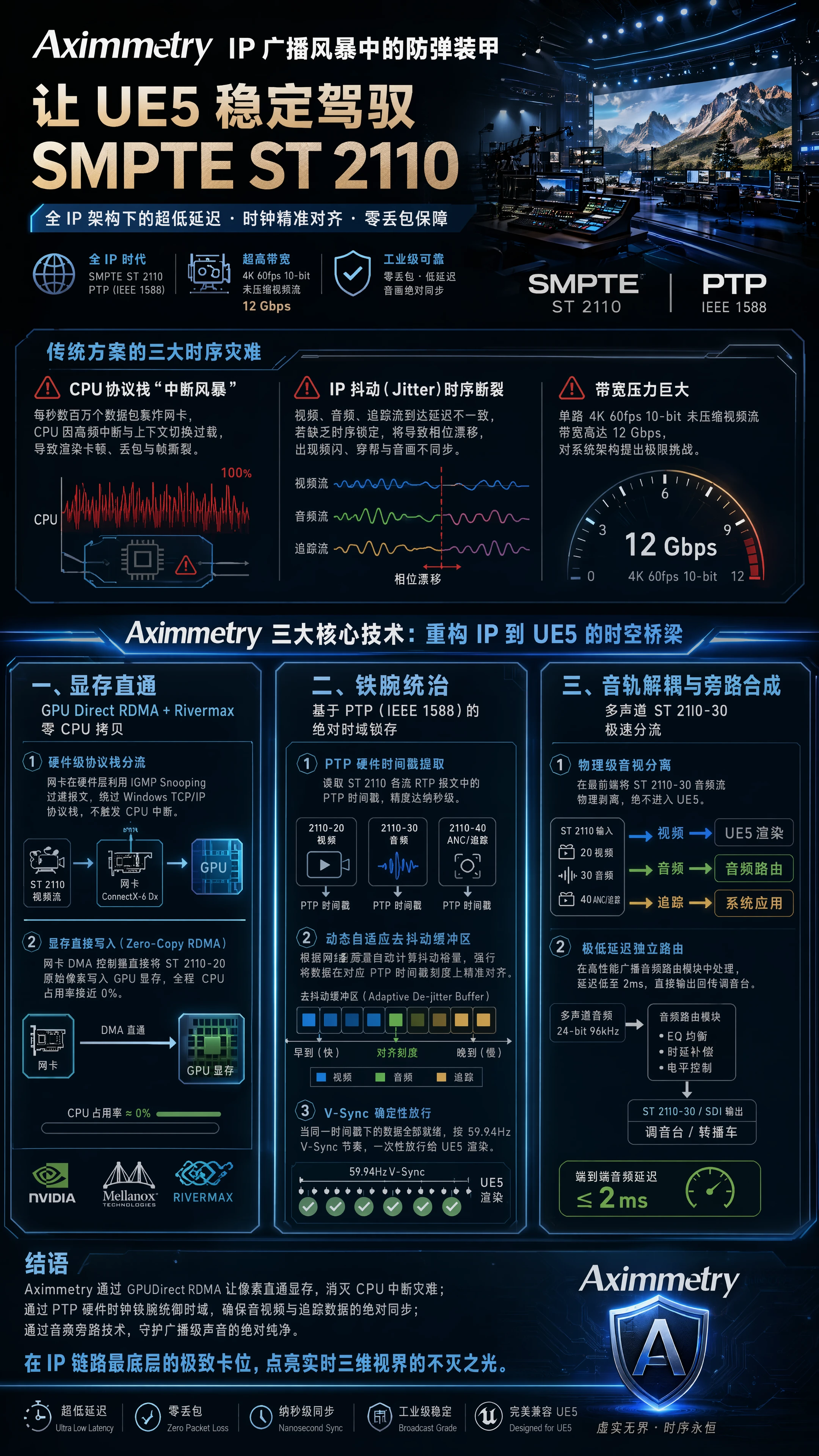
between 10GbE Ethernet and the Unreal rendering space.
I. Direct VRAM Access: Zero-CPU Copy Based on GPU Direct RDMA and Rivermax
To completely shield Unreal Engine 5 from the storm of billions of pixels per second on the network, Aximmetry has fundamentally abandoned the traditional Windows socket (Winsock) network transmission mechanism at the bottom layer. It has deeply collaborated with Mellanox (NVIDIA) to deploy at the I/O core layer 与 NVIDIA Rivermax SDK technology:
GPUDirect RDMA (Remote Direct Memory Access)
Hardware-Level Protocol Stack Offloading
When ultra-high-bandwidth ST 2110 video multicast streams enter the workstation via a 10GbE fiber card (e.g., ConnectX-6 Dx), the network card chip performs packet filtering at the hardware layer using IGMP Snooping. It bypasses the Windows OS kernel TCP/IP protocol stack without triggering any CPU hardware interrupts.
Direct VRAM Write (Zero-Copy RDMA)
Aximmetry leverages GPUDirect technology to establish a physical direct path between the network card chip and GPU VRAM. Uncompressed ST 2110-20 raw video pixels are directly written by the network card's DMA controller to a designated physical VRAM address on the GPU the moment they enter the motherboard. Throughout this process, the workstation's CPU usage remains near 0%, and memory bus bandwidth is perfectly freed. This allows UE5 to directly call this ultra-low-latency 4K live source for real-time keying and compositing in a burden-free GPU VRAM environment.
II. Iron-Fisted Control: Absolute Time Domain Latching Based on PTP (IEEE 1588)In an ST 2110 broadcast network, the PTP Grandmaster Clock
is the "hand of God" governing the entire system's time reference, with synchronization accuracy reaching the nanosecond level.“Aximmetry refuses to passively wait for data; instead, it places its own rendering engine clock entirely under PTP control, acting as the network timing”:
"Iron-Fisted Enforcer"
PTP Hardware Timestamp Extraction
When receiving ST 2110-20 (video), ST 2110-30 (audio), and ST 2110-40 (ANC metadata/tracking), Aximmetry reads the physical PTP timestamp encapsulated in the header of each RTP packet.
Dynamic Adaptive De-jitter Buffer
Due to network jitter, packets may arrive with slight timing differences. Aximmetry constructs a highly elastic time-latching buffer in memory. It automatically calculates millisecond-level fine-tuning margins based on network quality, forcibly aligning fast-arriving tracking data and slower video streams precisely at the corresponding PTP timestamp "ticks."
Deterministic V-Sync Release
Only after video, audio, and tracking data under the same physical frame timestamp are all aligned and ready does Aximmetry release the complete "spatiotemporal dataset" to UE5 for rendering at a 59.94Hz V-Sync vertical synchronization rhythm. This absolute rigidity in the time domain completely eradicates common broadcast-grade issues in IP transmission, such as audio-video sync problems and tracking delay jitter.
III. Audio Track Decoupling and Bypass Synthesis: High-Speed Splitting of Multi-Channel ST 2110-30
In large variety shows or sports event broadcasts, audio latency and clarity are the lifeline of the program. Multi-channel audio streams (ST 2110-30) from live microphones typically have extremely high sampling rates of up to 24-bit 96kHz and are highly sensitive to latency.If these audio streams were routed into UE5 for internal mixing, the engine's audio engine buffer depth of tens of milliseconds would cause severe。
audio playback lag“Aximmetry adopts an”"Audio Bypass"
architecture in its stream graph design:
Physical-Level Audio-Video Separation
When unpacking ST 2110 streams at the GPU VRAM layer, Aximmetry physically strips the ST 2110-30 audio stream at the very front end, preventing it from ever entering the Unreal Engine.
Ultra-Low-Latency Independent Routing
The stripped multi-channel audio runs within Aximmetry's high-performance broadcast audio routing module. The system can perform ultra-low-latency equalizer (EQ) adjustments and delay compensation directly here, then output via AJA/Blackmagic or ST 2110-30 back to the physical audio mixer in the OB van. This ensures the latency of the live audio channel is strictly controlled within 2 milliseconds, eliminating the "electronic echo" in the host's IFB feedback.
Conclusion: Bulletproof Armor in the IP Broadcast Storm
Aximmetry The transformation from traditional SDI baseband to all-IP SMPTE ST 2110 is a magnificent leap in broadcast technology history. However, in this leap, high-frequency, high-throughput network multicast packets are undoubtedly a deadly network storm for Unreal Engine 5, which is focused on 3D visual creation.“The core value of Aximmetry is to act as the”。
"Bulletproof Armor"

 简体中文
简体中文  English