
In a high-end AR broadcast or esports studio, as a real-time motion designer or TD, what director's command do you most dread hearing?
It's not “Help me add a model,” but rather— “That AR bar chart, can its glow intensity follow the live host's volume? Oh, and when the vote count exceeds 500,000, can the bar's material instantly change from glass to liquid metal? The live stream is about to start, hurry up and change it!”
If your workflow is completely locked insidenative Unreal Engine 5 (UE5), these few sentences are a nightmare. To achieve this requirement, you need to:
- Write a Blueprint to receive audio FFT data;
- Open the extremely complex Material Graph, do various Lerps and Parameter Collections;
- Set up a Blueprint to read the vote count API, then write a bunch of logic to control material parameter switching. The most fatal part is, if you find during the live broadcast that the multiplier for the glow intensity is set too high and the image is overexposed, you have to go back into the engine to modify the value, potentially even triggering a recompile of the shaders. In a live broadcast watched by tens of thousands, a 3-second engine freeze is enough to cost you your job.
Faced with this rigid pipeline that forcibly binds “data logic” with “visual performance,”Aximmetryunveiled a killer feature with incredible artistic intuition:Completely decouple data-driven control, establishing an external “material alchemy furnace” and procedural animation engine within the Flow Graph.
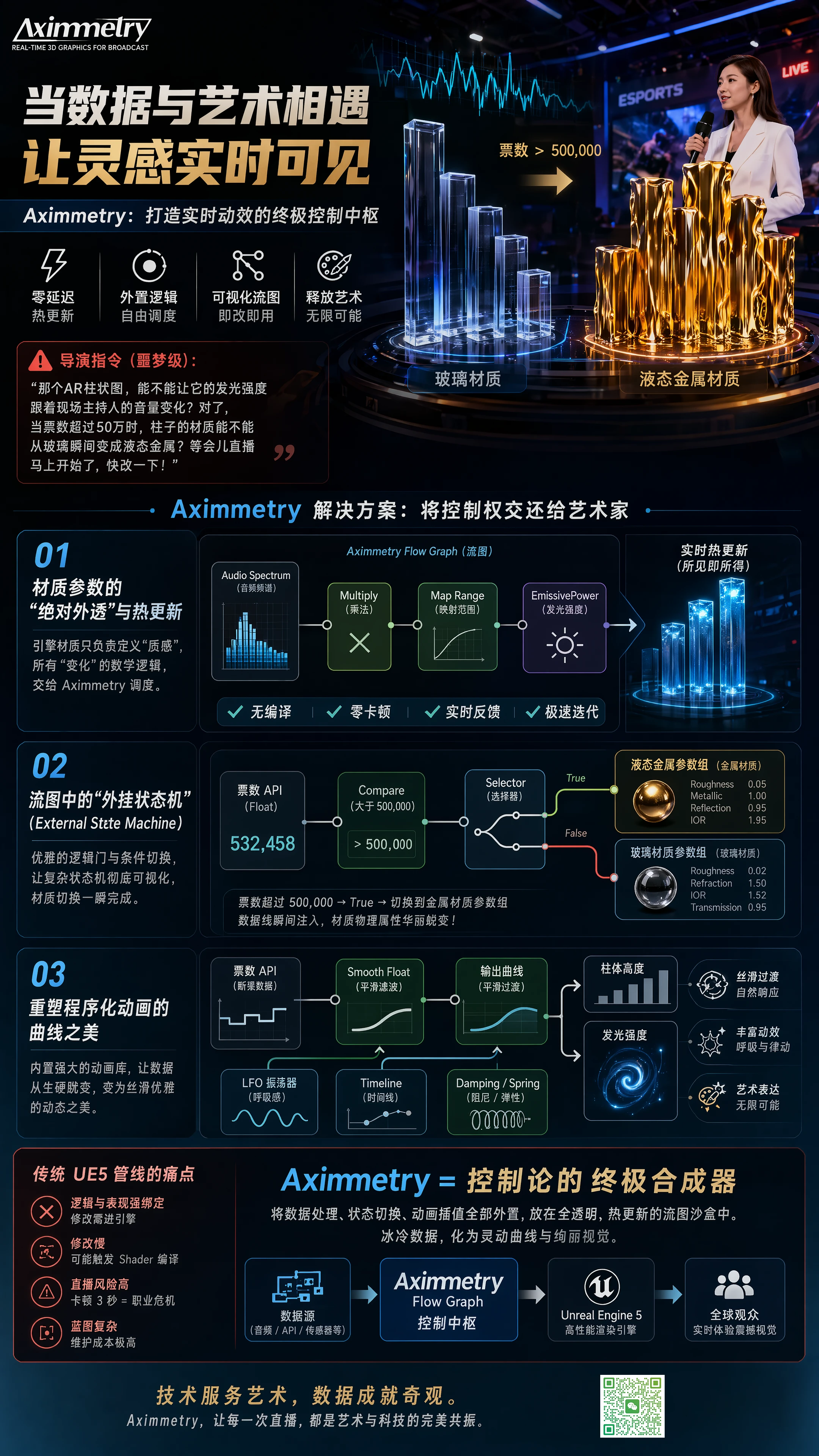
Core Solution One: “Absolute Externalization” and Hot-Reloading of Material Parameters
Aximmetry's pipeline philosophy is: “The engine's materials are only responsible for defining ‘texture,’ while all the mathematical logic regarding ‘change” must be scheduled by Aximmetry."
In Aximmetry's workflow, motion designers only need to leave extremely simple“Exposed Parameters”in the UE5 material, such as “BaseColor” or “EmissivePower.”
- Seamless Capture: When the UE5 project is loaded by Aximmetry (based on the Aximmetry DE architecture), all these parameter pins hidden deep within the material are instantly exposed on Aximmetry's clear and visible Flow Graph panel.
- Externalized Math Logic: Now, you don't need to write any Blueprints in the engine at all. In Aximmetry, you can drag out an “Audio Spectrum” node, connect it through a few intuitive math nodes (Multiply, Map Range), and directly link it to that “EmissivePower” pin.
- Zero Compilation, What You See Is What You Get: The greatest design aspect is that all of this isHot-ReloadingWhen you adjust that multiplier amplifier in Aximmetry, the glow intensity of the pillar in the engine viewport changes in real-time as you drag your mouse. No stuttering, no recompilation. The feedback loop between data and visuals is compressed to zero latency.
Core Solution Two: “External State Machine” in the Flow Graph”
Going back to the requirement of “when the vote count exceeds 500,000, the material instantly changes from glass to metal.” If written in engine Blueprints, as conditions increase, the connections quickly become a tangled mess.
Aximmetry's incredibly elegantLogic Gates and conditional switching nodes (Switch/Selector)completely “visualize” this complex state machine.
- You can drag out a “Vote Count (Float)” node from an external API, connect it to a “Compare (Greater than 500,000)” node.
- This comparison node outputs a Boolean value (True/False), which directly connects to a “Selector” node.
- Inside the Selector node, you can preset two completely different sets of material parameter arrays (one set for glass's roughness and refractive index, another for metal's reflectivity).
- When the vote count crosses the threshold, Aximmetry's logic sandbox instantly switches the array. A single, clean data line injects the new parameter set into UE5, and the material undergoes a magnificent physical transformation in an instant.
Throughout this process, the engine has no idea about the complex logic judgment that just occurred; it simply and rapidly executes the final values handed over by Aximmetry.
Core Solution Three: Reshaping the Beauty of Curves in Procedural Animation
Hard-switching parameters isn't enough. The true art of motion effects lies in Curves, Damping, and Springs.
Hand-coding smooth transitions with damping (Smooth Step/Interp) in Blueprints is often extremely rigid. Aximmetry understands the needs of motion designers deeply; it has a built-in, incredibly powerful“External Procedural Animation Library”:
- Filters and Interpolation Nodes: Even if the incoming API data is discontinuous (e.g., the vote count jumps from 10,000 to 20,000), you simply insert a “Smooth Float” node in the middle of the connection. Aximmetry automatically transforms this abrupt change into an incredibly smooth gradient based on the decay curve you set. The bar chart in UE5 will rise smoothly and elegantly.
- Built-in Oscillators & Timelines: Want the virtual particles in the background to have a breathing effect? No need to write complex Sine wave functions in the engine. Just drag out an LFO (Low-Frequency Oscillator) in Aximmetry, set the frequency, and feed its output curve directly to the particle's opacity parameter.
Conclusion: Achieving the Ultimate Reconciliation Between Logic and Art
In the high-pressure environment of live broadcasting, technical logic and artistic expression often constrain each other: programmers complain that material logic is too complex and affects performance, while motion designers complain that code changes are too slow and kill inspiration.
Unreal Engine provides a perfect canvas, but its massive logic system designed for game development is too cumbersome for a studio environment that requires “improvisation and second-level modifications.”
Aximmetry acutely grasped this pain point. It doesn't generate graphics, but through its extremely powerful node connections and parameter externalization mechanism, it transforms into a“Cybernetic Ultimate Synthesizer”。
It strips all the complex data processing, state switching, and animation interpolation from the fragile engine pipeline, placing them entirely within its fully transparent, hot-reloadable Flow Graph sandbox. Here, dry API data is brought to life by alchemical nodes, transforming into dynamic curves and breathing colors.
It is this architectural design that reduces the dimensionality of “technical logic” and seamlessly hands “control” back to the artist, making Aximmetry the most robust and elegant bridge connecting cold data with visual wonders.

 简体中文
简体中文  English