
With the leapfrog improvement in performance of real-time rendering engines (such as Unreal Engine), the film and television industry and broadcast transmission are fully advancing toward real-time and virtualized workflows. However, directly applying game-based rendering engines to demanding live broadcast environments and complex virtual production (VP) sets often encounters a series of engineering challenges, including signal routing, protocol compatibility, and on-set control logic.
Against this backdrop,Aximmetrywith its unique node-based processing architecture, broadcast-grade I/O (Input/Output) management, and deep integration with the underlying engine, it has established itself as the central hub of modern real-time audiovisual industryCentral Hubprofessional status. This article will provide an in-depth analysis of the specific applications of Aximmetry in virtual production and live broadcasting from the perspective of technical implementation mechanisms and core workflows.
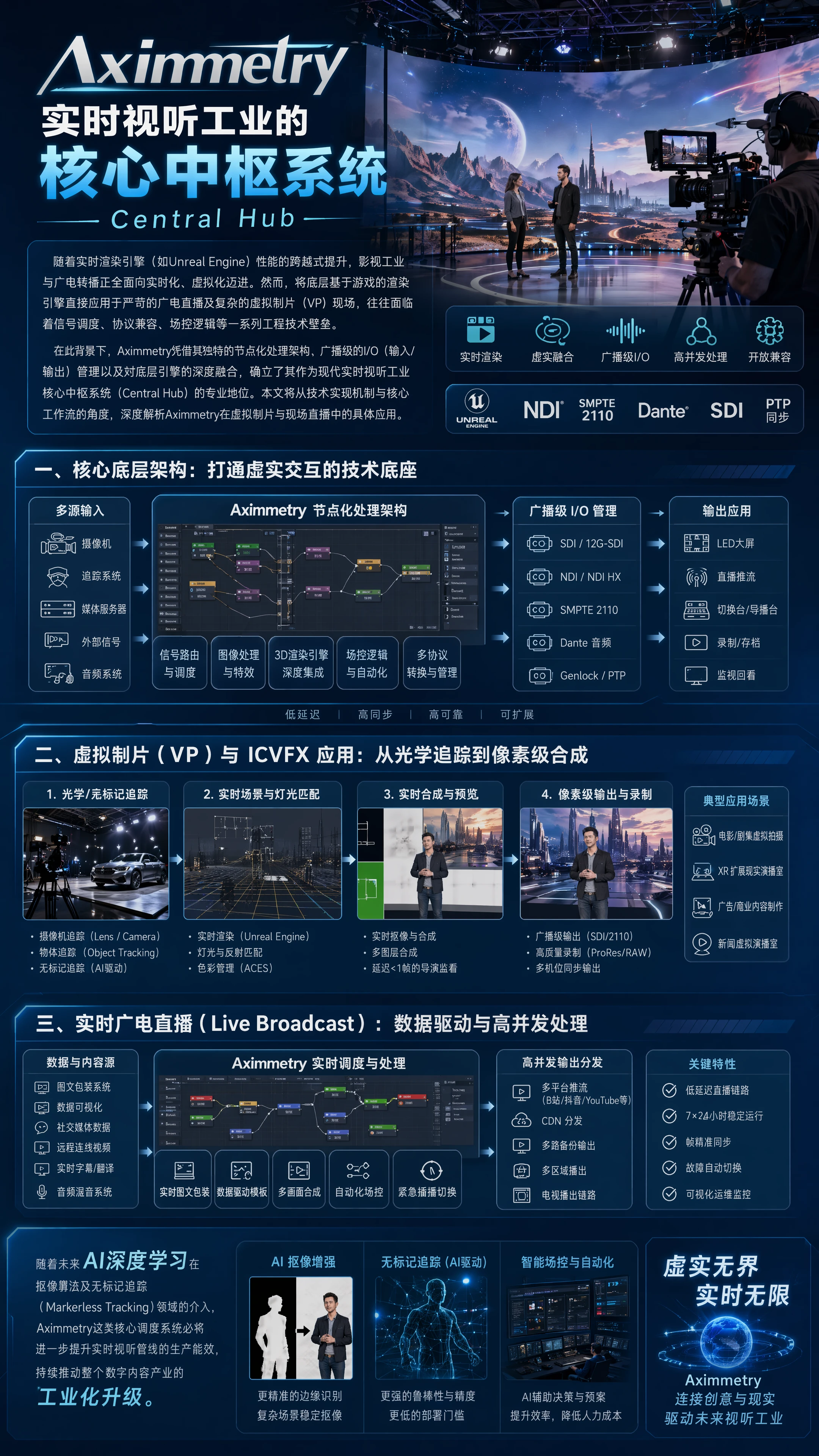
I. Core Underlying Architecture: The Technical Foundation Bridging Virtual and Real Interaction
The reason Aximmetry dominates high-end audiovisual production lies in the design logic of its system architecture.
Deep Nesting of Aximmetry DE (Dual Engine Architecture) Traditional UE production workflows rely heavily on Blueprints for scene control, making on-site modifications extremely costly and prone to crashes. Aximmetry developed the DE (Dual Engine) version, which deeply integrates Unreal Engine through underlying API calls. In this architecture, UE serves purely as a rendering backend (Render Backend), handling Lumen global illumination and Nanite polygon processing; while Aximmetry acts as the control interface (Control Interface), fully managing video signal input/output, camera tracking data solving, and multi-camera logic scheduling. This decoupled design significantly improves the system's on-site fault tolerance and operational agility.
Node-based Visual Scripting Aximmetry adopts a Flow Graph node logic structure. Without writing C++ code, technical directors can use node connections to achieve complex signal routing, mathematical operations, timecode synchronization, and external event triggering. This logical architecture endows the system with strong customization and development capabilities, allowing it to flexibly meet the engineering needs of different projects.
Hardware Neutrality and Protocol Versatility The system has built-in highly compatible I/O interfaces, supporting mainstream video stream protocols such as SDI, NDI, and SRT; it also natively supports common tracking protocols like FreeD and VRPN, as well as native SDKs from professional manufacturers such as Ncam, Mo-Sys, and Stype. This “protocol-neutral” characteristic breaks down the ecological barriers of hardware manufacturers.
II. Virtual Production (VP) and ICVFX Applications: From Optical Tracking to Pixel-Level Compositing
In cinematic virtual production and ICVFX (In-Camera Visual Effects) workflows, Aximmetry provides highly engineering-valuable solutions.
Core Driving of XR (LED Volume) Studios In LED virtual shooting, Aximmetry handles the most critical rendering scheduling:
- Frustum Rendering: Real-time solving of the tracking camera's spatial pose (6DOF), precisely controlling the high-resolution rendering of the “Inner Frustum” within the LED screen, while reducing the resolution of peripheral areas to save computing power.
- Set Extension: When the camera's FOV (Field of View) exceeds the physical LED screen boundary, Aximmetry uses its internal compositor to accurately overlay the UE-rendered pure 3D scene as an AR foreground over the physical space outside the screen, achieving seamless boundary extension.
- Color Space and Lighting Matching: Supports loading OCIO color configuration files and can communicate bidirectionally with on-site lighting consoles via DMX/Art-Net protocols, ensuring strict synchronization of the virtual scene's ambient light with the real set's physical fill lights in terms of color and brightness.
Broadcast-Grade Real-time Green Screen/Blue Screen Compositing For production teams without LED hardware conditions, Aximmetry offers a real-time keying solution with extremely high computing power efficiency.
- Advanced Chroma Keyer: Its proprietary algorithm supports sub-pixel edge processing. By generating a precise Clean Plate, it can perfectly solve the extraction of transparent materials (glass, water) and semi-transparent pixels (hair, smoke), and features advanced Spill Suppression to minimize post-production Roto (rotoscoping) workload.
III. Live Broadcast: Data-Driven and High-Concurrency Processing
Broadcast-grade live broadcasting imposes stringent requirements on the system'sFrame-accurate Sync和Operational RobustnessAximmetry demonstrates strong engineering capabilities in this area.
Dynamic AR Graphics and Data-driven Graphics In sports broadcasting, election coverage, and financial live streams, virtual graphics need to be tightly bound to real-time data. Aximmetry's node system supports HTTP requests and TCP/UDP port listening, enabling real-time parsing of external API data streams in formats like JSON and XML. This data, processed through node operations, can directly drive the displacement, scaling, or material changes of virtual 3D assets in UE (e.g., converting real-time economic data into a dynamic 3D AR bar chart). The entire process has extremely low latency and requires no offline baking.
Virtual Multi-Camera and Director Logic Scheduling Within a single 3D virtual studio environment, Aximmetry supports configuring an unlimited number of “virtual camera” positions. Unlike real physical cameras that require video capture card channels, virtual cameras are computed entirely within Aximmetry's engine. Technical directors can not only perform hard cuts but also use Spline nodes to achieve smooth spatial transitions (Tweening) between A-B points of various virtual cameras. Combined with physical tracking cameras, this enables grand broadcast camera language at a very low hardware cost.
Remote Holographic Production (Telepresence & Remote Production) For modern remote production needs, Aximmetry can process remote keyed video streams transmitted via SRT or high-bandwidth dedicated lines. The system can, within the same virtual coordinate system, calculate the spatial perspective and Z-Depth sorting of remote character signals in real-time based on the tracking data of the master control camera, and uniformly apply global lighting and Depth of Field (DOF) effects, achieving a seamless “remote co-location” interaction.
In summary, Aximmetry is not merely a “keying software” or “virtual scene player,” but ratheran integrated middleware system that deeply combines rendering engine control, multi-protocol I/O management, real-time compositing, and logic scheduling.。
It effectively bridges the technical gap between game engines and traditional film/television broadcast workflows, standardizing and streamlining the asset-heavy, high-barrier virtual production process. With the future involvement of AI deep learning in keying algorithms and markerless tracking, core scheduling systems like Aximmetry will undoubtedly further enhance the production efficiency of real-time audiovisual pipelines, continuously driving the industrial upgrade of the entire digital content industry.

 简体中文
简体中文  English