
Stepping into a multi-million-dollar virtual production (VP) studio or a top-tier AR live broadcast center, outsiders are awed by the technological marvel, while insiders often see“A Communication Disaster”。
On this set, it's packed with various high-priced, temperamental “top experts”:
- Optical tracking camera cranes(such as Mo-Sys, Ncam) spout obscure spatial coordinate signals containing 6DOF;
- Unreal Engine (UE5)as the master brain, immersed in complex C++ code and blueprint logic;
- The entire venue'sDMX lighting consolescan only receive archaic level signals;
- Meanwhile, various high-end and low-end cameras output video streams with differing frame rates and color spaces.
It's like locking a Russian mathematician, a Japanese engineer, and an Arab poet in the same room and asking them to build a space shuttle together—without an incredibly powerful “simultaneous interpreter,” they won't just fail to build the spacecraft; they'll end up brawling due to poor communication (system crashes, latency explosions, visual glitches).
In the past, to make these devices understand each other, crews had to hire technical experts at high costs, spending weeks writing extremely unstable middleware code.
UntilAximmetrydominated this industry. As the world's most dominant real-time 3D graphics and control hub, Aximmetry's greatness lies not in how many polygons it can render, but in how it has positioned itself as the audiovisual industry's“Ultimate Universal Interface (The Universal API)”With its immensely powerful parsing capabilities and all-encompassing node logic, it instantly bridges the “last hundred meters” between hardware silos and software engines.
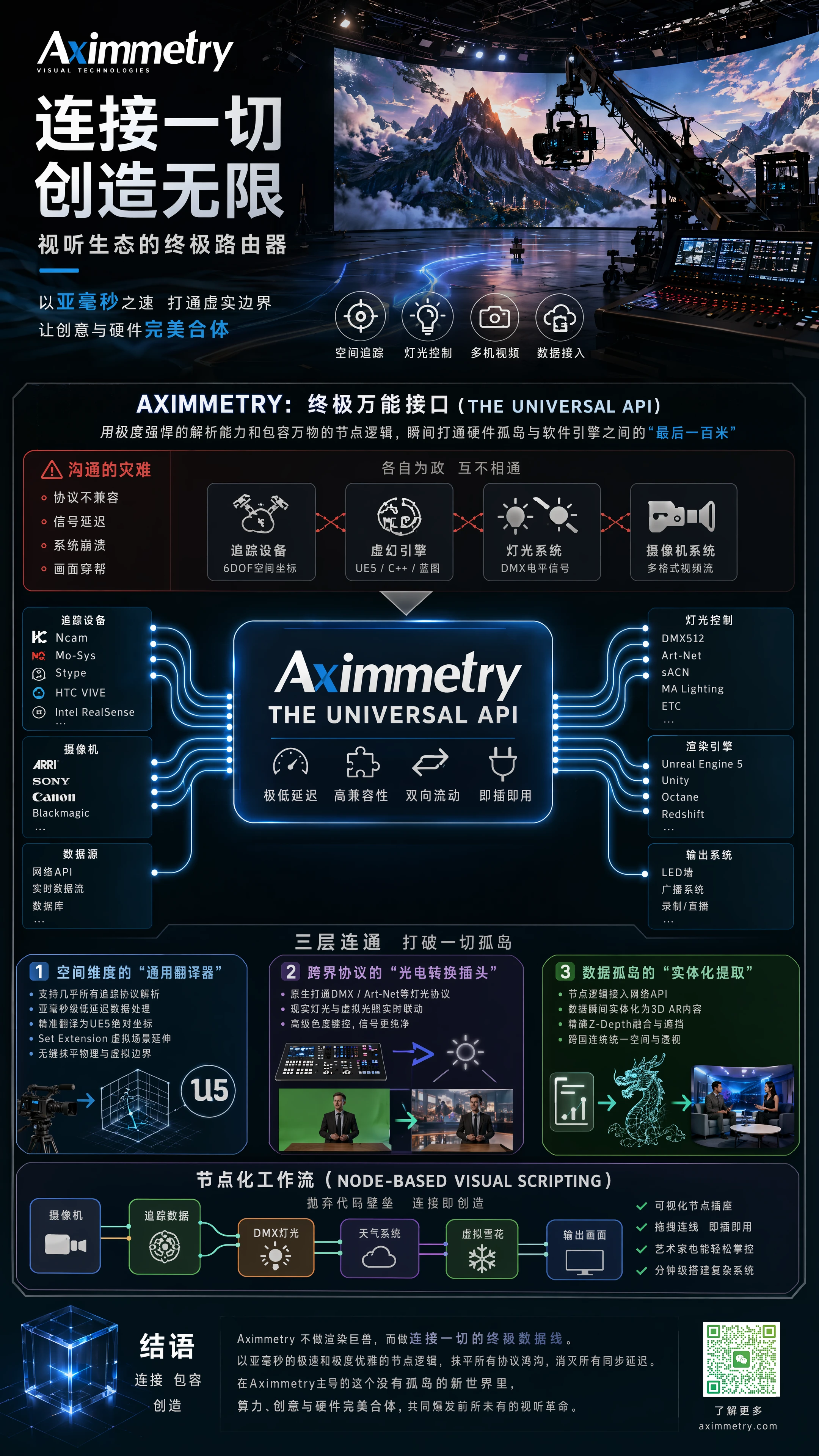
Layer One Connectivity: A “Universal Translator” for Spatial Dimensions”
The operation of any 3D system is built on the synchronization of spatial coordinates.
In an LED volume studio (XR shooting), if the real camera's movement data is transmitted to the UE5 engine just 0.05 seconds late, the virtual perspective will suffer from terrifying slippage, instantly causing dizziness for the audience. Aximmetry acts as the most efficient spatial translator on set. It natively integrates parsing capabilities for virtually all tracking protocols on the market—whether it's the expensive Ncam, Stype, or the affordable HTC Vive, Intel RealSense. With sub-millisecond ultra-low latency, it instantly “ingests” these messy tracking data streams, filters out jitter noise, and precisely translates them into absolute coordinates that the UE5 engine can execute immediately. This plug-and-play, zero-lag translation capability lets crews bid farewell to the painful ordeal of protocol debugging.
Even more impressive is its ability to handle physical boundary connectivity. When the camera pans beyond the LED screen, Aximmetry instantly triggers“Virtual Scene Extension (Set Extension)”It seamlessly continues with an AR scene at this physical blind spot, perfectly smoothing the boundary between the physical studio and the digital void, achieving seamless spatial visual connectivity.
Layer Two Connectivity: A “Photoelectric Conversion Plug” for Cross-Protocols”
Fake visual effects often look fake because the real-world lighting system and the engine's lighting system are “disconnected.”
Aximmetry, through its innovativeDE (Dual-Engine) architecture, creates a perfect “photoelectric conversion plug” that bridges the virtual and real. It not only uses Unreal Engine as its internal core but also natively integrates stage lighting protocols like DMX and Art-Net. Now, the faders on the real studio's lighting console directly become physical remotes controlling the virtual engine's weather. Pushing up a spotlight in reality sends an electrical signal through Aximmetry's interface, instantly translated into a digital command, and the virtual sun in the digital world bursts forth with the same intensity; shadows cast by digital clouds fall precisely on the real actor's face. Photons achieve perfect bidirectional flow between two completely different systems.
When dealing with green screen spill, Aximmetry's built-in advancedChroma Keyerdemonstrates exceptional “signal purity.” It precisely intercepts the green wavelengths that ruin the image, while allowing crucial “realism signals” like water glass refractions and contact shadows to pass through intact into the final composite.
Layer Three Connectivity: “Materializing Extraction” from Data Silos”
In live broadcast scenarios, massive network data is often an “outsider” isolated from the visual logic.
Leveraging its node logic (Flow Graph), Aximmetry becomes the ultimate extractor of network APIs. When external data streams, such as esports kills or stock market surges, arrive, it not only seamlessly integrates this information but also instantly “materializes” it. The dry data is instantly forged into an AR dragon with 3D volume, capable of casting shadows on the real floor. Through precise spatial depth calculation (Z-Depth), this dragon can even be perfectly occluded by the real studio desk. Data is forcibly pulled into the laws of physical space, achieving thorough connectivity at the information dimension.
For international live connections, Aximmetry uses low-latency network interfaces to forcibly pull video streams of different formats from two locations into the same virtual coordinate system, erasing time differences, unifying perspectives, and perfectly “connecting” distant guests onto the same virtual sofa.
The Philosophy of the Interface: The Great Unification of Nodes, Abandoning Code
A universal interface that is extremely cumbersome to use is still a failure. Aximmetry's greatest feat is eliminating the code barrier.
It provides what is called a“node-based visual scripting”minimalist operation interface.
- Here, there is no C++ code to memorize. All external hardware (cameras, trackers, lighting controls) and all internal engine materials and effects become visual “node sockets.”
- Artists don't need to know programming; they simply drag a line with the mouse to connect different sockets. “Want the live sound volume to control the size of virtual snowflakes?” Just connect a line, and it's done.
- This highly inclusive, plug-and-play logic completely unleashes the team's productivity. Whether it's a massive Hollywood crew or a small live-streaming team of a few people, they can set up an extremely complex and stable virtual-real interaction system in minutes.
Conclusion: The Ultimate Router of the Audiovisual Ecosystem
Future audiovisual production will inevitably face more device integration and an influx of greater computing power.
In this wildly expanding system, if we simply keep buying more expensive engines and better cameras while ignoring the efficiency of their connections, the entire system will inevitably collapse due to severe “internal friction.”
Aximmetry has cleverly chosen a different path. It doesn't strive to be the eye-catching rendering beast; instead, it settles down to be the “ultimate data cable” that connects everything and embraces all. It lurks beneath the complex array of devices, using sub-millisecond speed and extremely elegant node logic to erase all protocol gaps and eliminate all synchronization delays. In this new world without silos, led by Aximmetry, computing power, creativity, and hardware finally achieve a perfect fusion, collectively unleashing an unprecedented audiovisual revolution.

 简体中文
简体中文  English