
In the actual shooting of LED virtual production (ICVFX),Moiré Patternis a physical curse hanging over the Director of Photography (DP).
When the CMOS sensor pixel array of a high-resolution cinema camera overlaps in spatial frequency with the physical light-emitting dot matrix (Pixel Pitch, e.g., P2.6 or P1.5) of the LED screen, and does not satisfy theNyquist Sampling Theorem, large areas of colored interference fringes will erupt in the frame. This is especially severe in close-up shots, deep depth of field shots, or when the lens focus slides toward the background.
Traditional on-site anti-moiré methods are extremely passive and compromise-driven:
- Sacrificing Lens Aesthetics: Forcing the camera to shoot with a wide aperture to achieve a very shallow depth of field, forcibly blurring the background; or restricting the camera's movement trajectory to avoid approaching the LED wall.
- Heavy Reliance on Engine Computation: Enabling expensive cinematic depth of field (Diaphragm Depth of Field) in Unreal Engine 5 (UE5). However, this algorithm requires high-density physical raymarching and temporal denoising in 3D space, with single-frame rendering taking up to 5-8 milliseconds, easily causing computational overload and severe ghosting.
To completely eliminate moiré patterns without sacrificing lens movement or consuming rendering power,Aximmetry Aximmetry, with its proprietary“Focus-Coupled Spatial Filter based on optical focus feedback,”reconstructs a low-latency optical anti-aliasing pipeline between the physical camera and the LED controller.
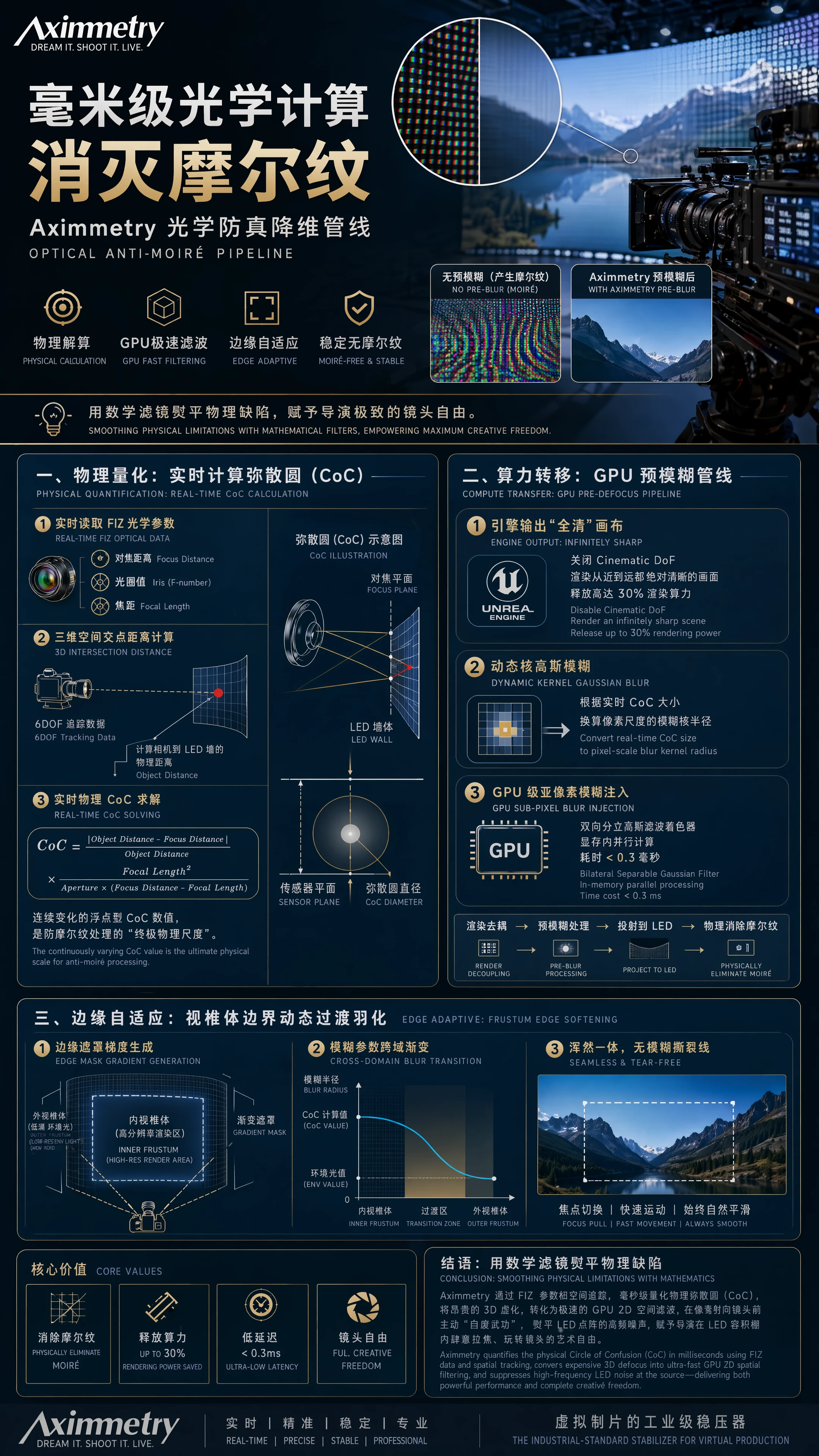
I. Physical Quantification: Real-time Calculation of the “Circle of Confusion (CoC)” Based on FIZ Metadata and Spatial Vectors
To safely and precisely apply anti-moiré protection to the background, the system must accurately calculate at every frame:At this very moment, to what degree the LED wall is blurred in the physical camera's imaging system.
Aximmetry abandons the blind full-scene blur algorithms of 3D engines and instead establishes a highly preciseReal-time High-Precision Gaussian Circle of Confusion (CoC) Mathematical Model:
Real-time Reading of FIZ Optical Parameters
Aximmetry obtains the lens's absolute physical focus distance, real-time aperture value (Iris/F-number), and current focal length with sub-millisecond latency via a high-speed serial channel (LDS/i-tech protocol or external motor encoder).
3D Spatial Intersection Distance Calculation
Using the bound 6DOF camera tracking data, Aximmetry's geometric computing core emits a virtual ray from the physical camera's nodal point along the optical axis in the virtual 3D space, calculating the intersection point with the LED wall's geometric model in real time. This yields theAbsolute Distance (Object Distance)。
from the camera sensor plane to the physical surface of the LED.
Real-time Physical CoC Solution
Aximmetry substitutes the above focus distance, focal length, aperture value, and physical distance into the Gaussian imaging formula to calculate the physical diameter of the circle of confusion for the LED surface under the current optical state:
er
This continuously varying floating-point CoC value is the "ultimate physical scale" for anti-moiré processing of the LED image.
II. Computational Offloading: Adaptive GPU Shader-Based Pre-Defocus Pipeline
Native UE5, when performing physical depth of field calculations at high resolution, requires multi-sampling of massive pixels, resulting in extremely high graphics card bandwidth overhead.“Aximmetry adopts a”"Render Decoupling, Post-Process Pre-Blur"
storm algorithm:
Engine Outputs an "Infinitely Sharp" Canvas
Aximmetry instructs UE5 to disable its expensive and inefficient Cinematic DoF algorithm. UE5 only needs to render a 3D background image that is absolutely sharp from foreground to background, with no blur at all, using the most efficient pipeline state. This instantly frees up to 30% of the GPU's rendering power.
Dynamic Kernel Gaussian BlurThis fully sharp image is immediately transferred to Aximmetry's GPU compositing engine. Based on the CoC size calculated in real-time in the previous stage, Aximmetry dynamically converts it into a pixel-scale。
Blur Kernel Radius
GPU-Level Sub-Pixel Blur Injection Aximmetry uses a customized, highly optimized bidirectional separable Gaussian/box filter shader to perform physical blurring directly in video memory on the background image to be projected onto the LED wall. Because this filtering is computed in parallel in 2D pixel space and utilizes the hardware-level bilinear interpolation of the GPU texture sampler, its computation time is firmly locked within3 milliseconds
When the background image, after Aximmetry's pre-blur processing, is projected onto the LED screen, the hard edges (high-frequency spatial signals) between the screen's physical light-emitting pixels are perfectly smoothed out, reducing their overall frequency below the cutoff frequency of the physical camera's OLPF (Optical Low-Pass Filter). The moiré pattern is cleanly and physically eliminated at its source.
III. Edge Adaptation: Anti-Aliasing and Multi-Smooth Transitions at the Frustum Edge
In actual shooting, the camera's frame corresponds to theInner Frustum (High-Resolution Rendering Area)on the LED wall. If full-frame blur is forcibly applied to the inner frustum, during rapid camera movement, due to tracking latency, a highly noticeable “blur tear line” can appear between the inner frustum edge and the outer frustum (background lighting area).
Aximmetry introduces “Frustum Edge Dynamic Transition Softening” technology:
Edge Mask Gradient Generation
Based on the camera's frustum matrices, Aximmetry generates an outward-gradient alpha channel at the junction of the inner and outer frustums.
Cross-Domain Gradient of Blur Parameters
Within this gradient channel, Aximmetry does not use a one-size-fits-all CoC blur value. Instead, it allows the blur radius to transition non-linearly and smoothly from the “optically calculated value” of the inner frustum to the “global ambient lighting value” (low resolution to provide ambient light) of the outer frustum.
This ensures that no matter how drastically the focus changes or how fast the camera moves, the light and shadow transition across the entire LED wall remains seamless, never creating a physically visible blur discontinuity.
Conclusion: Smoothing Physical Defects with Mathematical Filters
Moiré patterns are an unavoidable optical friction when digital sensors meet dot-matrix screens in the physical world. Faced with this hardware limitation, simply stacking 3D rendering power in the game engine is not only inefficient but also introduces significant latency risks.
Aximmetry Aximmetry's wisdom lies in choosing to deconstruct the problem using the laws of physics and solve it with highly optimized mathematical filtering.
It quantifies the lens's physical Circle of Confusion (CoC) within milliseconds using FIZ parameters and spatial tracking, transforming expensive 3D blurring computation into ultra-fast GPU 2D spatial filtering. It proactively “disarms” the high-frequency noise of the LED dot matrix before the pixels reach the lens. This precise intervention at the lowest level of the real-time video signal not only preserves the precious rendering power of Unreal Engine 5 but also grants directors the artistic freedom to freely pull focus and manipulate lenses within the LED volume. This is another core testament to why Aximmetry can serve as the “industrial-grade voltage stabilizer” for top-tier virtual production sets.

 简体中文
简体中文  English