
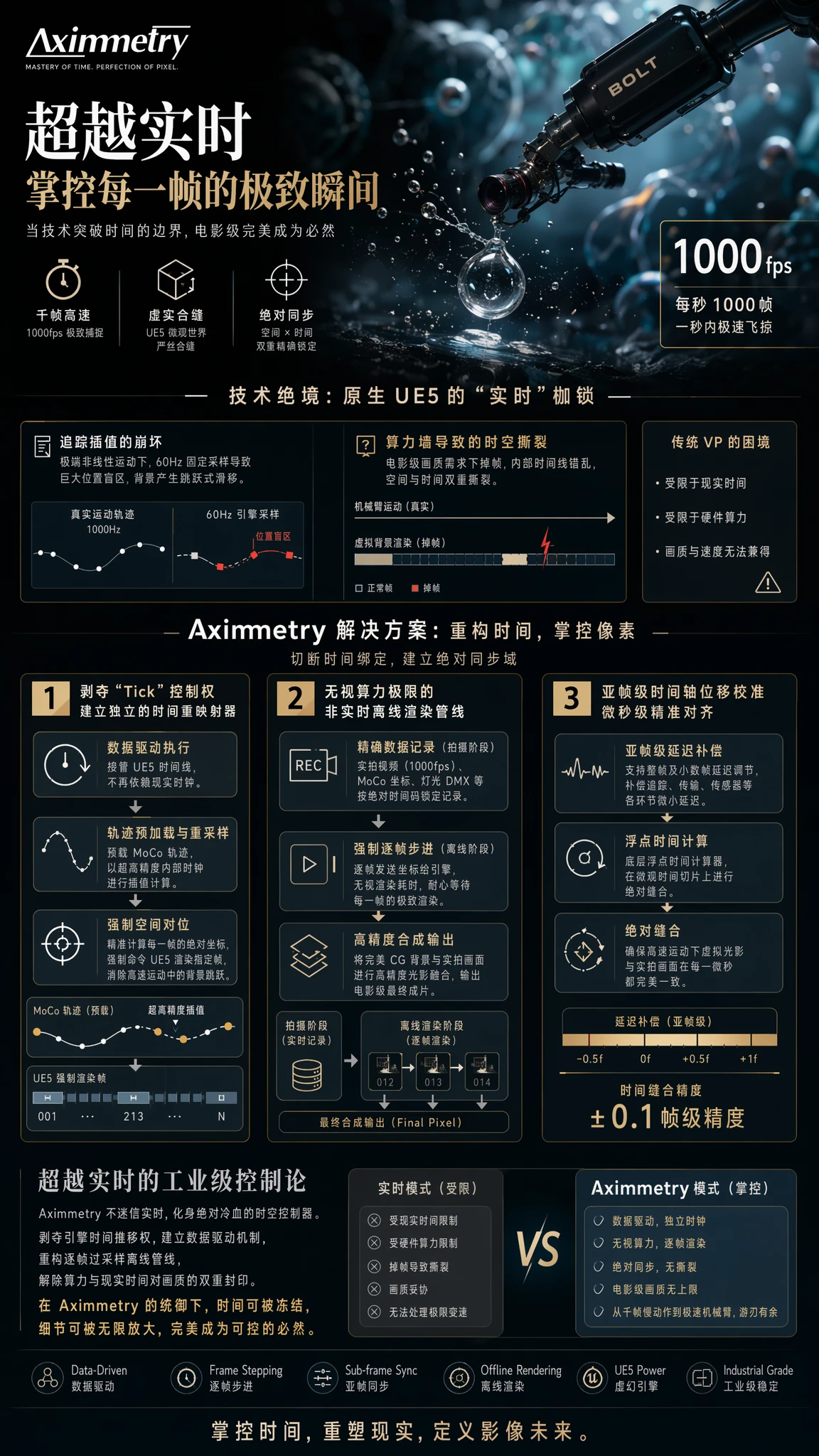
 When the director demands the use of a Bolt robotic arm to fly past a water droplet at an extreme speed of 1000 frames per second (1000fps) within one second, while requiring the virtual background (a micro-world rendered in UE5) to perfectly align with the live-action water droplet in terms of spatial perspective and temporal dimension, a technical dead end emerges.
In the native Unreal Engine (UE5), its underlying time logic is based on“the ”game engine's Tick (frame-by-frame update)", commonly known as “Real-time.” By default, if one second passes in real time, the engine must also pass one second, and it forcibly outputs at, for example, 60fps.
When encountering MoCo's extreme speed changes or ultra-high frame rates:
- Tracking interpolation breakdown: MoCo's motion is extremely nonlinear (instant acceleration to very high speeds). If the engine still consumes MoCo's tracking data at a fixed 60Hz, a huge positional blind spot occurs between two frames, causing the virtual background to exhibit extremely stiff “jumping slippage” during acceleration phases.
- Temporal tearing caused by the compute wall: If the director requires UE5 to enable cinematic Lumen, full ray tracing, and billions of Nanite geometry, the GPU simply cannot maintain 60 frames per second (each frame might take 0.5 seconds to render). Once the engine drops frames, its internal timeline becomes disordered. The result: the robotic arm has already reached its endpoint, while the virtual background has only played halfway—spatial and temporal tearing occur simultaneously.
Faced with such extreme industrial demands that break the “real-time” rule,Aximmetrythe solution provided is extremely ruthless and powerful:Sever the engine's binding to real time, establishing an absolute synchronization domain based on “Data-Driven Frame Stepping” at the underlying level.
Core Solution 1: Deprive the “Tick” of control, establishing an independent time remapper
The first step for Aximmetry to solve the MoCo challenge is to“disengage the clutch”—completely cut off the engine's own clock (Real-time Clock) and take over the control of time progression.
- Data-Driven Execution: Aximmetry intercepts UE5“s timeline at the underlying level. The engine no longer renders the next frame based on ”how many milliseconds have passed in reality," but insteadonly obeys Aximmetry's commands.
- Tracking data preloading and resampling: MoCo's greatest advantage is that its trajectory is extremely precise and repeatable. Aximmetry can directly import MoCo's trajectory files (such as FBX or dedicated XML pre-programmed files). Before formal shooting, Aximmetry already knows the absolute coordinates of the robotic arm at every millisecond. When the arm starts at extreme speed, Aximmetry uses an ultra-high-precision internal clock far exceeding the engine's frame rate to perform extremely high-precision interpolation of the motion curve. It precisely calculates the perfect spatial position of the camera at frame 213 and forcibly commands UE5: “Don't care how much real time has passed; now, immediately render this frame at camera coordinates (X,Y,Z)!” This forced spatial alignment completely eliminates background jumping during high-speed motion.
Core Solution 2: “Offline Rendering / Sequencer” pipeline that ignores compute limits
What if the director demands image quality so high that the GPU cannot handle it? In traditional VP, the only option is to compromise and lower quality.
Aximmetry elegantly supports“Frame-by-Frame Oversampling Recording”。
It provides a high-end recording pipeline independent of real-time live broadcasting:
- Precise binding of live footage and coordinates: During shooting, even if the real-time engine stutters like a slideshow, it doesn't matter. Because Aximmetry locks and records the live green screen video stream (even a 1000fps slow-motion source), MoCo's precise spatial coordinates, and all lighting DMX parameters to the hard drive based on absolute timecode.
- Forced Frame Stepping: After shooting, the offline rendering phase begins. Aximmetry controls the engine to enter “non-real-time mode.” Aximmetry sends the previously recorded coordinates (e.g., frame 12) to the engine. Even if the engine needs a full 2 seconds to render this frame to perfection using top-tier Path Tracing, Aximmetry patiently waits. Once the engine finishes rendering this frame, Aximmetry performs extremely high-precision advanced compositing of the live footage with this perfect CG background, compressing it into a final video frame, and then sends the command for frame 13 to the engine.
This “forced stepping” architecture, freed from the constraints of real time, makes Aximmetry the perfect bridge between “real-time preview (Pre-vis)” and “final cinematic output (Final Pixel).” Compute power is no longer the ceiling for image quality.
Core Solution 3: Sub-frame timeline shift calibration
When dealing with high-speed photography, microsecond-level errors are magnified. For example, if the tracking data trigger is a quarter of a frame late relative to the video stream, the image may still blur or misalign during fast pans.
Aximmetry has built an extremely rigorousSub-frame Delay Compensation systemwithin its Flow Graph. The visual effects supervisor can not only adjust the delay of a full frame but also fine-tune by fractions of a frame (e.g., compensating for subtle filtering delays in the tracking system's internal gyroscope). Aximmetry's underlying floating-point time calculator performs absolute stitching of the camera's motion trajectory with the live video at extremely microscopic time slices, ensuring that behind every high-speed splash of water, the refraction of virtual light is in the absolutely correct position.
Conclusion: Industrial-grade cybernetics beyond “real-time”
“Real-time” is Unreal Engine's most powerful weapon, but it is also its greatest shackle when facing extreme industrial filming.
Because real filmmaking involves not only smooth 24fps but also狂暴的千帧慢动作、极速的机械臂,以及对画质上限无底线的压榨。 In these extreme physical and compute pulls, the native engine's underlying clock mechanism, designed for gaming experiences, is destined to fall apart.
Aximmetry demonstrates extremely advanced system architecture capabilities. It does not blindly believe in “real-time” but instead transforms into anabsolutely cold-blooded time-space controllerBy depriving the engine of its underlying time progression control, establishing a forced data-driven mechanism, and reconstructing the frame-by-frame oversampling offline pipeline, Aximmetry completely lifts the dual seal of compute power and real time on image quality.
Under its command, Unreal Engine becomes a perfect pixel workshop where time can be frozen at will and details infinitely magnified. It is this ability to arbitrarily disassemble, knead, and perfectly reassemble the timeline that makes Aximmetry an irreplaceable industrial cornerstone in the highest-end commercial visual effects shooting.

 简体中文
简体中文  English