
Over the past three decades in the film and television industry,Green Screenhas been the undisputed “king of visual effects.”
From *Avatar* to *Avengers*, countless fantastical worlds were born in a green-tinted studio, painstakingly “keyed out” frame by frame by post-production VFX artists.
However, technology evolves relentlessly and rapidly. Today, in Hollywood and top-tier production hubs in China,traditional green screens are being rapidly phased out, replaced by the LED walls of XR virtual production.
Why is this “industry hero,” which dominated for decades, now facing the fate of being abandoned by history?
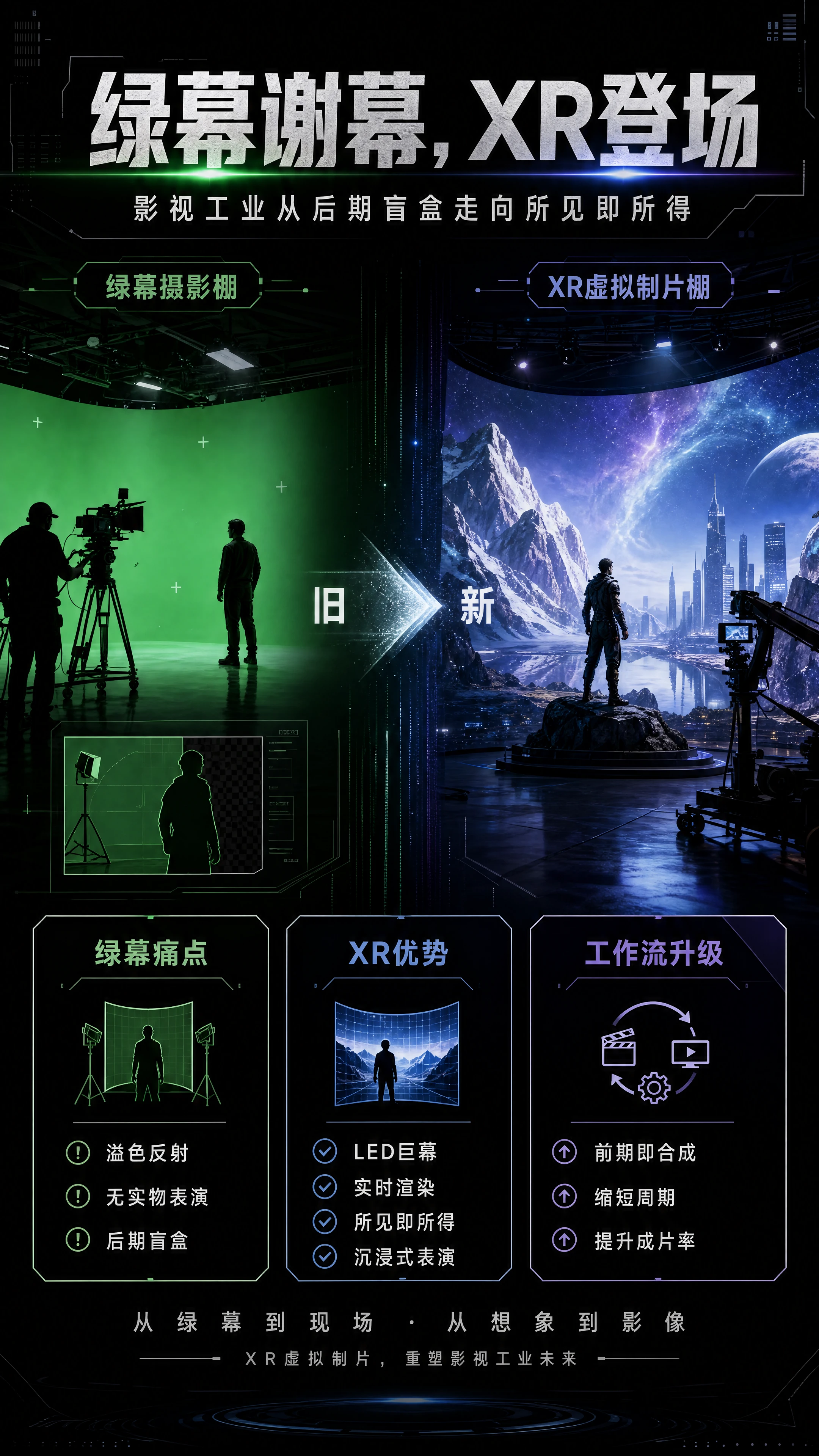
I. The “Three Fatal Flaws” of Green Screens”
The invention of green screen technology was a great leap forward, but as audiences demand higher visual fidelity, its limitations have become glaring, turning into a major headache for production crews.
- The Unsolvable “Green Spill” Green screens are green because this color is least likely to be confused with human skin and hair. But this comes with a critical side effect:Green light reflects. When strong lights hit the green screen, the green light spills onto actors“ skin, hair, clothes, and even props. Post-production VFX artists spend enormous effort ”cleaning up" these stubborn green edges, often with unnatural results.
- The Torturous “Acting with Nothing” In a green screen studio, actors face an empty green void and a few marker poles with tape. “Look to the left—there's a dragon breathing fire at you.” Actors rely solely on their imagination to perform, a draining exercise in “suspension of disbelief” that often results in superficial performances.
- The “Post-Production Blind Box” with No End in Sight” Green screen shooting means “post-production determines the final result.” Directors and producers watch monitors showing a “green background” on set, reassuring themselves: “It'll look great after post.” But months later, when the VFX are composited, perspective mismatches and lighting inconsistencies emerge. Fixing them at that stage costs nearly as much as starting over.
II. XR Virtual Production: The Perfect Replacement
XR virtual production emerged, using a“LED wall + real-time rendering”combination to shatter all the pain points of green screens.
A “Quantum Leap” in Physical Lighting”
In an XR studio, the background is no longer a reflective green screen but a high-quality LED wall. The virtual world displayed on the screen itself becomes the light source. The cold light of snow-capped mountains, the red glow of a volcano, the dappled green of a forest—allnaturally and realistically fall onto actors and props.No more spill, no more fake lighting composites—the visual quality instantly reaches cinematic levels.
The Liberation of “What You See Is What You Get”
For directors and producers, XR's greatest appeal is eliminating the “blind box.” On set, the monitor shows the final composited image. Is the spaceship in the background moving too slowly? Adjust the parameters on the spot. Not enough clouds in the sky? Draw them in with a mouse.“Post-production moved upfront” gives the creative team absolute control over the final product.
An “Immersive” Experience for Actors
When an actor stands in an XR studio, surrounded by towering snowy peaks and falling snowflakes (played on the LED wall), they no longer act against a tennis ball. They can truly “see” the world. This immersion instantly unlocks their best performance—their eyes, breath, and emotional expression become incredibly authentic.
III. This Is Not Just a Tech Upgrade, But a Workflow Revolution
From green screen to XR, on the surface it's a change of “background panel,”but at its core, it's a restructuring of the entire film and television production workflow.
- In the green screen era, the workflow was linear: Scriptwriting → Shooting (green screen) → Post-production VFX → Final film.
- In the XR era, the workflow is cyclical and interactive: The 3D post-production scene is built before shooting; the set itself is the compositing stage, with a completion rate of over 80%.
This transformation not only shortens production cycles by more than 30% but also frees creators from being bogged down by tedious post-production processes, allowing them to return to the artistic essence of “storytelling” and “refining performances.”
Conclusion
The tide of technological change never bends to human will.
Green screens accompanied us through a long and magical era of digital cinema, earning their place in history. But as the LED walls of XR virtual production rise, the era of the green screen has indeed come to a close.
Farewell, green screen; hello, the future of infinite reality.

 简体中文
简体中文  English