
In traditional film sets, capturing a “Fast & Furious”-style car chase often requires deploying Hollywood's largest and most expensive“Steel Behemoths”。
You need a pursuit vehicle traveling at hundreds of kilometers per hour, with a giant hydraulic crane known as the “Russian Arm” mounted on its roof; you need to block off entire city streets and deploy dozens of traffic police and safety officers; you also need to purchase astronomical insurance for that multi-million-dollar cinema-grade camera, violently jolting mid-air.
This kind of shooting is a gamble involving human lives, money, and the limits of physics.
But today, if you walk into an XR (Extended Reality) virtual studio, you'll witness an extremely eerie scene:
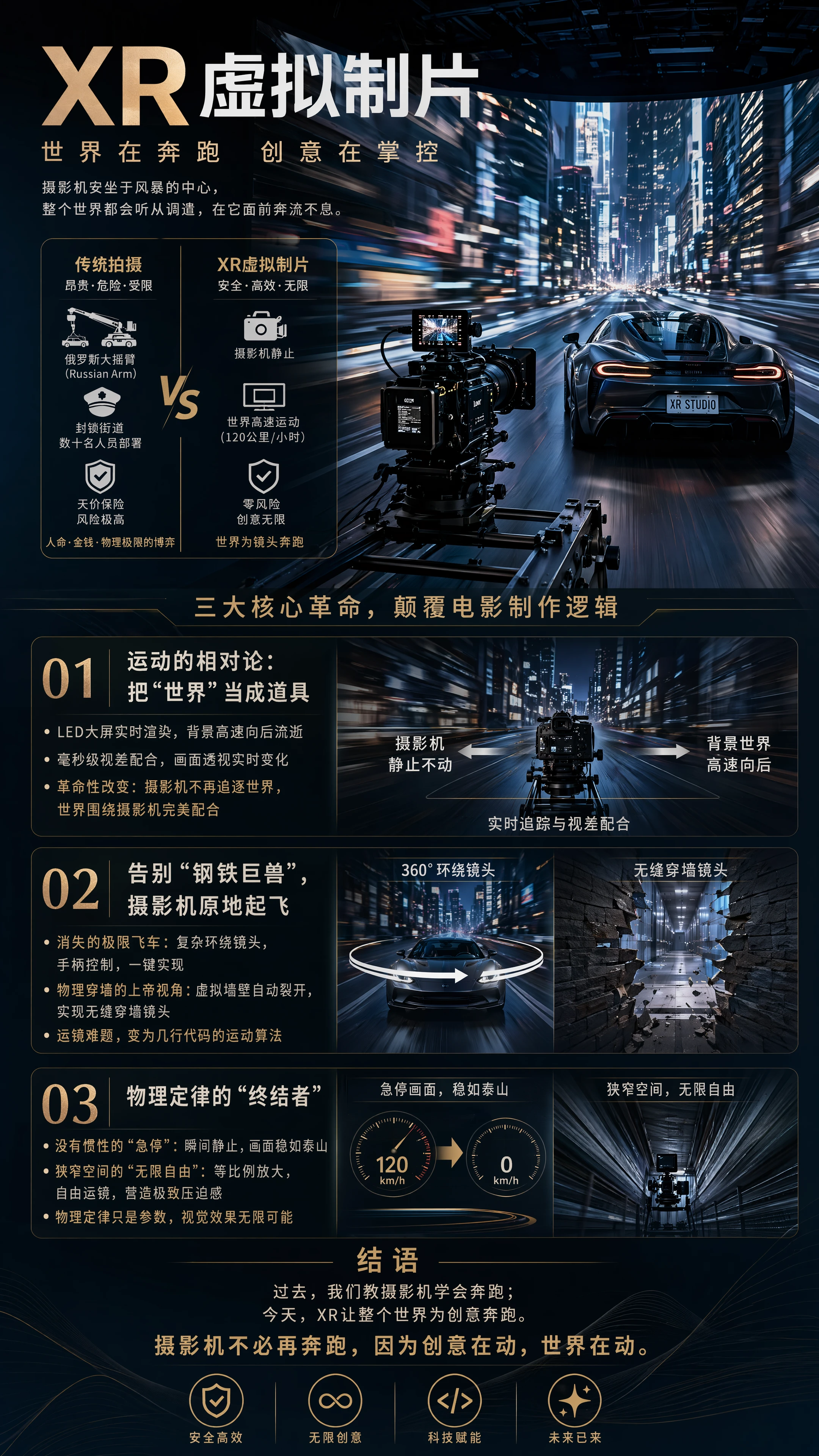
That prop sports car sits still in place, and the camera is securely mounted on a dolly track, barely moving. Yet on the director's monitor, the entire city is racing backward at 120 kilometers per hour.
In this visual miracle,The camera hasn't moved at all—it's the entire world that's sprinting for it.
I. The Relativity of Motion: Treating the “World” as a Prop
XR virtual production executes an elegant“Relative Motion Magic Trick”。
Based on physics principles, when you sit in a stationary train and the train beside you starts moving backward, your brain creates the illusion that you are moving forward. XR technology pushes this illusion to its extreme.
- Letting the background run instead of the camera: In front of the LED wall, actors and vehicles remain still. But the 3D city streets generated by a real-time rendering engine (such as Unreal Engine) on the large screen are racing backward at extremely high speed.
- Millisecond-level parallax coordination: Not only does the background move, but when the on-site camera adjusts 5 centimeters to the left, the tracking system instantly commands the virtual world on the LED wall to rotate the corresponding angle to the right. This real-time change in perspective (parallax) convinces the lens that it is traveling through a high-speed moving space.
[Revolutionary Change]: Previously, the camera had to chase the moving world; now, the entire world revolves around that stationary camera, performing a perfect, seamless coordination.
II. Farewell to “Steel Behemoths,” the Camera Takes Off in Place
This logic of “relative motion” completely liberates the cinematographer. Those “god-level shots” that once required sky-high equipment can now be easily “freeloaded.”
- The Vanishing “Extreme Stunt Car”: In reality, capturing a wrap-around shot from the front of the car to the back, then rotating 360 degrees, requires extremely complex stunt driving and crane coordination. In an XR studio, the cinematographer only needs to stand still and use a controller to rotate and scale the virtual scene on the LED wall.The image spins, but the actors and cinematographer don't even have a hair out of place.
- The “God's-Eye View” of Physical Wall-Passing: Traditional wall-penetrating shots require actually drilling holes in the wall or complex post-production effects compositing. But in an XR studio, the wall is virtual. As the camera moves forward, the “digital wall” on the large screen automatically splits open to both sides the moment the lens approaches, achieving a “seamless wall-penetrating” shot that is physically impossible.
Those camera movement challenges that once kept cinematographers up all night have now become motion algorithms behind a few lines of code on the screen.
III. The “Terminator” of the Laws of Physics”
In real outdoor shooting, the camera is mercilessly battered by physical laws like gravity, inertia, and tight spaces. But in the XR world, the laws of physics are just a“Parameter”。
- that can be modified at any time. Inertia-Free “Sudden Stop”:
- In reality, when a heavy camera weighing dozens of kilograms moves at high speed, inertia prevents it from stopping instantly, inevitably causing image shake. But in an XR studio, because the physical camera barely moves, you can make the virtual world on the large screen “stop instantly,” resulting in a rock-steady image with maximum visual impact. “Infinite Freedom” in Tight Spaces:
Conclusion
Want to capture a wide crane shot inside a narrow elevator shaft or even a space capsule? In reality, the camera simply can't fit. But in an XR studio, you can “scale up” the virtual scene proportionally, allowing the cinematographer to move freely in the spacious studio, while the large screen shrinks and restores the image in real time, creating an extreme sense of oppression.
In the over one hundred years since the birth of cinema, we have been teaching the camera to "learn to run." We invented tracks, cranes, Steadicams, and drones, just to keep up with this fleeting real world.
Yet XR virtual production overturns this logic with technology—it lets the camera sit calmly at the center of the storm, becoming the singularity of the universe.

 简体中文
简体中文  English