
In the real-world workflow of virtual production (VP) and XR live streaming, if only a single-camera “one-shot” approach is used, this technology is already quite mature.
But if you have ever served as a TD (Technical Director) for any large-scale XR broadcast, you know that the moment the director shouts “Prepare to cut to Camera 2,” the hearts of the backstage technical team skip a beat.
In a traditional vision mixer, multi-camera switching is just a video signal cut (Cut) that takes a few milliseconds. However, in a real-time pipeline based on Unreal Engine 5 (UE5),multi-camera switching is nothing short of a disaster at the engine's core.
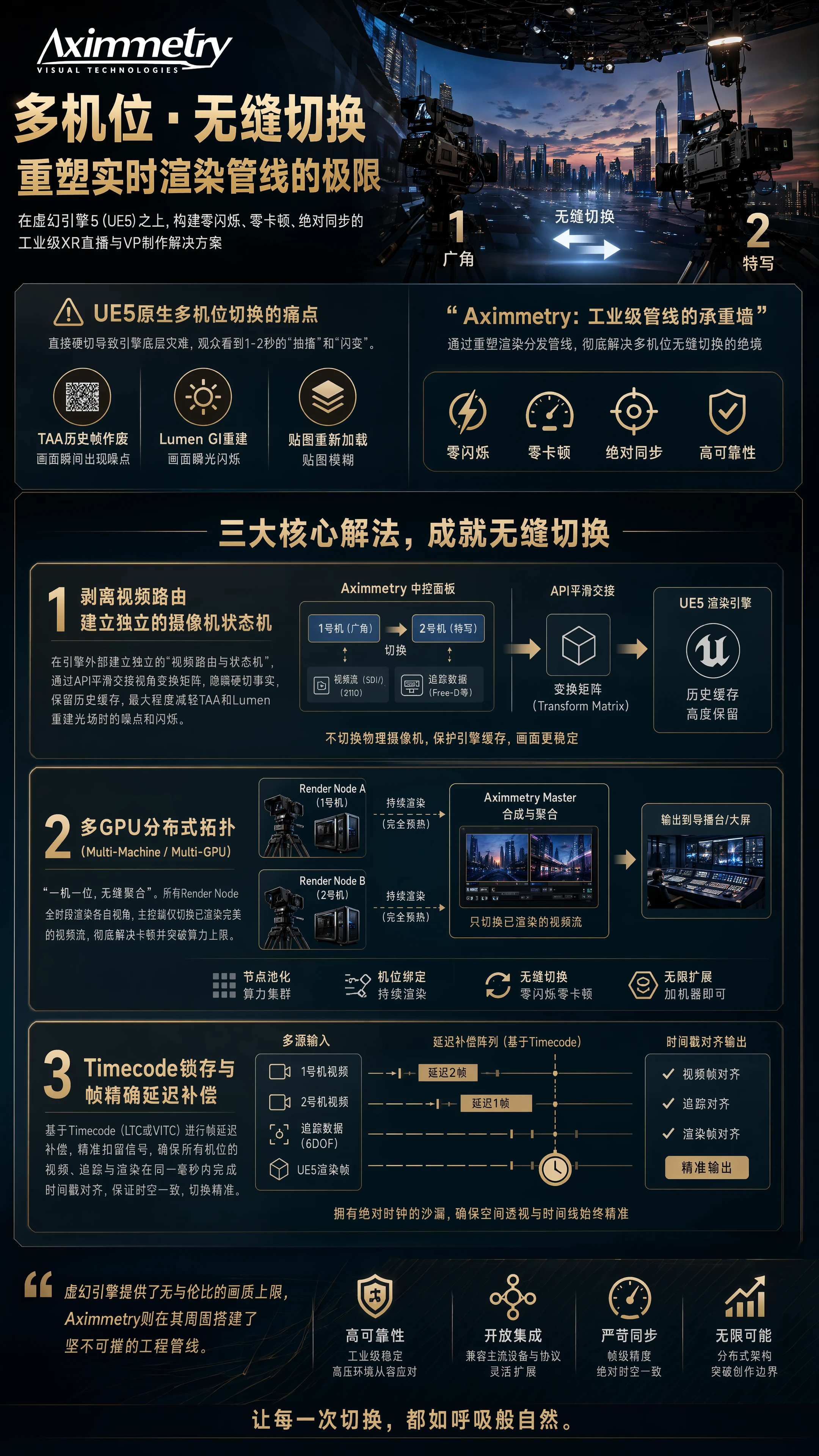
Why? Because UE5 (especially after enabling Lumen and Nanite) heavily relies on Temporal Anti-Aliasing (TAA/TSR) and History Buffers. When you instantly cut from Camera 1 (wide shot) to Camera 2 (close-up), the engine's view frustum undergoes a drastic change:
- All the TAA history frames previously accumulated by the engine become invalid, causing instant noise in the image;
- Lumen's Global Illumination (GI) needs to recalculate diffuse reflections, leading to exposure flickering;
- High-resolution textures (Mipmaps) need to be reloaded, resulting in texture blur.
If you use UE's native nDisplay for a direct hard cut, the audience will see 1-2 seconds of “stuttering” and “flickering” on screen. This is absolutely unacceptable in demanding broadcast television and film production.
Faced with this inherent pain point at the core of UE,Aximmetrythe solution provided is akin to a surgical revolution in real-time rendering pipeline architecture. By reshaping the rendering distribution pipeline, it completely resolves the dilemma of seamless multi-camera switching.
Core Solution One: Decouple Video Routing, Establish an Independent Camera State Machine
When using native UE for multi-camera setups, many teams try to write blueprints inside the engine to switch virtual cameras. This is the primary cause of cache clearing and system crashes.
Aximmetry's approach is:To establish an independent “Video Routing & State Machine” outside the engine. Aximmetry intercepts all physical camera video streams (SDI/2110) and tracking data (Free-D, etc.) within its own control panel. When the director presses the switch button on the Aximmetry interface, inside the UE5 engine, there is actuallynophysical camera switching happening.
Aximmetry uses underlying APIs to extremely smoothly “hand over” the current Unreal Engine rendering view's Transform Matrix from Camera 1“s data to Camera 2”s data. This handover is highly optimized at the core level, hiding the fact that "we are hard-cutting camera positions" from the engine, thereby maximizing the retention of history caches in the rendering pipeline and significantly reducing the noise and flickering caused by TAA and Lumen rebuilding the light field.
Core Solution Two: Multi-GPU Distributed Topology (Multi-Machine / Multi-GPU)
If the project is extremely complex (e.g., a billion-polygon outdoor large scene heavily reliant on ray tracing), relying solely on a single GPU in one machine to handle camera switching instantly presents an insurmountable computational bottleneck. A true industrial-grade solution must rely on distributed rendering.
While native UE has features like Multi-User, the configuration is extremely cumbersome and prone to disconnections. Aximmetry, through its enterprise-grade architecture (Aximmetry Broadcast DE), pushes the multi-camera pipeline to the pinnacle of distributed rendering:
“One Camera, One Node, Seamless Aggregation”
- Node Pooling: Aximmetry can connect multiple workstations equipped with top-tier GPUs (Nodes) into a single computational pool.
- Camera Binding: You can assign Camera 1's tracking data to Render Node A for continuous rendering, and Camera 2's data to Render Node B for continuous rendering. At this point, all machines arerendering their respective camera viewsfull-time, at full capacity (with caches and ray tracing information fully pre-warmed).
- Master Compositing: Aximmetry's Master unit acts solely as a “pure video/depth map” compositor. When the director switches cameras, the Master unit is simply switching between already perfectly rendered video streams. Because Render Node B has been rendering continuously, there is no Lumen flickering or texture loading issue at the moment of the switch.
This architecture not only completely solves the stuttering problem but also addresses the computational ceiling issue—if the scene gets more complex, just add more machines.
Core Solution Three: Timecode Locking and Frame-Accurate Delay Compensation
In multi-camera production, what's most frustrating isn't just rendering stutter, but also“the misalignment of video, tracking, and rendering output timing.”Camera 1 might pass through a video matrix, adding a 2-frame delay; Camera 2 might go directly into a capture card, adding a 1-frame delay. If the timing isn't synchronized when switching cameras, the image will exhibit spatial jumps.
Aximmetry, within its underlyingVideo I/O module,incorporates an extremely rigorous delay compensation array. As a TD, you can set individual frame delay compensation based on Timecode (LTC or VITC) for each camera's input source within Aximmetry's Flow Graph. Aximmetry acts like an hourglass with an absolute clock, precisely holding back signals that are running fast until the real video frames, 6DOF tracking coordinates, and UE5's render frames from all cameras achieve Timestamp alignment within the same millisecond before allowing the image to be output.
This ensures that no matter how many cameras or how complex the topology network you switch between, the spatial perspective and the physical world's timeline remain as precise as a scalpel.
Conclusion: The “Load-Bearing Wall” of the Industrial-Grade Pipeline”
Many people mistakenly believe Aximmetry is just a “good chroma key software” or a “node-based patching tool.” But in the eyes of technical engineers who have truly been responsible for billion-level broadcast projects, Aximmetry is an irreplaceable“load-bearing wall”。
in the real-time rendering pipeline. Unreal Engine provides an unparalleled ceiling for visual quality, but it natively lacks the underlying mechanisms for broadcast-grade multi-camera setups, absolute frame synchronization, and high-pressure fault tolerance. Aximmetry, with its unique external state machine, elegant distributed rendering topology, and rigorous clock synchronization system, builds an indestructible engineering pipeline around UE5.
It is precisely because this pipeline takes over the dirtiest, most laborious, and most crash-prone I/O and distribution work at the core level that frontline teams can confidently press the multi-camera switch button during live broadcasts, presenting flawless visual spectacles to a global audience.

 简体中文
简体中文  English