
On the set of cinematic virtual production (ICVFX) and high-end automotive/commercial shoots, technical teams bridging the “virtual and real space” often encounter an insurmountable“Optical Divide”。
Traditionally, we rely on external spatial tracking systems (e.g., Mo-Sys StarTracker, Vicon, Ncam) to obtain the 6DOF (six degrees of freedom) spatial coordinates of the camera body. For the lens's FIZ (Focus, Iris, Zoom), the traditional approach involves attaching physical motor encoders externally to the lens.
However, this “external patchwork” pipeline has fatal industrial limitations:
- Mechanical Lag and Wear: Physical gears exhibit minute mechanical slack during high-speed zooming and follow-focus operations, causing a visible “focus desync” in the depth of field between the virtual and real worlds on a millisecond scale.
- Calibration Black Box: The lens profile established manually using a checkerboard calibration target is a static, discrete database that cannot fully simulate the extremely complex non-linear optical distortion and edge attenuation (vignetting) inside modern high-end cinema lenses.
To address this pain point, top lens manufacturers like ARRI and Cooke have introducedSmart Lens Metadata Systems(ARRI LDS/LDS-2, Cooke /i Technology). These lenses integrate micro electronic contacts at the mount, capable of outputting highly precise physical focus distance, aperture value, zoom position, and even real-time non-linear distortion and shading maps as digital signals at a frequency of tens of times per second.
However, these precious “optical truth data” are encapsulated within theAncillary Data (ANC) packetsof the SDI video stream or dedicated serial buses.
How can one intercept this high-speed metadata in real-time, fuse it with spatial tracking data at the nanosecond level, and perfectly drive the cinematic rendering of Unreal Engine 5 (UE5)?
Aximmetry plays an indispensable role here as the“Optical Digital Umbilical Cord”By reconstructing the metadata unpacking and hybrid tracking pipeline at the underlying level, it completely eliminates the optical disconnect between virtual and real in high-end film production.
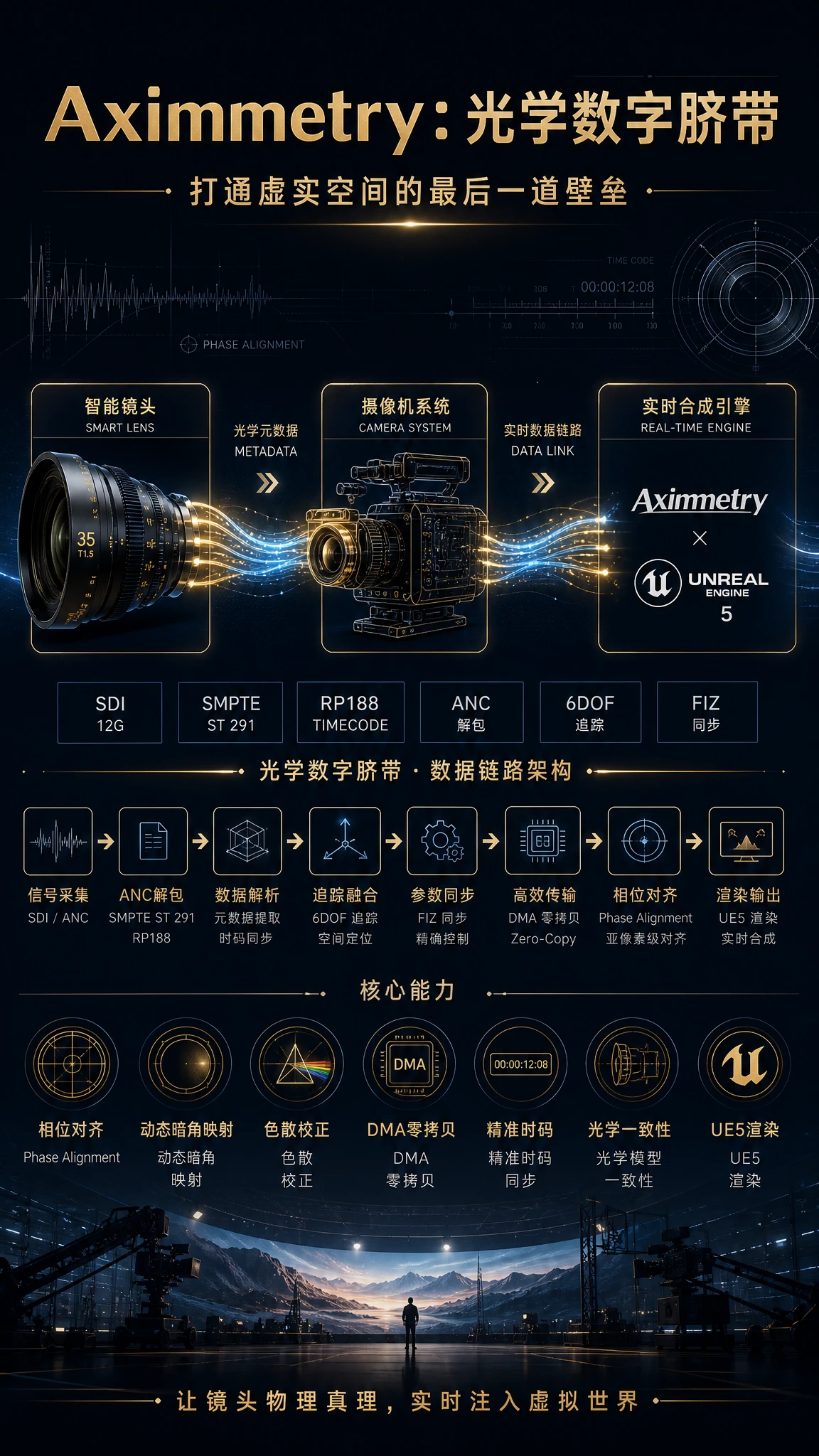
Pain Point 1: The Real-Time Unpacking Disaster of SMPTE ST 291/RP188 Ancillary Data (ANC)
Smart lens metadata (e.g., Cooke /i or ARRI LDS) is typically embedded by the camera (e.g., ALEXA 35, RED V-RAPTOR) into the ancillary data space of the SDI signal, following the SMPTE ST 291 (ANC) or RP188 (Timecode & Metadata) standard.
If using UE5's native I/O interface directly, the engine simply cannot read and parse these underlying SDI VANC (Vertical Ancillary Data) packets. Forcing unpacking logic via a third-party plugin on the CPU would cause severe thread stalls due to the high-frequency data stream, leading to drastic jitter in the rendering frame rate.
[Smart Lens (LDS/i-tech)]
│ (Mount contact data)
▼
[Camera (Encapsulates metadata into SDI/IP ANC field)]
│
▼ (12G-SDI / ST 2110 signal)
[Aximmetry Underlying I/O Driver (DMA Zero-Copy Unpacking)]
│
├─► [Extract precise FIZ data] ───┐
│ ▼ (Forced alignment based on SDI frame boundary timestamp)
└─► [Extract SDI physical timecode] ─┼─► [Synthesize unified optic-spatial state matrix] ──► [Inject into UE5 render pipeline]
▲
[External Spatial Tracking (6DOF coordinate data stream)] ───┘
Aximmetry's Underlying Restructuring:
Aximmetry rewrites the data link at its I/O driver layer (directly interfacing with AJA or Blackmagic hardware SDKs).
When the 12G-SDI signal enters the workstation, Aximmetry utilizes the GPU's DMA (Direct Memory Access) technology to instantly strip the smart lens metadata packets from the SDI VANC field under a zero-copy premise.
This process completes silently within the video memory and the lowest-level I/O threads, consuming no CPU main thread processing power. Aximmetry acts like a high-energy physical packet unpacker, translating unstructured SDI ancillary data into high-precision floating-point FIZ values within microseconds.
Pain Point 2: Spatial and Optical Phase Alignment in Hybrid Tracking
In high-end car chase or crane shots, you have two independent sets of data:
- One set is the physical camera'sspatial trajectory (6DOF Position Matrix);
- transmitted via optical calibration systems (e.g., Vicon infrared cameras).The other set is the smart lens's。
optical state (Focus/Iris/Zoom)
unpacked from the SDI cable.
Aximmetry's Underlying Restructuring:
These two data sets originate from two completely different hardware worlds and travel along different transmission paths. Spatial tracking data might be transmitted over a local network (UDP/IP) with a latency of approximately 15-20ms; while lens metadata within SDI travels with the video stream, potentially incurring a latency of 2-3 frames (33-50ms).If these two "temporally misaligned" data sets are fed directly into UE5, the image will suffer catastrophic misalignment: When the camera moves rapidly and the focus puller simultaneously turns the focus wheel, the virtual scene's bokeh will exhibit an eerie delay due to the temporal misalignment of spatial position and optical focus, instantly breaking the illusion.Aximmetry, with its powerfulFlow Graph Time Latch Matrix。
, implements Phase Alignment on these two asynchronous data streams at the underlying level.
- Aximmetry introduces an absolute synchronization mechanism based on the SDI Physical Frame Boundary Clock
- : Unified Timestamp:“Using the timecode of the SDI video frame entering the capture card as the benchmark, it forcibly stamps the real-time unpacked LDS/i-tech lens metadata and the externally incoming 6DOF tracking data with a ”spacetime tag" from the same temporal dimension.”Ring-Buffer Sync:
Aximmetry establishes a dynamic ring data buffer. If the spatial tracking data arrives faster, Aximmetry holds it back. Only when the lens FIZ data (from the slower SDI ancillary channel) representing the same physical instant arrives does Aximmetry assemble them into a
"Unified Optic-Spatial Matrix"
and dispatches it all at once to UE5's render pipeline within the same V-Sync cycle.
This precise phase alignment ensures that regardless of how violently the image moves or how quickly the focus switches, the spatial perspective and optical depth of field remain in absolute physical self-consistency.
Aximmetry's Underlying Restructuring:
Pain Point 3: Real-Time Dynamic Vignetting and Chromatic Aberration Pixel-Level MappingThe physical characteristics of a real lens change dynamically with different Iris and Zoom settings. For example, when the aperture is opened wide to F1.2, edge light falloff (vignetting) becomes extremely severe, and noticeable green/purple fringing (chromatic aberration) appears at the edges of the optical axis; when the aperture is stopped down to F8.0, these imperfections almost completely disappear.In traditional virtual production, the vignetting and chromatic aberration parameters in the Post Process Volume are statically set. This results in the virtual background's edge vignetting in the composite image failing to adjust in real-time with changes in the real lens's focal length and aperture, revealing the "fake composite" nature.
Smart cinema lenses (e.g., ARRI Signature Prime) can directly output real-time
│
dynamic Shading Maps and Chromatic Aberration Correction Coefficients
Aximmetry seizes this advanced feature to reshape the real-time post-processing compositing chain.
[Aximmetry Real-Time Unpacking LDS-2 Data]
├──► [Extract dynamic vignette rate] ───┐
│ ▼
- └──► [Extract chromatic aberration offset] ─────────┼─► [Inject into Aximmetry ultimate pixel shader] ▲ (Performs pixel deformation on the final composite image)
- [UE5 Rendered Flawless 3D Background] ─────────────────────────────┘ Parameter-Level Dynamic Mapping (Parameter Injection):After Aximmetry unpacks the LDS-2 vignetting and chromatic aberration coefficients in real-time, it injects them directly into the final pixel shader of the post-processing pipeline via its high-speed parameter channel.。
Fully Dynamic Post-Processing Compositing:
The moment a focus puller on set violently racks the aperture from F5.6 to F1.4, Aximmetry senses this change and immediately applies
pixel-level dynamic dimming and chromatic shifting
to the edges of the perfect background rendered by UE5 at the very end of the compositing chain.
The edge characteristics of the virtual scene respond with flawless synchronization to the changes in the real lens's physical structure. This unification of microscopic optical properties invisibly and completely eliminates the “sticker-like” feel of the virtual-real composite, achieving true cinematic fusion.
Conclusion: The Unshakeable Guardian of Optical Truth

 简体中文
简体中文  English