
As a TD who has been responsible for AR broadcasting of S-level esports finals or New Year's Eve galas, if you have experienced “data-driven graphics,” you must be familiar with the fear of a potential crash at any moment.
“Director, director! Wait a second, the bullet chat interface just flooded in with ten thousand pieces of data, and UE's Blueprint froze!” “The player just got a triple kill, and the API sent back three kill signals. The AR mech's model animations are overlapping and glitching out!”
This is the native Unreal Engine (UE5) when handlinghigh-concurrency dynamic data (Data-Driven Graphics)the most easily exposed technical blind spot.
UE5's core is a powerful rendering machine, accustomed to playing animations along a timeline or preset logic. However, when exposed to a real live broadcast environment, facing hundreds of HTTP/WebSocket requests per second, complex JSON deserialization, and unpredictable data surges:
- String parsing can severely block the main thread (Main Thread Stall): causing the rendering frame rate (FPS) to plummet instantly.
- Logic race conditions in the animation state machine (Race Condition): If the entry animation for the previous data hasn't finished playing and the next data rushes in, the logic line can instantly become tangled.
- Garbage collection disaster (GC Thrashing): A large number of temporarily generated string variables can trigger frequent UE memory reclamation, causing periodic stuttering.
Facing this “API concurrency storm” capable of destroying an entire broadcast,Aximmetrythe trump card deployed is:Completely stripping away data parsing authority, establishing a bulletproof data buffer zone and state machine outside the engine.
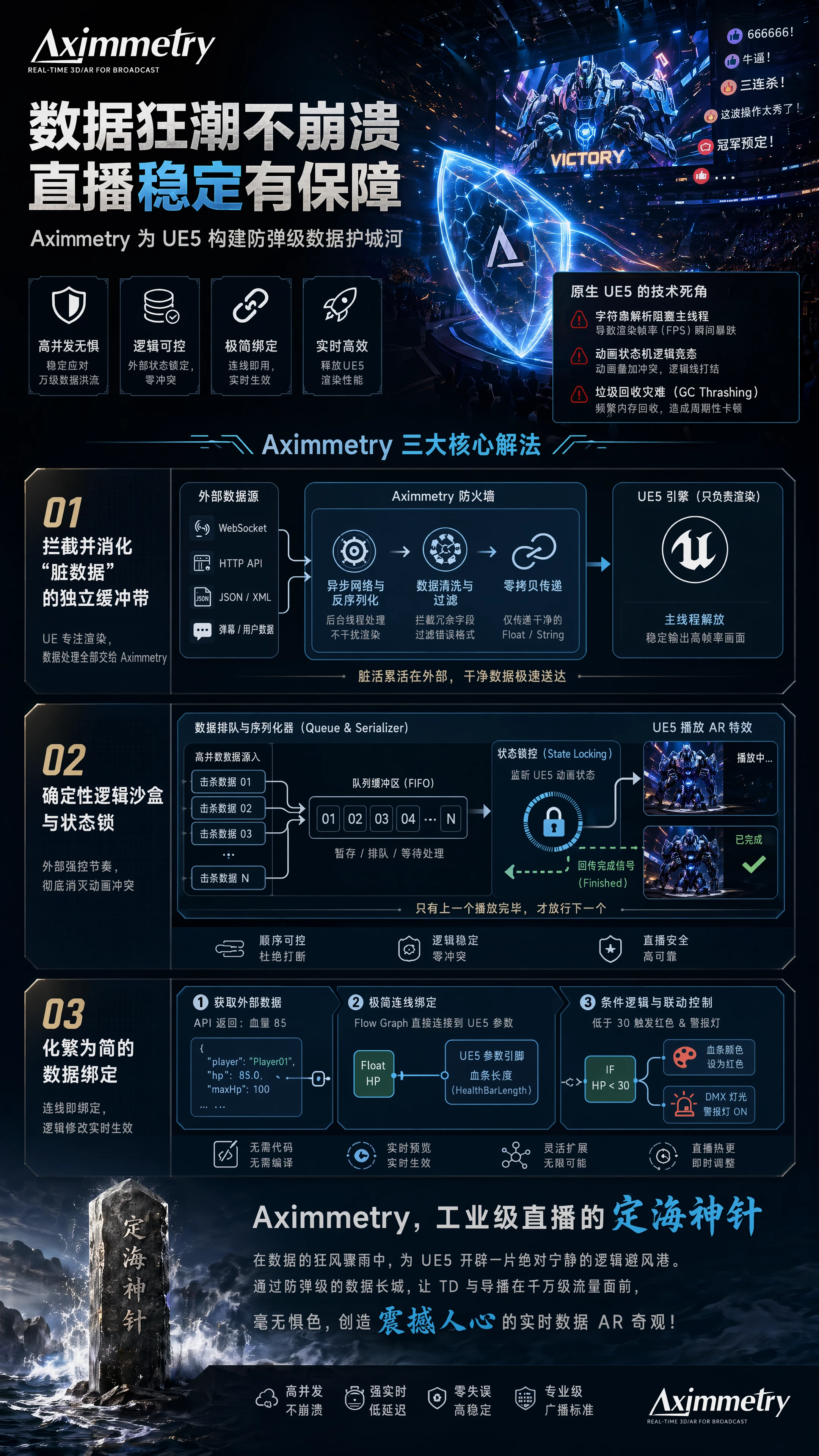
Core Solution One: An Independent Buffer Zone to Intercept and Digest “Dirty Data”
In Aximmetry's pipeline philosophy, “dirty and heavy work must never be left for UE, which handles the rough work.”
Aximmetry positions itself as the system's“First Firewall”:
- facing external data. Async Networking & Deserialization:
- Aximmetry's underlying network module is written in highly optimized C++. It can handle high-frequency WebSocket or HTTP requests with extreme ease. Whether it's complex JSON nesting or XML, Aximmetry completes parsing instantly in its own background threads (completely without interfering with video rendering). Data Sanitization & Filtering:
- If the API sends a bunch of useless redundant fields or formatting errors, Aximmetry's Flow Graph nodes can directly intercept and clean them. Zero-Copy Transfer:Only pure floats or stringsthat have been cleaned, validated as safe and useful, are then lightly “handed off” to UE5 by Aximmetry via the high-speed channel of shared memory. The engine is only responsible for displaying the final values, and the main thread is completely liberated.
Core Solution Two: Deterministic Logic Sandbox and State Lock
The data is clean, but “how to play it” remains a critical issue. If 10 kill data entries surge in within a short time, how do you ensure the AR model in UE5 doesn't crash due to animation conflicts?
Aximmetry builds an extremely powerful“Deterministic Logic Sandbox”:
- externally. Data Queue & Serializer:
- In Aximmetry's Flow Graph, you can easily pull out a Queue node. When the API stuffs 10 data entries into it within 1 second, this node acts like a calm traffic officer, temporarily storing all data in the queue. State Locking:Aximmetry monitors UE5's current animation state. Only when "Kill AR Effect 1" has perfectly finished playing in the engine and sends a "Finished" trigger signal back to Aximmetry, will Aximmetry's traffic officer node be allowed to release the second data entry from the queue into UE5. Thisexternally enforced state control
completely eliminates the tragedies of "animation interruption and logic overlap" that often occur with engine-internal Blueprints.
Core Solution Three: Simplifying Complexity with Data Binding
In a native pipeline, to have a UI Blueprint read external data, you often need to write many complex Event Dispatchers and strong references.Aximmetry, through its minimalistFlow Graph Connections
- achieves extremely elegant data binding.
- You obtain a value representing “current player health” in Aximmetry (e.g., Float: 85).
- You simply draw a line on the interface, directly connecting it to a "health bar length" parameter pin exposed by the UE5 engine.
No code, no compilation. When the external API health value jumps to 40, the health bar model in UE5 instantly shortens.
If the director suddenly requests: “Can we turn the color red when health drops below 30 and trigger an alarm light?” In Aximmetry, you just add an "IF" judgment node, connect one line to the color parameter, and another line to the physical DMX lighting console. All logic modifications take effect in real-time during the live broadcast (Hot-Reload), which is an unimaginable luxury in a native pipeline.”
Conclusion: The "Stabilizing Pillar" of Industrial-Grade Live Broadcasting
On the live broadcast battlefield demanding zero errors, strong real-time performance, and high concurrency, system stability always trumps polygon count.
While the native Unreal Engine has a gorgeous appearance, its underlying game-level architecture often proves too fragile when facing the wild and disorderly data flood of the real world.
Aximmetry profoundly understands this fragility. It doesn't try to steal the spotlight from UE5 but acts like a steady “stabilizing pillar,” firmly planted at the intersection of external data and engine rendering.

 简体中文
简体中文  English