
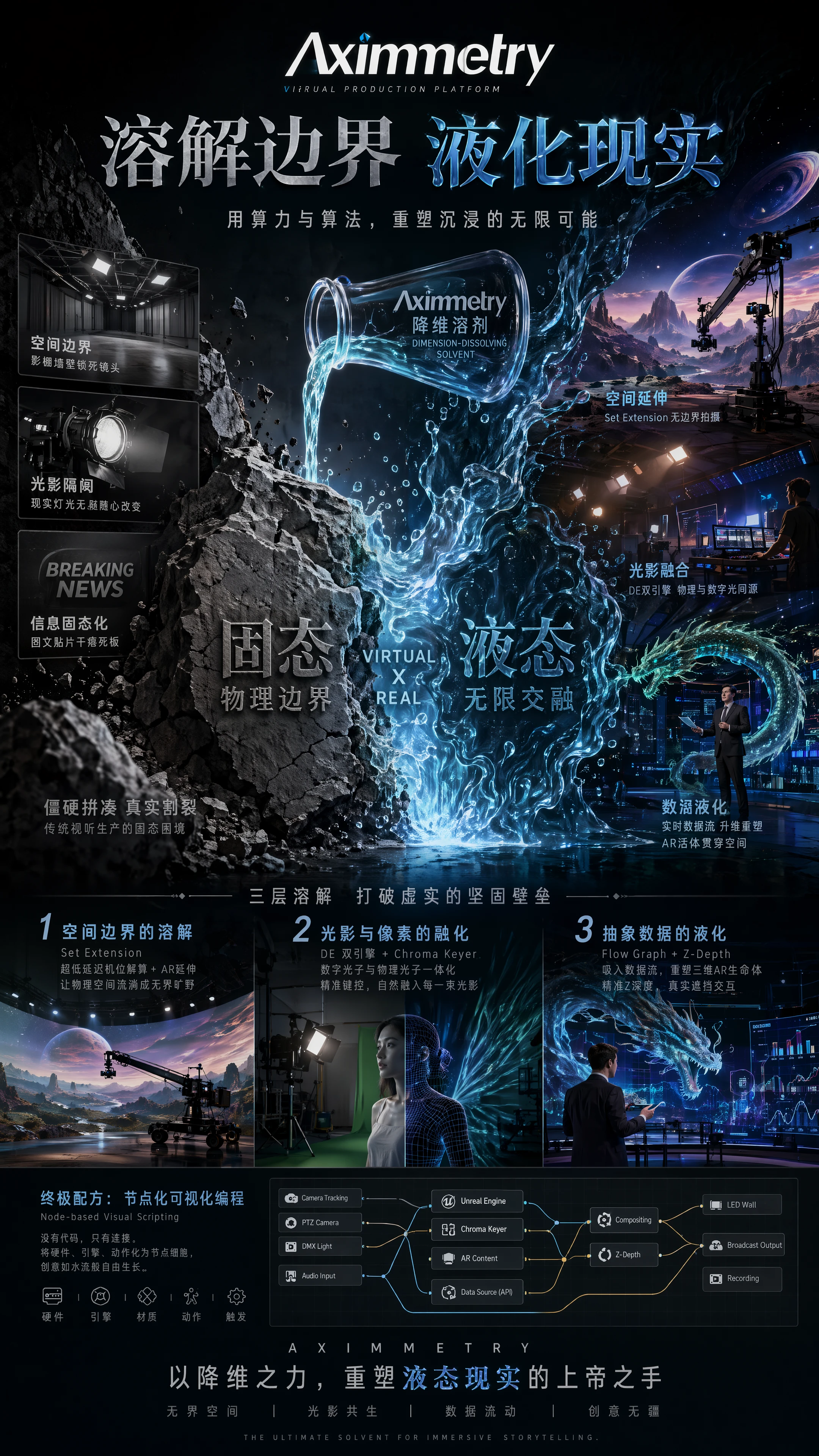
If we zoom in on traditional audiovisual content production at a microscopic level, you'll find it is pieced together from chunks of hard “solid matter.”
The walls of a studio spanning just a few dozen square meters are solid, locking the camera's range of motion; the lights hitting an actor's face in reality are solid, unable to freely change color or angle; even the TV graphics viewers see on screen are solid, clinging to the picture like withered paper cutouts.
This “solid” physical law fills virtual production (VP) and live broadcasting with a rigid sense of patchwork. In this era of pursuing ultimate immersion, what we need is not how to squeeze two stones tighter, but a way to“dissolve”the stones with a powerful solvent.
This is precisely whyAximmetryThe fundamental reason it is hailed as a masterpiece. It is not a simple compositor, but a highly destructive and creative“dimensional solvent”in the audiovisual industry. Catalyzed by computing power and algorithms, it dissolves heavy physical boundaries layer by layer, allowing the virtual and the real to achieve impeccable fusion in a “liquid” state.
First Layer of Dissolution: Dissolving the Hard Rock of “Spatial Boundaries”
In an LED volume studio (XR shooting), the worst nightmare is the camera panning off-screen—at that moment, the meticulously crafted alien fantasy instantly collides with the cold, hard studio ceiling.
Aximmetry applies a powerful solvent to this physical boundary through ultra-low-latency camera tracking. This is its proud“Virtual Scene Extension (Set Extension)”When the camera approaches the physical edge of the LED screen, Aximmetry instantly “melts” it using AR technology. The once rigid screen border disappears, replaced by a three-dimensional digital wilderness extending infinitely outward. The end of physical space is completely liquefied, and the studio of a few dozen square meters flows into a boundless universe within the lens.
Second Layer of Dissolution: Melting the Stubborn Crystals of “Photons and Pixels”
The essence of fake effects is the “immiscibility” of light and pixels.
In the past, light from a real set could not enter the computer, and computer-rendered light could not reach reality. Aximmetry's pioneeringDE (Dual-Engine) architectureacts like a drop of solvent breaking the optical dimension. Using the DMX protocol, it merges the digital sunlight of Unreal Engine (UE5) with the physical fill lights of the real set. When a real lighting technician pushes up a spotlight, the virtual sun in the engine also shines brighter simultaneously; physical photons and digital photons are dissolved in the same optical reaction chamber.
On traditional green screen sets, the spill around the green screen edge is the most stubborn visual crystal. Aximmetry features industry-leadingChroma KeyerIt does not perform harsh “keying cuts” but uses algorithms to “dissolve” green screen pixels into absolutely transparent channels, while perfectly preserving the refraction of translucent cups, flying strands of hair, and easily shattered contact shadows. Characters are no longer rigid paper cutouts pasted onto the background but naturally settle into the digital environment like water droplets dissolving into the sea.
Third Layer of Dissolution: Liquefying the Dry Shell of “Abstract Data”
In high-pressure live broadcasts like esports tournaments and financial summits, massive network data is often dull and rigid.
Aximmetry's node logic (Flow Graph) can ingest these external API data streams in real time and perform “dimensional liquefaction” on them. When a stock surges or an esports player lands a finishing blow, the two-dimensional subtitles originally floating on the screen surface are instantly dissolved and reshaped into a three-dimensional AR dragon or连绵的立体山脉. More astonishingly, Aximmetry can precisely calculate the Z-Depth of the studio. When this AR dragon flies through the live room, it is perfectly occluded by the real host. The dry data is dissolved and recast into a “living organ” with physical weight, flowing freely through the air of the live room.
Ultimate Formula: Alchemy Using “Nodes” Instead of Code
A solvent that is too dangerous, if extremely complex to operate, will backfire on the user. In the past, to manipulate these complex virtual-real interactions, creators had to memorize and write tens of thousands of lines of obscure C++ code.
Aximmetry elegantly melts this “ice of code” as well. It provides creators with an ultimate container called“Node-based Visual Scripting”.
- Here, there are no hard-to-remember code commands. Every piece of hardware (tracking crane, PTZ camera), every engine material, every trigger action becomes a visual “node cell” on the interface.
- Artists only need to drag connection lines with the mouse to link these cells together.
- This extremely intuitive operation completely “liquefies” the once steep technical learning curve. A director has a flash of inspiration: “Let the live sound volume control the intensity of virtual rain.” The next second, a few connections turn the idea into reality on screen.
Conclusion: The God Hand Reshaping Liquid Reality
What we pursue on screen is never “looking real,” but “a reality that cannot be doubted.”
As long as reality and the virtual remain in solid patchwork, the audience's eyes will always find that cold seam. With its astonishing computing power scheduling, aggressive rendering engine, and universal hardware compatibility, Aximmetry successfully plays the role of the “dimensional solvent” in this audiovisual revolution.
It dissolves spatial limitations, melts the barriers of light and shadow, and converges heavy physical laws with wild digital imagination into a surging undercurrent called “immersion.” In this new audiovisual era liquefied by Aximmetry, creators for the first time possess the ultimate privilege of freely molding time and space like water.

 简体中文
简体中文  English