
On the set of cinematic LED virtual production (ICVFX), the most expensive asset is not the graphics card, nor the LED wall, buttime。
To maximize shooting efficiency, directors often demand“multi-camera simultaneous shooting”For example: Camera A captures a wide shot, while Camera B simultaneously captures a close-up of the actor. However, in front of a single LED wall, this triggers a devastating“Frustum Collision”。
Because the LED screen can only display a high-definition background with correct perspective for Camera A (Inner Frustum) at any given moment. If Camera B is forced to shoot, the background it captures will be completely stretched, distorted, and reveal the illusion.
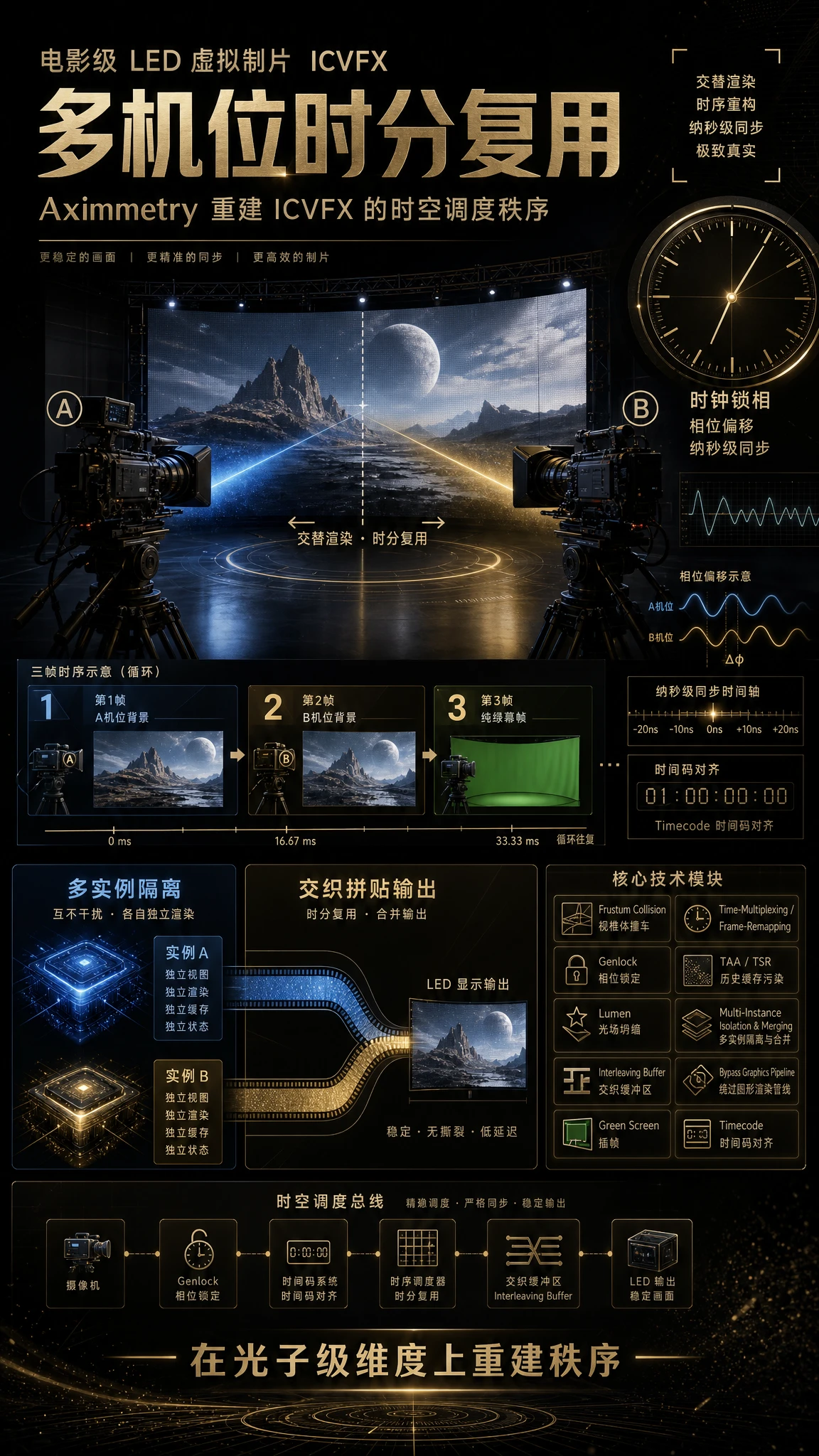
To overcome this physical limitation, the industry has introduced the most advanced synchronization technology—Time-Multiplexing / Frame-Remapping。
The principle is to boost the LED screen's refresh rate to its physical limit (e.g., 120Hz, 192Hz, or even 240Hz) and phase-lock it with the shutters of multiple cameras viaPhase Shifting:
- Frame 1: The LED wall renders Camera A's background, Camera A's shutter opens, capturing the frame;
- Frame 2: The LED wall renders Camera B's background, Camera B's shutter opens, capturing the frame;
- Frame 3 (optional): The LED wall renders a pure green screen, Camera C's shutter opens, capturing clean footage for post-production VFX.
All this happens within hundreds of tiny slices per second. The human eye sees only a blurred mix, but each camera captures an absolutely clean, interference-free perfect image.
However, this “photon interleaving” magic is, in terms of system integration, anindustrial-grade nightmareIt requires:
- Microsecond-level phase shifting of camera tri-level sync (Genlock);
- High-speed frame sequencing by LED processors (e.g., Brompton Tessera, Megapixel Helios);
- The Unreal Engine 5 (UE5) rendering pipeline alternating between two completely different camera perspectives at over 120fps.
Native UE5 nDisplay is extremely fragile when faced with this alternating rendering.
This article delves into how Aximmetry as a“spatiotemporal scheduling bus”, overcomes the three most critical underlying technical black holes in the time-multiplexing pipeline.
Pain Point 1: UE5 History Buffer Contamination and TAA/TSR Collapse
Unreal Engine 5 (UE5), to achieve cinematic quality, relies heavily on its underlying Lumen global illumination and TSR (Temporal Super Resolution) which are extremely dependent on“History Buffers”和and Motion VectorsIt uses pixels from the previous frame to calculate noise reduction and light bounces for the current frame.
In a 120Hz time-multiplexing pipeline, the render sequence is:Camera A -> Camera B -> Camera A -> Camera B。
If UE5 renders frame by frame directly, the engine's default buffer mechanism will cause severe“spatiotemporal cross-contamination”:
- and Ghosting: When rendering Camera A, the engine incorrectly reads the history buffer from the previous frame (Camera B) for temporal denoising, causing strange residual artifacts on the edges of Camera A's image due to Camera B's perspective.
- Lumen Light Field Collapse: Because the frustums of the two cameras are completely different, Lumen's ray tracing field is forcibly cleared and recalculated every 1/120th of a second, causing harsh flickering and a computational avalanche.
Aximmetry's Underlying Restructuring:
Aximmetry, with its unique“Multi-Instance Isolation & Merging”architecture, rewrites the rendering topology from the ground up.
Under the Aximmetry DE architecture, it does not hard-switch cameras within a single UE5 instance. Instead, it runstwo completely isolated engine render instances (Engine Instances)simultaneously in the background, locked to Camera A and Camera B respectively.
- Instance A has its own dedicated, clean TAA history buffer and Lumen render tree. It is solely responsible for rendering odd frames from Camera A's perspective at a 1/120-second rhythm;
- Instance B operates independently, rendering even frames from Camera B.
Aximmetry's underlying Frame Orchestrator then establishes a high-speed “Interleaving Buffer” within the GPU memory. At a highly precise physical frequency of 120Hz/240Hz, it interleaves the frames rendered by the two independent engine instances like the teeth of a zipper, outputting them to the LED processor.
This completely eliminates buffer contamination between cameras, preserving Lumen's high quality while eradicating temporal anti-aliasing ghosting.
Pain Point 2: Nanosecond-Level Clock Drift in Genlock Phase Shifting
The core of time-multiplexing is to open the camera shutter within a specific, fleeting millisecond window. For example, at 120Hz, each camera's exposure time is less than 4 milliseconds.
If the Genlock signal phase angle of a camera drifts by just 1 millisecond (0.001 seconds), the camera shutter will open during the transition period when the LED screen is refreshing the next camera's background. In the captured footage, this manifests as a faint overlay of Camera B's image on Camera A's film (physical light leakage, Camera Leakage).
On set, manually adjusting the phase offset between cameras and the LED controller is extremely painful. Furthermore, due to network latency and hardware clock thermal drift, the system will develop tinyClock Drift。
Aximmetry's Underlying Restructuring:
after running for several hours.“Aximmetry acts as the entire system's”。
"Master Clock Commander"It no longer passively accepts external signals. Instead, by directly controlling the hardware-level Genlock input of high-end video SDI/IP capture cards (e.g., AJA Kona 5), it consolidates the server's render clock, the tracking system's metadata clock, and the PTP/tri-level sync signals from external physical sync generators (e.g., Evertz) into Aximmetry's internalof that virtual light source through one-dimensional matrix operations.
high-precision hardware Phase-Locked Loop (PLL)
Aximmetry's Flow Graph can output microsecond-level control commands. When it detects even the slightest frame sync jitter, it can fine-tune and adjust the sync phase sent to the LED processor and tracking system in real-time via API.
This self-feedback "closed-loop phase-locking system" ensures that the camera's shutter angle and the LED screen's photon emission cycle remain unbreakably and absolutely aligned over tens of hours of continuous shooting.
Pain Point 3: Real-Time Dynamic Green Screen Frame Insertion and Multi-Channel Deep Fusion
In Hollywood-level productions, directors not only want dual-camera live shooting but also desire a backup camera (Camera C) to capture a pure green screen background. This allows for a painless switch back to the traditional VFX compositing workflow if the virtual background is unsatisfactory in post-production.
This requires forcibly inserting a frame ofpure green screen background (with virtual tracking markers)into the。Camera A background -> Camera B background

 简体中文
简体中文  English