
Imagine an S-level broadcast project requirement: The main director's room and master control room are in Los Angeles; Host A is in a green-screen-equipped sub-studio in London; Guest B is in another green-screen studio in Tokyo. The director's requirement: These two real people, thousands of miles apart, must be “sitting” on the same virtual studio sofa in real time, and when the host in London hands out a virtual trophy, the guest in Tokyo must visually “catch it seamlessly.”
If your first reaction is “Use Zoom or SRT to send the video back to Los Angeles, then key out both people in the engine and composite them together,” as a Technical Director (TD), you will immediately encounter a“Physical Catastrophe of Spatiotemporal Dislocation”。
In native Unreal Engine (UE5) and traditional video production pipelines, Wide Area Network (WAN) transmission is fatal:
- Asymmetric Latency Disaster: The video stream latency from London to Los Angeles is 150ms, and from Tokyo to Los Angeles is 120ms. If rendering directly in Los Angeles, the timelines of the two people are misaligned (Tokyo is 30ms faster than London).
- “Soul Departure” of Tracking Data and Video Footage: The 6DOF spatial tracking data (very small data packets) from the London camera can reach Los Angeles in just 50ms, while the encoded high-quality green screen video stream takes 150ms. If the UE5 in Los Angeles directly consumes this data, it will render the background using the “camera position from 50ms ago” but pair it with the “actor footage from 150ms later,” causing a catastrophic sliding of the virtual perspective.
- Conflict of Heterogeneous Coordinate Systems: The London studio is 3 meters high, the Tokyo studio is 2 meters high, and the optical nodal points of the two cameras have completely different origins. If they are forcibly placed into the same virtual space, the Tokyo guest might end up half-buried in the sofa.
Faced with this collapse of physical laws caused by geographical distance,AximmetryThe solution provided is nothing short of spatial magic:Completely abandon the outdated “centralized rendering” approach and establish an industrial-grade REMI (Remote Integration) topology architecture based on “edge distributed rendering, central spatiotemporal alignment.”
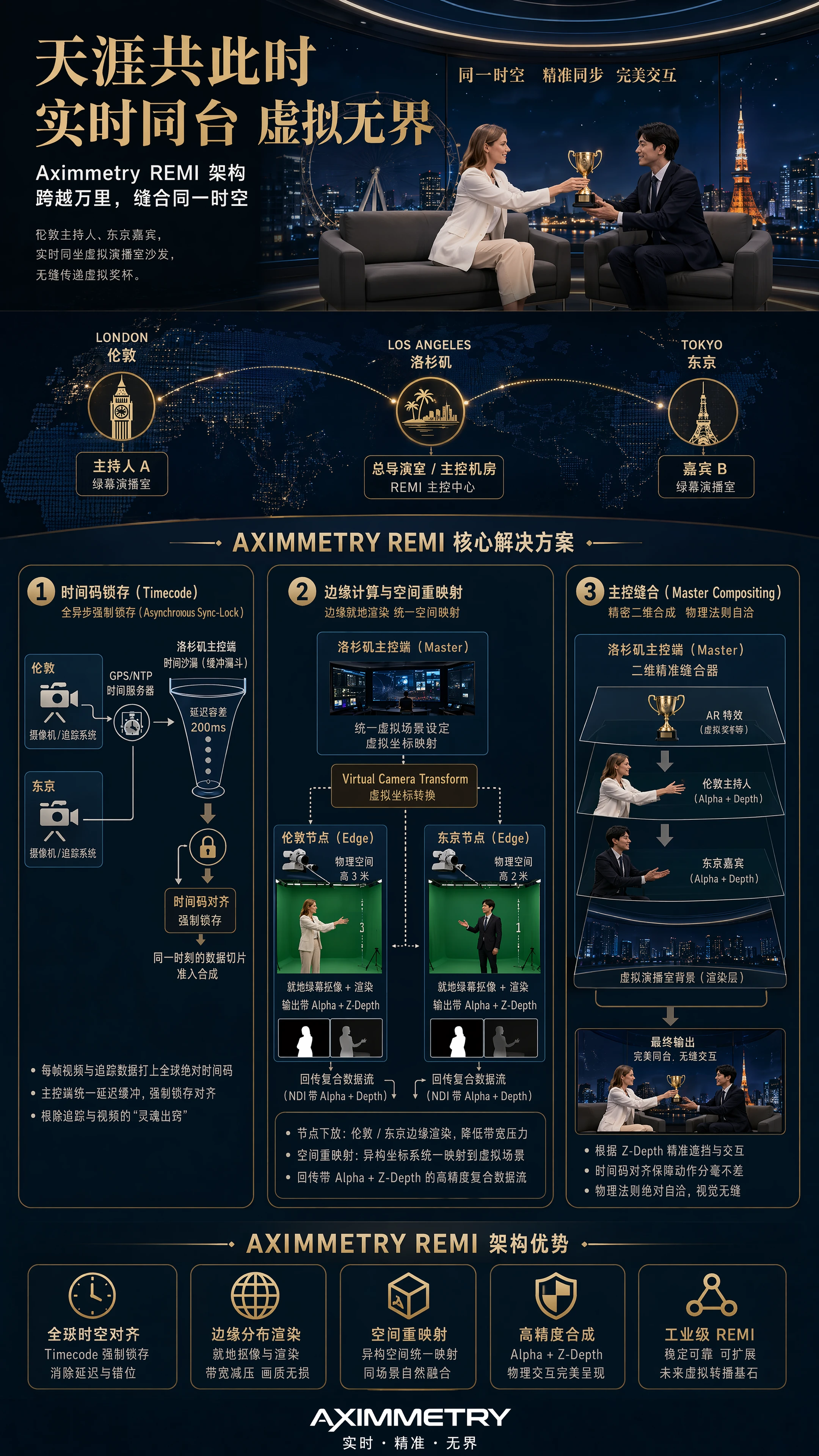
Core Solution 1: “Asynchronous Sync-Lock” Based on Timecode”
Aximmetry's first step in solving cross-border latency is to establishabsolute temporal dominance over the chaotic public network data.
It completely abandons the passive logic of “render whenever the data arrives.”
- Source Timestamping: At the remote sites in London and Tokyo, Aximmetry nodes require the camera video stream and tracking system to connect to the same GPS/NTP time server. Every video frame and every set of coordinate data is stamped with an absolutely precise global timecode before leaving its local site.
- The Master's Hourglass: When these timestamped data streams flood into the Aximmetry Master in Los Angeles like tangled threads, Aximmetry's underlying video I/O module transforms into a massive “buffer funnel.” It sets a global latency tolerance (e.g., a uniform delay of 200ms). Even if tracking data arrives 150ms early, Aximmetry ruthlessly “detains” it in memory until the video frames (e.g., London's Frame A and Tokyo's Frame B) with absolutely matching timestamps have all arrived. Before assembling all slices bearing the “same year, month, day, and millisecond,” Aximmetry will never release any data set to the downstream compositing pipeline. This forced sync-lock completely eradicates the “soul departure” of tracking and video.
Core Solution 2: Edge Rendering and Remapping of Multi-Active Coordinate Systems
If all video from London and Tokyo were sent back to Los Angeles for engine-based keying and rendering, the bandwidth pressure would be immense, and image quality would suffer. Aximmetry's exceptionally elegantdistributed topologysolves this problem.
- Node Decentralization: The Master in Los Angeles is not responsible for heavy 3D rendering. Instead, an Aximmetry rendering node is deployed in both London and Tokyo.
- Space Remapping: The lead TD in Los Angeles sets up the unified virtual scene within Aximmetry's flow graph. Then, using the“Virtual Camera Transform”node, they perform a dimensionality reduction on the physical spaces of both locations. This maps the physical origin (0,0,0) of the London camera to the “left sofa area” of the virtual studio and the origin of the Tokyo camera to the “right sofa area.”
- Local Rendering and Alpha Return: The Aximmetry node in London uses local tracking data and video streams to perform the highest quality green screen keying (Advanced Keyer) with extremely low latency, rendering a “virtual background” with correct perspective and a “foreground talent” with a precise alpha channel. What it sends back to Los Angeles is not just a video, but a composite data stream (e.g., NDI with Alpha channel) carrying Z-Depth and a perfect alpha matte.
Core Solution 3: Master Compositing at the Terminal
Now, what does the Master in Los Angeles receive? Two “fragmented universes” with absolutely aligned timestamps, pre-mapped perspective coordinates, and high-precision transparency channels.
The Aximmetry Master node in Los Angeles now transforms into a pure2D precision stitcherIt doesn't need to run a massive UE5 scene. It simply needs to layer the alpha-keyed host from London, the guest from Tokyo, and locally generated AR effects (like the flying virtual trophy) together seamlessly, like stacking a hamburger, based on Z-Depth.
In this reconstructed spacetime, when the host in London hands over the trophy, the moment the guest in Tokyo reaches out is perfectly synchronized thanks to the forced alignment of timecodes. Because Z-Depth is preserved, the trophy is perfectly occluded by the hands of the two remote guests in turn.
Conclusion: The Ultimate Router Against Physical Distance
“Sharing the beauty of this moment across a thousand li” is romance in ancient poetry, but on the blueprints of live broadcast engineers, it is a nightmare bought with countless late nights debugging data packets.
The essence of the internet is chaos and latency. If you simply expose UE5 as a rendering tool to the WAN, it is like a fragile baby running naked in a storm.
Aximmetry demonstrates the coldness and rigor of a top-tier architecture controller. It is no longer limited to allocating computing power within a single machine but extends its reach across the global internet. Through ruthless timecode-based sync-locking, dimensionality reduction mapping of heterogeneous coordinate systems, and an incredibly clever “edge keying - master compositing” pipeline, Aximmetry has, in this war against geographical distance, literally ironed out the curvature of the Earth with code.
It forcibly knots together the fragmented, misaligned data pieces from Los Angeles, London, and Tokyo via fiber optics, ultimately delivering to the global audience on screen an indestructible, unified spacetime where physical laws are absolutely self-consistent. This is the true cornerstone of future virtual broadcasting (REMI).

 简体中文
简体中文  English