
In the visual dream-making industry, whether it's a sci-fi blockbuster costing hundreds of millions or a top-tier esports livestream with tens of millions of views, a Sword of Damocles hangs overhead—“Visible seams”。
Between actors in the physical world and digitally rendered backgrounds, there is often an insurmountable “gap”: perhaps a harsh green screen edge, misaligned spatial perspective, or mismatched lighting tones. Once the audience detects this gap, immersion instantly collapses.
Among the many technologies attempting to bridge this gap,Aximmetryplays an irreplaceable role. Unlike Unreal Engine, which flamboyantly renders stunning models, it works behind the scenes, transforming into a high-precision“digital loom”Using algorithms as needles and data as threads, it stitches the reality of the physical world and the illusion of the digital world together, thread by thread, into a seamless audiovisual tapestry.
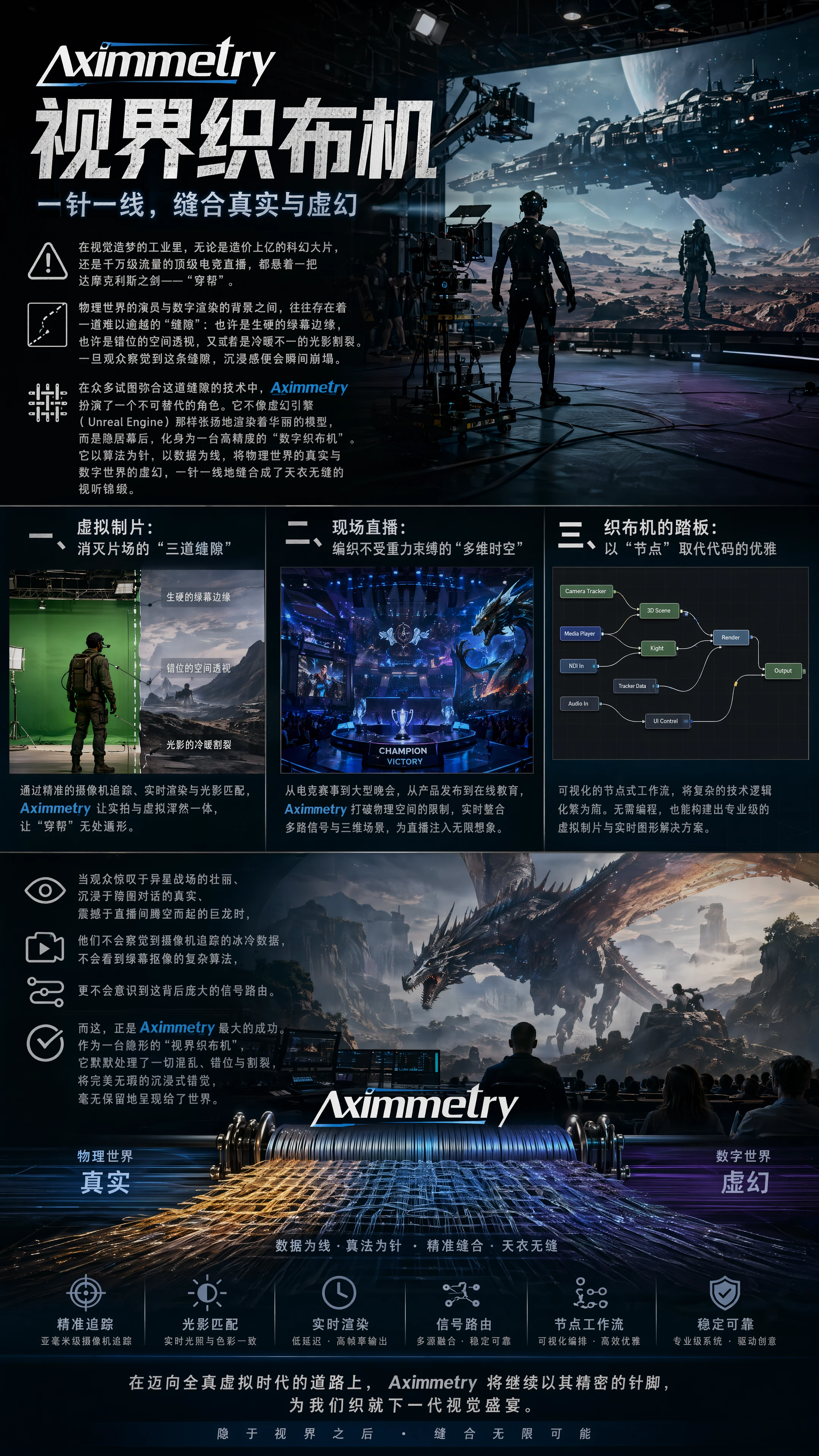
I. Virtual Production: Eliminating the “Three Gaps” on Set”
The essence of virtual production (VP) is to deceive the camera lens. Aximmetry showcases astonishing stitching skills on set, perfectly eliminating three fatal gaps between reality and virtuality.
Eliminating the “Spatial Gap”: Infinite Extension at XR Edges In today's most advanced LED volume studios (XR), the most awkward moment is when the camera pans beyond the physical boundary of the LED screen—in that instant, the virtual universe turns back into a cold studio wall. Aximmetry's“Virtual Scene Extension (Set Extension)”technology is the perfect solution for this. It tracks the camera's frustum in real-time and seamlessly extends the 3D scene from Unreal Engine at the LED screen's edge using AR (Augmented Reality) technology. The physical screen's boundary is perfectly concealed, and a studio of just tens of square meters is “stitched” into a vast, endless world in the lens.
Eliminating the “Lighting Gap”: Photon Synchronization via Dual Engines If the light on the character doesn't match the light in the background, the brain immediately judges the scene as “fake.” Aximmetry's pioneeringDE (Dual Engine) Architectureuses the UE5 engine as the native rendering foundation, achieving a “two-way street” for lighting. On one hand, it leverages UE5“s Lumen global illumination to make digital scene lighting incredibly realistic. On the other hand, through lighting control protocols like DMX, it ”binds“ the fill lights on the real set to the sunlight in the virtual scene. When the lighting technician dims the warm lights in reality, the sunset in the virtual world also fades synchronously. This photon-level synchronized stitching allows actors to truly ”blend into" the digital environment.
Eliminating the “Pixel Gap”: Keying at the Limits of Computing Power For crews using traditional green screens, green spill (green edges around characters) and rough edges on semi-transparent objects are post-production nightmares. Aximmetry features industry-leadingChroma KeyerIt acts like a precision nanoscale scalpel, perfectly extracting flowing individual strands of hair, the complex refraction of a transparent cup, or even the faint contact shadow of an actor's foot on the ground from the green screen. It stitches physical pixels and digital backgrounds together in milliseconds, delivering real-time output quality that rivals months of post-production compositing.
II. Live Broadcasting: Weaving a “Multi-Dimensional Space-Time” Unbound by Gravity”
If film sets can rely on post-production fixes, live broadcasts require all “stitching” to succeed in a fraction of a second. Aximmetry brings a weaving capability that transcends physical laws to live streams.
Weaving Data into Space: Deep AR Packaging Traditional live data (e.g., scores, comments, financial trends) floats on the screen's surface as 2D overlays. Aximmetry can directly read vast network API interfaces, “weaving” these flowing data streams into three-dimensional physical space. When an esports match reaches its climax, Aximmetry can make massive 3D data models, accompanied by lighting and particle effects, accurately “grow” out of the real studio floor. Data is no longer flat subtitles but a real entity with volume and the ability to create occlusion relationships (Z-Depth) with the physical space.
Stitching Geographic Distance: Holographic Remote Connections In global live broadcasts, how do you make guests thousands of miles apart appear to be in the same room? Aximmetry demonstrates the stitching magic of folding space-time. It takes video streams from green screen studios in Beijing and New York, transmits them with low latency, and places them into the same 3D coordinate system within Aximmetry. The system automatically matches the spatial perspective for remote guests and generates virtual shadows between them. What the audience sees is a perfectly aligned “co-hosted conversation” spanning an ocean.
Virtual Switcher: Navigating Digital Stitches In a large-scale gala, Aximmetry allows the director to set up dozens of “virtual cameras” within the generated virtual studio. The director can use the system to smoothly pan, tilt, zoom, and dolly in the virtual space, just like operating a real camera crane. This seamless switching between real camera positions and virtual digital perspectives weaves a visually dynamic broadcast network for the audience.
III. The Loom's Pedal: Elegance Replacing Code with Nodes
Does such high-precision stitching require a large team of programmers coding behind the scenes? Aximmetry's answer is: absolutely not.
It transforms extremely complex underlying logic into an artist-friendlyNode-based Workflow。
- Here, there is no obscure code. Every hardware input (e.g., Mo-Sys tracker, Sony camera) and every output effect (e.g., triggering fireworks, switching lights) is a small block (node) on the screen.
- Visual artists only need to draw a line with their mouse to connect these blocks, weaving countless interactive logics.
This “universal adaptability” not only allows Aximmetry to accommodate all hardware, from high-end cinematic optical tracking costing tens of thousands to consumer-grade VR trackers costing a few thousand, but also completely frees creators“ hands, allowing them to focus 100% on ”creation" itself.
Conclusion: The Invisible Is the Greatest
When evaluating the greatness of audiovisual technology, we often fall into a paradox:The best technology is often the “invisible” technology.
When audiences marvel at the grandeur of an alien battlefield, immerse themselves in the reality of a cross-border conversation, or are awestruck by a dragon soaring in a live stream, they don't notice the cold data of camera tracking, the complex algorithms of green screen keying, or the massive signal routing behind it all.
And this is Aximmetry's greatest success. As an invisible “world loom,” it silently handles all chaos, misalignment, and fragmentation, presenting a flawless immersive illusion to the world without reservation. On the path toward a fully realistic virtual era, Aximmetry will continue to weave the next generation of visual feasts with its precise stitches.

 简体中文
简体中文  English