
As Unreal Engine (UE) breaks out of its niche, the film, television, and broadcasting industries have reached an unprecedented level of pursuit for “real-time rendering.” However, when producers and directors actually bring UE into studios and sets, they encounter a harsh reality:“Looking good” does not equal “working well.”
UE's native environment is complex, lacking broadcast-grade director logic, multi-camera scheduling, and plug-and-play support for various external tracking hardware. It is precisely at this huge gap between “engine visual quality” and “on-site operation” thatAximmetryemerged. It does not replace the engine but instead plays the role of a“real-time compositing master” and “on-site commander,”completely bridging the meridians between the virtual and the real.
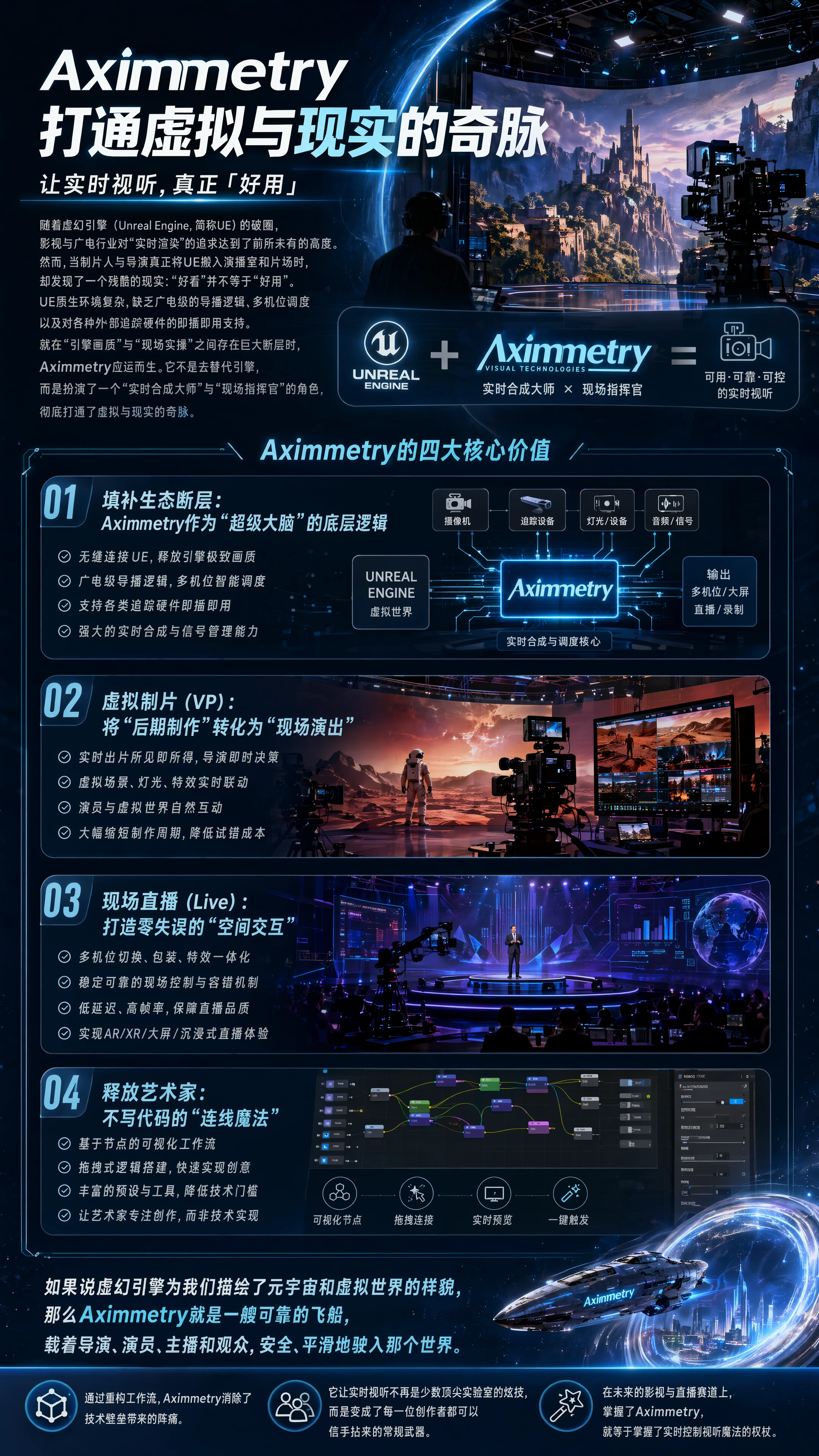
I. Filling the Ecosystem Gap: The Underlying Logic of Aximmetry as a “Super Brain”
It might be more intuitive to think of Aximmetry as a highly capable “set-top box” or “switcher.”
Its pioneeringAximmetry DE (Dual Engine Architecture)is an industry innovation. It uses UE5 as its “graphics card” to handle ultimate lighting and model rendering, while positioning itself as the “motherboard,” fully taking over camera tracking, green screen keying, multi-camera switching, AR compositing, and data interaction.
This collaboration, where “UE handles the exterior (visuals) and Aximmetry handles the interior (logic),” instantly transforms complex virtual assets into live tools that can be freely deployed on set or during broadcasts.
II. Virtual Production (VP): Transforming “Post-Production” into “Live Performance”
On virtual production sets for films and commercials, time is money. Aximmetry's greatest value is turning the traditional pipeline into a real-time synchronized “multi-part ensemble.”
- “Boundless” Expansion of the XR Stage: In LED wall shooting, the screen's boundaries often limit the director's composition. Through precise camera tracking, Aximmetry not only renders the viewport image in real-time on the LED wall but also uses“Virtual Scene Extension (Set Extension)”technology to instantly replace the physical ceiling and floor exposed outside the screen in the camera's view with the virtual world's sky and ground, allowing a limited studio to present an infinite expanse.
- “Digital Twin” of Lighting: The biggest fear in blending real actors with virtual scenes is lighting separation. Aximmetry can bind the on-set lighting console (e.g., DMX system) in real-time with the virtual scene's sunlight and streetlights. When the lighting technician pushes a fader in reality, the virtual world's lights synchronously brighten, achieving a perfect match between real and virtual lighting.
- The Ultimate Savior for Green Screen: For teams without the budget for an LED wall, Aximmetry's built-inAdvanced Chroma Keyeris a standout in the industry. It flawlessly handles issues that traditional software struggles with—like glass refraction, hair strands, and even contact shadows on the ground—within millisecond latency, pushing the quality of green screen footage close to that of real sets.
III. Live Broadcasting: Creating Zero-Defect “Spatial Interaction”
Live broadcasts have no “Ctrl+Z” (undo). In TV programs, large galas, and esports live streams, Aximmetry not only provides high system stability but also endows live broadcasts with unprecedented interactivity.
- Data-Driven “Living” Effects: Aximmetry's powerful node-based system can easily connect to external APIs. During an esports final or election broadcast, it can automatically capture real-time scores or voting data and transform them into stunning 3D holographic charts that, following camera movement, precisely float in the host's hand or above the studio.
- “Spatial Displacement” of the Virtual Control Room: For a large gala, with just a few fixed cameras shooting in front of a green screen, Aximmetry can generate over a dozen virtual cameras (crane, track, drone angles) in the virtual space. The director can use Aximmetry's interface to smoothly switch between these cameras within a massive virtual venue, just like cutting between traditional multi-camera feeds.
- Holographic Remote Connection (Telepresence): The pandemic spurred remote connections, and Aximmetry takes it to the extreme. It can strip the video signal of a guest in a Beijing green screen studio in real-time and transmit it to the main virtual studio control in Shanghai. In the final broadcast frame, the two guests appear to be sitting at the same table, drinking tea and chatting, with perfectly matched perspective and lighting—the audience sees no seams.
IV. Empowering Artists: “Connection Magic” Without Coding”
Why do not only technical directors but also visual artists fall in love with Aximmetry?
The answer lies in itsnode-based workflow (Flow Graph).Complex interactions that previously required a programmer to write C++ or Blueprint code (e.g., when the camera pushes in, the virtual floor automatically splits open and a dragon flies out) can be achieved in Aximmetry simply by connecting a “camera distance node,” a “trigger node,” and an “animation node” with lines using the mouse.
Furthermore, it is a staunch “hardware agnostic.” From top-tier film tracking devices (Mo-Sys, Stype) to consumer-grade VR trackers (HTC Vive), and even an iPhone with a tracking app, all can be smoothly integrated.
Conclusion: Defining the Next Generation of Audiovisual Language
If Unreal Engine paints the picture of the metaverse and virtual worlds, then Aximmetry is a reliable spacecraft, carrying directors, actors, hosts, and audiences safely and smoothly into that world.
By restructuring the workflow, Aximmetry eliminates the pain caused by technical barriers. It turns real-time audiovisual production from a trick performed by a few top-tier labs into a standard tool that every creator can use with ease. On the future track of film, TV, and live streaming, mastering Aximmetry means holding the scepter to control the magic of real-time audiovisuals.

 简体中文
简体中文  English